Autonomous Equipment Creeps Even Closer to Conventional Jobsites
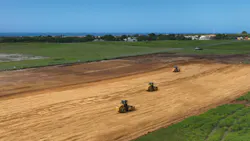
Once the purview of mining and quarry applications (or in trenches), autonomous and remote-control equipment is being seen on more and more conventional jobsites.
Contractor Ferrovial, a global infrastructure company that may be best known in the U.S. for their work on JFK's new Terminal 1, is running three autonomous rollers to construct a new runway at an airport in Puerto Rico.
How close are we to fully autonomous jobsites?
The single-drum vibratory soil compactors are a construction technology geek's dream, using AI-powered vision systems and obstacle detection tech in their arsenal of safety equipment.
The job
A $239 million project Rafael Hernandez International Airport in Aguadilla involves construction of a new 10,990-foot-long, 150-foot-wide runway — without disrupting airport operation.
Isn't that always the catch?
To carry out the project, Ferrovial has deployed three Caterpillar compaction rollers that have been adapted to operate autonomously, under the supervision of a single operator. This solution enables the rollers to perform multiple passes within a previously defined area, following planned trajectories.
The tech
The automation of the machinery allows continuous and precise control of each compaction phase, while helping improve productivity by reducing downtime typically associated with manual operations.
One of the key advantages offered by this technology is the ability for a single operator to supervise several machines operating simultaneously. This model facilitates more efficient management of resources on-site.
John Deere explains how AI cameras aid equipment safety
By incorporating AI-powered vision systems and obstacle detection technology, the company is further enhancing safety across its operations. With this technology, machinery can automatically stop when people or vehicles are detected, reducing the risk of incidents in high-activity work areas.
As these technologies evolve, an increase in collaborative models among construction companies, regulatory agencies, and technology providers is expected, with the goal of creating common standards and accelerating large-scale adoption across the industry.
Pretty cool.
About the Author
 Frank Raczon
Frank Raczon
Frank Raczon has covered and influenced the equipment industry for 35 years, including 15 years as senior editor of Construction Equipment, and marketing, advertising, and public relations work with the industry's top manufacturers. In addition to authoring "Caterpillar: Modern Earthmoving Marvels" (Motorbooks, 2015), he has won numerous awards in his career, highlighted by nods from the Construction Writers Association, the Association of Equipment Manufacturers, the Business Marketing Association, and BtoB magazine. Raczon has also won a number of awards from publishing peer groups such as ASBPE and TABPI.