Construction's Autonomous Future Starts with Operator Assist Functionality
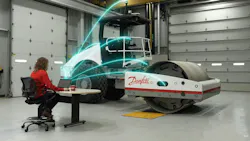
From Tesla to tractors, driverless vehicles have captured headlines for years. But on construction sites, autonomy is taking a far more practical path. Rather than leap straight to fully autonomous machinery, the industry is advancing through operator-assist functionality. Such capabilities deliver tangible value while avoiding many of the engineering and economic challenges of autonomy.
Operator assistance and the value equation
Construction environments are inherently dynamic. Machines such as excavators and wheel loaders perform a wide range of tasks that can change hour by hour across constantly evolving jobsites. That variability makes full autonomy significantly more complex than in structurally static environments such as farm fields or warehouses. Operator-assist functionality focuses on specific machine actions or tasks an operator may need to perform. A few examples include grading to given specifications, controlling bucket positioning, detecting obstacles, or limiting digging depth. The operator remains in control, but the machine helps the operator complete the task quicker, with greater precision, or less effort.
The advantage for contractors is faster job completion, less rework, and shorter learning curves for novice operators. For the OEM, it’s feasibility and economic viability. Fully autonomous systems require substantial upfront investment and years of development, often with uncertain outcomes. Operator-assist features deliver immediate benefits at a lower cost and with faster return on investment. They also provide a feedback loop. Each deployed feature helps OEMs understand how equipment is used in the field and how systems can be refined, building toward more advanced capabilities.
Where autonomy is headed
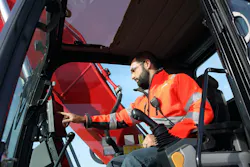
This is not to say that autonomy is off the table. Today’s operator-assist capabilities will expand over time, taking on larger portions of machine operation under defined conditions. But even in more advanced applications, such as semi-autonomous rollers, the operational model remains hybrid. Machines may operate autonomously during repetitive tasks, but operators typically still manage setup, navigation to and from the work area, and unexpected situations, also known as edge cases. This division of labor is likely to persist. High-variability tasks and the ability to resolve edge cases are typically better suited to human judgment.
Where advanced autonomy will happen first
The segments of construction most likely to see faster progress share a common trait: repeatability. Soil compactors and rollers are prime examples. Their work involves consistent passes over defined areas, making them strong candidates for semi-autonomous operation. Similarly, trench compactors present opportunities to automate repetitive compaction cycles while improving safety for workers nearby.
Specific types of jobsites may also lend themselves to increased automation. Solar farm construction, for example, requires placing posts at consistent, precise intervals over large areas. Similarly, concrete screeding on large projects such as data centers benefits from systems that help operators achieve uniform surfaces on the first pass, reducing costly rework. Even on complex, multi-use machines such as excavators, progress is underway. At Conexpo earlier this year, several OEMs demonstrated advanced vision systems and assistive controls to help operators place material more accurately and work more efficiently.
The road to autonomy
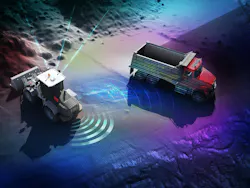
Operator assistance is a pragmatic approach that reflects the realities of construction. For contractors, the value proposition is safer operation, more consistent results, and improved productivity. For the industry, each step and each additional function builds toward ever-more-capable machines. Autonomy is not arriving all at once. It is showing up in the features that make machines and the people running them better, one task at a time.
Sam Long is an autonomy sales development manager and Shelley Nation is a senior manager for solutions at Danfoss Power Solutions.