Remote Trench Rollers: The Ultimate Guide to Safer Soil Compaction
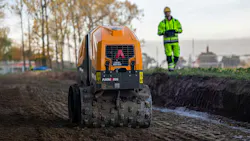
Key takeaways:
- Remote-control trench rollers improve safety. Operators stay out of trenches and away from cave-ins, vibration, dust, and moving equipment.
- Trench rollers lead the remote-control compaction market. Remote operation is standard on most articulated trench rollers, and the technology is expanding into larger vibratory plate compactors and specialized ride-on rollers.
- Most contractors rent rather than buy. New remote-control trench rollers typically cost $35,000 to $60,000, making rentals a practical choice for contractors.
Compaction equipment is designed to make the ground stronger. Unfortunately, it can also be tough on the operator. Compaction equipment sometimes requires working in dangerous environments — narrow trenches, utility cuts, retaining wall backfills, and pipeline excavations. Also, mechanized compaction equipment uses constant vibration or pounding to increase the density and stability of soil, aggregate, or asphalt. That vibration and impact will wear down any operator. Those two challenges explain why remote control has spread to various categories of compaction.
“The trench roller is the most popular remote control compaction machine because of the safety nature of the trench,” explains Roberto Martinez, director of product management and market development with Wacker Neuson. “Keep the operator outside the trench as much as possible and away from conflict with other equipment on the jobsite, as well.”
Martinez also notes bigger walk-behind compaction plates are starting to be engineered with the option for remote-control systems.
“As far as larger plates go, well, the larger the plate, the higher the compaction force and the greater the impact on the operator,” he says. “Therefore, it’s important to take measures to minimize hand-arm vibrations [HAV] for a more comfortable work experience that can result in greater productivity. Remote-controlled plates not only eliminate HAV, they also allow a better overall view, being out of the trench or active construction environment.”
Remote-control compaction technology reduces exposure to cave-ins, vibration, dust, noise, and moving equipment while often improving visibility and productivity. Today’s remote-control compaction market centers on articulated trench rollers, which will be the major focus of this article, but manufacturers are expanding remote technology into larger reversible vibratory plates and even specialized ride-on rollers for hazardous applications.
Trench roller market overview
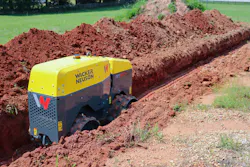
Remote is not new for compaction. The first commercially successful articulated, remote-controlled trench roller was introduced by Wacker Neuson (then just Wacker) in 1991 with the RT820. “It’s been a very popular machine category in rental fleets for at least 30 years,” says Martinez, noting today Wacker Neuson sells the RTLx-SC3 and RTD-SC4 remote trench rollers. Other units on the market in 2026 include:
- Ammann’s ARR 1575-2 articulated trench roller and ARR 1585-2 rigid-frame trench roller
- Bomag’s BMP 8500 multi-purpose compactor
- Bobcat’s TR75 trench roller
- Hamm’s HTC Series trench rollers
- Multiquip’s Rammax RX1575 trench roller
“Deep trenches and unpredictable conditions require operator protection, including remote machine control from a safe distance,” advises Josef Dementev, global product specialist at Ammann. “And training is very easy. It can be confidently said that after just five minutes of explanation, the operator can safely control [a remote-control trench roller]. The full machine control is almost self-explanatory and very intuitive.”
Trench rollers explained
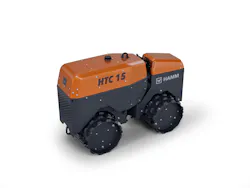
A remote-control trench roller is basically two small padfoot rollers connected by a hinge. Controlled using handheld remote controls, trench rollers usually focus on compacting cohesive soils (fine-grained earth material primarily composed of clay and silt). Trench rollers find steady work in utility trenches, foundation excavations, pipeline installations, and structural backfill. They combine weight, vibration, and a kneading action to eliminate air pockets, preventing settling and increasing weight-bearing capacity of the soil.
Units can utilize rigid and articulated steering frames (the latter is the most popular). An articulated frame pivots in the center, allowing the front and rear drums to oscillate independently as the machine travels over uneven ground. This design helps all four drum contact points maintain consistent pressure on the soil. It also improves traction and maneuverability. A few manufacturers also offer rigid-frame trench rollers, which eliminate the center articulation joint in favor of a fixed chassis. These machines emphasize straight-line stability and easy maintenance. Rigid units are ideal for consistent compaction over long trench runs.
Most of these units use padfoot or “sheepsfoot” drums. Some machines can also be fitted with smooth drum shells for compacting granular soils or asphalt. Manufacturers may offer different drum widths and padfoot configurations to match trench dimensions and soil conditions. Most remote-control trench rollers weigh between 3,000 and 4,500 pounds and use diesel engines ranging from roughly 19 to 25 horsepower. High and low vibration settings let operators balance productivity and compaction quality based on lift thickness and material type. A few premium models now offer basic intelligent compaction or compaction measurement systems.
“Ammann’s optional ACE intelligent compaction system will increase productivity and eliminate unnecessary passes on our remote-control rollers,” says Dementev. “ACE is a relative compaction measuring device that provides continuous information about compaction levels — and displays compaction progress in real time. It indicates when maximum compaction has been achieved and therefore reduces the number of compaction passes. LED lights change color to inform the operator about compaction status or double jumping. The system is automatically activated when vibration is engaged.”
When it comes to specs, buyers should consider things like drum impact force, vibration frequency, gradeability, and ground clearance. Some models emphasize higher centrifugal force, while others prioritize maneuverability. Some brands may offer unique options and technologies like Ammann’s 3D-LF (Near-Field-Detection system).
“With this system, antennas transmit signals in a 2-meter radius around the machine to create an active safety zone,” says Dementev. “The machine automatically stops if it enters that safety zone. Of course, trench work can be tight, so operators can override the safety zone via remote control. They can move within the 2 meters but never closer than 0.5 meters.”
Remote-control transmitters also vary. Some use simple joysticks and switches, while others feature color displays that provide machine status, engine diagnostics, battery level, and fault codes. Also, consider how the remote control is powered. An exchangeable battery? Can it be charged on-board and externally?
Infrared versus radio remote
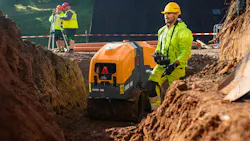
Remote control has become the defining feature of today’s trench roller market, but there are different technologies.
“Our products use infrared solutions,” explains Dementev. “It is one of the most secure wireless signal technologies for machine control and has been successfully used on ARR trench rollers for many years. It requires direct visibility between the machine and the remote control. If visibility is lost for more than a second, the machine stops automatically. This ensures safe operation and prevents damage when the operator does not have full control of the working environment.”
Then there are radio-frequency transmitters.
“Traditionally, we have used infrared for trench rollers, but we have radio today too,” says Martinez. “We decided to go to radio just because radio now has a lot of the benefits now with technology and software. You can modulate that signal to make it safer. Infrared you have to be pointing at it all the time. Radio has a wider band of being able to control a machine, a secondary machine. Let’s say you’re in an excavator and you want to control the trench roller. It gives you a lot more leeway just because of the type of signal that it has. You don’t need to be pointing to the machine completely at all times.”
Regardless of communication method, today’s machines share several common safety features:
- Automatic shutdown if communication is lost
- Minimum and maximum operating distance
- Operator proximity detection
- Roll-angle or tip-over protection
- Big emergency stop buttons
“Our equipment is engineered so that any loss of communications longer than one second results in a safety shut down of the equipment,” says Brian Brown, product specialist/training at Ammann. “Also, our remote can be operated with a connection cord or wirelessly. Connected to the cord, the remote can operate safely between 6.6 feet and 16.4 feet. Wirelessly, the remote can operate safely between 6.6 feet and 66 feet.”
How much do trench rollers cost to rent and buy?
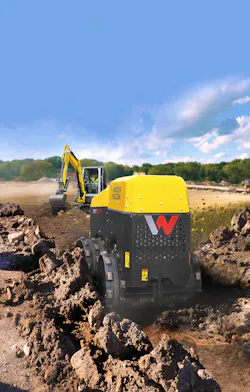
Depending on size and features, new machines typically cost $35,000 to $60,000, making them a common rental choice for contractors that only occasionally tackle trenching and utility work.
“Remember, compaction is only a phase of a project,” says Martinez. “So, once you compact, especially when you’re laying down piping and foundations, you’re done. Then you start building up and then you don’t need these machines, so customers tend to rent them a lot rather than owning them.”
To rent, expect to pay roughly $300 to $450 per day, $900 to $1,500 per week, or $2,500 to $4,000 per month, depending on the region and rental supplier.
What other remote-controlled compaction equipment is available?
The compaction market includes a wide variety of machine categories — rammers, vibratory plate compactors, walk-behind rollers, tandem asphalt rollers, pneumatic tire rollers, single-drum soil compactors, and even landfill compactors. Today, remote control is standard across the trench roller market, but what other equipment might embrace remote tech? Well, heavy reversible vibratory plates represent an up-and-coming remote-control category. These machines remain far more common in Europe than North America, but manufacturers such as Wacker Neuson continue developing increasingly powerful remote-controlled plates for large granular soil applications.
“A lot of remote applications are going onto larger compaction plates,” confirms Martinez, noting Wacker Neuson’s DPU130r model. “Usually over here in America, our compaction plates are between 45 to 65 kilonewtons. In Europe, we’re talking about machines that are above and beyond 90 kilonewtons, 130 kilonewtons. Those machines are larger and usually work on granular soil, especially railways, a lot of application on draining ditches with a lot of gravel. It’s a different method of construction, but we’re seeing remote on those bigger machines.”
Rammers and smaller walk-behind plate compactors generally remain manually operated because their lighter weight and lower vibration levels don’t justify the added complexity or cost of remote systems.
Can bigger rollers go remote?
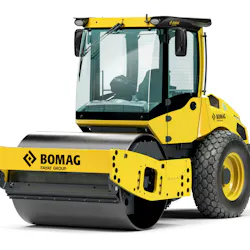
Yes, but don’t expect to see them at many rental yards. Manufacturers have developed specialized remote-controlled single-drum rollers for hazardous environments where operators shouldn’t remain in the cab. Quarry reclamation projects, unstable slopes, and contaminated-site remediation jobs might have the use for remotely-operated soil compactors. An example of this would be Bomag’s BW 177 D RC single-drum vibratory soil compactor.
Overall, remote-controlled compaction has quietly become one of the construction industry’s most practical safety technologies. It doesn’t eliminate skilled operators. It simply moves them out of the way.
“Right now, confined spaces and deep trenches are the applications that really require remotes for the safety of personnel and equipment,” says Brown. “But I would imagine that any application that puts human safety at risk could benefit from some type of remote-control application.”
Five Tips for Choosing a Remote Trench Roller
- Prioritize safety systems. Look for automatic shutdown, proximity detection, and tip-over protection.
- Match the machine to the soil. Padfoot drums excel in cohesive soils, while smooth drums work better on granular materials.
- Evaluate serviceability. Accessible hydraulic components, filters, and wear items reduce repair costs.
- Consider operator experience. Simple controls and clear machine feedback shorten training time.
- Think beyond today. Telematics and intelligent compaction can improve fleet utilization and reduce unnecessary passes.
About the Author
Keith Gribbins
Keith Gribbins is the head of content at Construction Equipment, where he leads editorial strategy across print, digital, video, and social channels. An award-winning journalist with more than 20 years of experience, Keith has won 17 national and regional editorial awards and is known for his hands-on reporting style, regularly visiting manufacturers, operating equipment, and covering major industry events worldwide.