How Close Is Construction to Fully Autonomous Jobsites?
Key takeaways:
- Autonomy will come in stages. Construction jobsites are becoming more automated, but fully autonomous operations remain years away.
- People still drive the jobsite. AI can assist with decisions, but experienced operators remain essential.
- Trusted data enables autonomy. Secure data, open standards, and connected workflows are critical to future automation.
The idea of an autonomous jobsite is popular, and while some in the industry promote the notion that the jobsite is either already or largely self-sufficient, to most, it doesn’t look very autonomous — if by autonomous, we mean that no people are needed to start or complete a construction project.
To be sure, some aspects are automated, but the jobsite itself is far from autonomous. If we’re honest, it may never reach 100 percent autonomy — and perhaps it shouldn’t. That’s because technology and autonomy cannot fully replace the human factor — the person on the jobsite who makes decisions based on intangible factors and actionable data.
Even the Jetsons, the cartoon that in many ways accurately predicted where humanity was headed in the 21st century, had people around to perform tasks. The jobsite should too. And while artificial intelligence contributes to the autonomous jobsite, it cannot solve every challenge that the jobsite will present. Unless AI can analyze soil logs and design files, create estimates, assemble bids and schedules, coordinate logistics, and operate machinery without human oversight, in a rapid and ever-changing environment, a fully human-free jobsite remains out of reach.
How autonomous is autonomous?
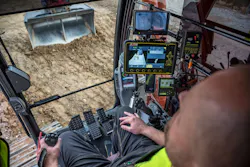
Autonomy is a spectrum, and complete autonomy remains a ways away. We’re still in the pioneering phase. While we are continuously automating features and repetitive machine motions, today, perhaps 5 percent of the jobsite is autonomous. A good goal over the next 10 years is to reach around 40 to 50 percent autonomy, meaning not fully autonomous but rather more automated components, with a few autonomous assets we can leverage.
Machines cannot replace the intuition and judgment of experienced operators. Consider compaction, which is still as much a mystery to contractors today as it was decades ago. Operators still interpret the data, and it’s often more of an educated guess, based upon years of experience with different soil and rock types, in differing weather conditions.
When someone figures out how to measure density with a roller, that becomes hugely interesting, because now you’re mapping deficiencies in your grade as you go. That’s because there is a difference between solving a technology problem and solving a contractor problem. If you solve a contractor problem, it gets adopted. If you don’t, it may not add value.
As technology providers, we must focus on solving contractor problems — not just technology problems — to truly add value. People already take what AI says as gospel truth. How do we know the data is reliable before we let it make decisions? It only takes one failure for people to lose trust, and on the jobsite, a failure could be catastrophic.
AI will continue to be an increasingly powerful tool. The journey to an autonomous jobsite will never stop and will continue long after we are all gone.
Where do we go from here?
Contractors aren’t going to flip a switch and go completely autonomous overnight, even if the technology is fully available. We’re not built that way; we do things a little at a time. Autonomy is going to come in pieces — function by function and machine by machine. It’s not about flipping a switch; rather, it’s about building toward it. A fully autonomous jobsite remains a distant goal, if it's achievable at all.
In the short term, AI will help with geography, materials, and planning logistics. In the midterm, it should connect field and office data. In the long term, it automates entire machines and even machine fleets, reducing labor requirements. But that’s aspirational, perhaps a decade or longer out. Consider autonomous cars as a case study. They exist, but not widely, and not all business models are sustainable.
Uber uses drivers’ cars, while Waymo owns and retrofits vehicles. They have different cost structures, but the same revenue target. Technology has to work, and the business model has to work. Right now, we have good data. What the overall industry lacks is a seamless workflow. We need to move data easily from person to person and then automate that movement. Once that’s solved, we can layer in decision-making automation.
Factories have already done a lot of this
Large OEMs for many years have had factories moving floors, robotics, and automated workflows. As advanced and automated as they are, they are still not fully autonomous. The same is true for construction. We’ve already automated more than we realize: GPS replaced the many steps of manual layout. We have automated self-leveling buckets and safety systems. Each of these technology improvements and automations seemed small at first. Taken holistically, they have automated significant aspects of the jobsite, but only a small portion of it. Safety and productivity go together. And when you improve both, the entire system also becomes more sustainable.
Data security must be a pillar in autonomy progress
AI introduces risks. People trust it too much, and the data, unless verified or from a known source, might be biased or wrong. This isn’t about being negative on AI; it’s about understanding the verification hurdles. As part of that, contractors need to ensure they have the right governance and validation requirements in place. The construction industry has reached an important milestone with the release of ISO/TS 15143-4, a new international standard designed to improve how critical project data moves from the office to the field. This project, leveraging leaders across the industry, is essential for advancing toward true autonomy, as shared standards create the foundation for integrated, automated workflows.
For contractors and project teams working with mixed fleets and multiple technology platforms, this standard helps remove long-standing barriers by enabling smoother, more reliable data exchange across brands. The result is less friction, better collaboration, and more efficient workflows on site.
It only takes one failure to lose trust

Data security will remain critical, as contractors seek trusted ecosystems and robust protections while leveraging more integrated, automated systems. The construction industry’s opportunity lies in balancing automation, data security, and human expertise to build smarter, safer jobsites. Embracing change and participating in the development of new standards and technologies will be key to unlocking the full potential of autonomy, while ensuring that people remain at the heart of every project.
Troy Dahlin is vice president of construction at Leica Geosystems (part of Hexagon).