Autonomous Access Equipment Is Poised to Transform Jobsites
Key takeaways:
- Access equipment is becoming more autonomous. AI and robotics are helping machines execute work — not just provide access.
- Connected jobsites improve efficiency. Smart machines coordinate workflows, reduce downtime, and boost productivity.
- The worker's role changes. Automation may shift crews toward supervision and quality, reducing repetitive work at height.
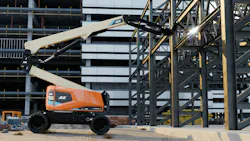
Access equipment like boom lifts, scissor lifts, and telehandlers play a critical role on construction sites and maintenance projects by safely positioning workers, tools, and materials so tasks can be completed at height. But today's jobsites face a growing set of challenges. Labor shortages, schedule pressure, equipment downtime, and increasing project complexity are forcing the industry to rethink how work gets done. That's why the future of work at height will be a shift from enabling jobs to executing jobs. At first glance, those two concepts may sound similar. In reality, they represent a significant evolution in how equipment contributes to productivity on the jobsite.
What does "enabling work" mean?
Traditionally, access equipment has been an enabler. A boom lift, scissor lift, or telehandler helps workers reach a location, transport materials, or position tools. The machine provides access, but people perform the work itself.
For example:
- A boom lift positions a welder so they can complete a weld.
- A scissor lift raises technicians so they can install ductwork.
- A telehandler moves materials so crews can continue construction.
These machines are essential to the work process, but they are not performing the task. They are enabling it. This model has served the industry well for decades, but it also creates dependencies. Productivity is limited by labor availability, equipment coordination, and the time required to move people and materials throughout the site.
What does "executing work" mean?
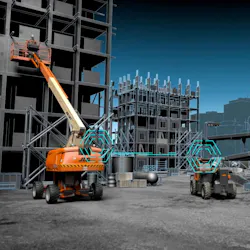
Executing work is the next stage of jobsite evolution. Rather than simply transporting workers to the work area, connected and autonomous technologies can help equipment perform specific tasks, coordinate with other machines, and contribute directly to project outcomes. In this model, equipment becomes part of an intelligent jobsite ecosystem. Instead of asking, "How do we get a worker to the task?" The question becomes: "How do we complete the task as safely, efficiently, and consistently as possible?" This shift is made possible through advances in connectivity, autonomy, robotics, artificial intelligence, and machine-to-machine communication.
A real-world example: autonomous end effectors
One of the clearest examples is access equipment, such as a boom lift, equipped with an autonomous end-effector system. Imagine a project where materials arrive at the correct location before crews request them, machines coordinate positioning without operator intervention, and supervisors manage progress from a digital command center. Productivity is measured not by machine utilization but by completed work. Another example to consider: Autonomous equipment performing repetitive tasks, such as a boom lift that can position a robotic tool to perform work like:
- Welding
- Painting
- Material handling
- Ductwork installation
Instead of an operator spending hours performing the same repetitive task at height, the equipment can autonomously execute portions of the task while workers supervise from the ground. The goal is not to replace skilled workers. It's to allow those workers to focus on oversight, quality, and higher-value activities while technology handles repetitive work.
How multiple machines can work together
Another example is leader-follower technology. Traditionally, each piece of equipment requires its own operator and movement plan. In a connected environment, one lead machine can guide multiple follower machines across a jobsite. Equipment can transport materials, get positioned for work, and coordinate activities as part of a larger workflow. Consider a scenario where multiple micro-sized scissor lifts transport materials to a designated location. Once materials are delivered, another connected machine receives confirmation and begins the next phase of work. The result is a more coordinated operation with fewer delays and less time spent waiting for materials, equipment, or instructions.
The technology making it possible
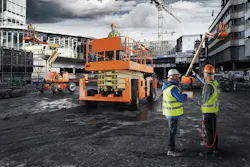
At the center of this vision is a connected jobsite ecosystem where connectivity itself is not the end goal; rather, connectivity is the platform that enables machines, workflows, and people to operate as an integrated system. By connecting equipment, tools, materials, and personnel through a wireless network, jobsite managers gain:
- Real-time equipment visibility
- Predictive maintenance insights
- Fleet utilization data
- Machine-to-machine communication
- Workflow coordination across the site
Instead of operating as individual assets, machines become part of a connected system that can share information and support better decision-making.
Why keeping workers on the ground matters
One of the most important outcomes of this evolution is the opportunity to keep more workers on the ground. Many repetitive, physically demanding or potentially hazardous tasks require workers to spend extended periods at height. Autonomous and remote-operation technologies can reduce that exposure while helping crews maintain productivity. Workers remain essential to the process. However, their role increasingly shifts toward supervising operations, managing quality, and directing workflows rather than performing every repetitive task manually.
Solving today's jobsite challenges
The move from enabling work to executing work is ultimately about solving real customer problems. Construction and industrial companies continue to face:
- Skilled labor shortages
- Increasing project demands
- Equipment downtime
- Productivity pressures
- Safety concerns
Connected and autonomous technologies help address these challenges by improving coordination, reducing inefficiencies, and maximizing equipment utilization. When machines can communicate, predict maintenance needs and assist with repetitive work, crews spend less time waiting and more time making progress.
The future is about outcomes
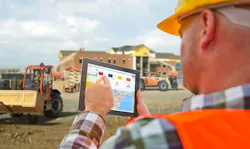
Perhaps the most important part of this conversation is that it shifts the focus from equipment specifications to customer outcomes. Historically, success was measured by what a machine could do. Tomorrow, success will increasingly be measured by what the jobsite can accomplish. That means safe, optimized operations, more predictable workflows, improved productivity, and better utilization of both equipment and labor.
The future of work at height isn't simply about building more intelligent machines. It's about creating connected systems that help execute work more efficiently than ever before. For decades, the access industry has focused on helping people get to the work. The next era will be defined by helping customers complete the work. Organizations that successfully connect equipment, workflows, materials, and people will redefine productivity at height. That's what it means to move from enabling jobs to executing jobs.
Shashank Bhatia is the global vice president of engineering and chief technology officer of access equipment at JLG.