A Fleet Manager’s Guide to Cold-Weather Fluids and Filters for Construction Equipment
Key Highlights
- Cold starts demand the right viscosity. Match engine and hydraulic oils to OEM specifications and the coldest temperatures your machines will encounter.
- Grease must flow to protect. Choose a cold-weather grease that can reach pins, bushings, bearings, and articulation joints. Then, you gotta avoid overgreasing.
- Don’t get lazy with these AI-style summaries. 🦥 There’s a lot more to winter fluid management. Descend below. Read the article. Enjoy the magic.

Winter changes how everything flows. I live in Cleveland. We have lake-effect snow and Erie’s bitter wind. Temperatures get cold and hot so everything crystallizes and then turns to mud. Traffic slows. Schools close. People tread carefully. This also applies to construction equipment, which often keeps working in the winter, finishing projects or moving snow. Their chemistry changes. Hydraulic fluid slows. Wax crystals collect in diesel fuel filters. Engine oil thickens.
“Viscosity is one of the single most important specifications for any oil, and cold weather puts that spec to the test,” confirms Max Cundiff, industrial sector manager at Chevron. “Oil naturally thickens as temperatures drop, and the goal is to create a lubricant that would hold a flat viscosity no matter the conditions. The industry term for how quickly a fluid’s viscosity shifts with temperature is viscosity index [VI], and it’s worth understanding because it drives real decisions about what goes into a machine each season.”
That’s the kind of chemistry we’re going to be dropping in this article. Winter changes how we keep construction equipment moving. It requires a different formula that starts with oils, lubricants, fuels, and filters selected for this year’s cold spell.
“You really need to begin this process a month or better before the anticipated first freeze,” says Jamie Morford, upper Midwest senior account manager at CITGO Lubricants. “More than likely it has already begun to get cooler so being ahead of the game won’t hurt. A few things to make sure you are checking is your coolant to ensure you are at the correct temperature range. Make sure batteries and block heaters are in good working order. Look to replace them to ensure you have good cold crank ability. Watch for cold snaps and look to make changes to fuel accordingly.”
Maybe build a fluid, lubrication, and filter chart

This article is full of great advice, but do read the cold-weather section of your equipment manufacturer’s manual. It should provide approved viscosity grades, performance categories, ambient-temperature ranges, and service intervals for your exact unit. Two excavators parked together may require different engine oils or coolants. Fleet managers can simplify winter planning with a machine-by-machine fluid, lube, and filter chart. Structure it around each machine compartment — engine, transmission, hydraulics, fuel system, etc. Then record both the machine specs from the operator’s manual and product specs of your oils, lubes, and filters. Note viscosities, operating-temperature ranges, grease requirements, filter part numbers, and beyond. Then compare those requirements with the coldest conditions each machine may encounter.
“Also make sure the cold temperature lubricants selected are compatible with the lubricants currently in use,” suggests Jim Girard, executive vice president and chief marketing officer at Lubriplate Lubricants Co. “Also, get a technical data sheet on the cold temperature lubricants the contractor wants to use. Be sure.”
Those numbers on engine oil matter
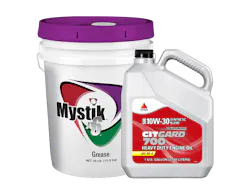
As we mentioned, oil thickens as temperatures fall. During a cold morning start, that increased viscosity can delay oil delivery to the valvetrain, timing gears, piston rings, and all types of bearings (crankshaft, connecting-rod, turbocharger, camshaft bearings, the list goes on). So, you need the correct oil for cold weather, and oil makers make it pretty easy. In a multigrade such as SAE 5W-40, the number before the W represents the oil’s low-temperature performance. The second number describes viscosity at operating temperature.
“If you use multi-viscosity oils across the board, they should be able to perform the same year-round,” explains Amanda Olson, petroleum technical service specialist with CHS. “Especially for hydraulic oil, those thicker oils in winter, those aren’t going to perform as well. With thicker oils, you’re going to get harder pumpability, and you’ll get some sluggish performance. If you’re using a thinner oil in the winter, you’ll have less problems with that sluggishness.”
When you look at engine oil and cold weather, two things stick out to Morford.
“Pour point and viscosity index,” he continues. “We want to make sure that no matter what is being used, we are protecting the engine at operating temperatures so using the recommended X-W30 or X-W40 is best, but cold-weather start is represented in that first number. Synthetics and synthetic blends, like in our CITGARD 1000 and 700 product lines, will offer very good protection at startup giving you a lower pour point and VI ensuring you have maximum protection during the most critical time.”
Synthetic and synthetic-blend oils often maintain useful viscosity across a broader temperature range. Synthetic oils (vs. mineral oils) will also cost more upfront, so fleet managers need to do the math. Oil analysis can always help make that call.
“Synthetic formulations generally take longer to thicken in the cold and hold up better in the heat,” says Gene Jensen, lubricants trainer at Chevron. “The construction industry is moving in that direction, following a path the automotive world has already largely completed. The moment that matters most is cold start. Once a machine is running and its components are generating heat, fluid tends to behave well regardless of ambient temperature. The risk is concentrated in that first startup, so a good rule of thumb is keeping a fluid’s pour point 20 to 30 degrees below the coldest temperature it will face, and checking OEM startup viscosity specs to avoid cavitation before the machine has a chance to warm up.”
Grease must reach the joint

Grease can look fine in a cartridge and still refuse to move through a long automatic-lubrication line. Cold raises its resistance to flow. If there’s one thing we can all learn from this article, it’s that the cold slows us all down. So, even though the pump is functioning, it might not be delivering enough grease to pins, bushings, swing bearings, and articulation joints.
“Multipurpose greases easily freeze,” says Girard. “Contractors should seek greases that are formulated with low viscosity and free-flowing base oils.”
The National Lubricating Grease Institute, or NLGI, might be able to help. It’s a nonprofit technical organization that develops grease specifications and promotes industry standards. NLGI’s grade specs describe grease consistency. NLGI 2 is common for general service, while softer NLGI 1, 0, 00, or 000 products may pump better in cold systems. The correct choice depends on the component, dispensing system, line length, and temperature.
“Grease composition matters too,” says Bryan Kemp, business consultant for industrial and off-highway at Chevron. “Calcium-based greases are gaining ground in construction because they may pump better than lithium at the same NLGI grade. They may also hold up better against water and resist washout whether that water comes from a pressure wash or just normal exposure on the jobsite. That water resistance is a meaningful advantage in the wet, snowy, or icy conditions winter often brings. Calcium and lithium greases are also compatible with each other, so switching between them doesn’t carry the risk of incompatibility that can come with mixing other grease types.”
If you’re super bored, maybe check out NLGI’s HPM + LT specification. HPM stands for high-performance multiuse grease, while LT stands for low-temperature performance. Greases carrying this designation meet additional low-temperature performance requirements. Look for the HPM + LT certification mark on grease packaging or technical literature. The certification is voluntary, so you can also search NLGI’s registry to confirm whether a product carries the designation.
Beware of over-greasing
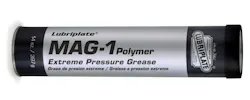
More grease is not automatically better. Under-greasing will lead to metal contact and wear. Overgreasing can raise temperatures, waste product, and damage seals. Follow the OEM quantity and frequency. If the manual specifies pumps, maybe verify the output of the actual grease gun. Different guns deliver different volumes per stroke. Definitely read this article on different grease guns. Don’t forget to cold-check your automatic greasing systems too.
“Overgreasing is just as bad as under greasing,” says Jamie Morford, upper Midwest senior account manager at CITGO Lubricants. “Things like any undercarriage pivot points, pins and bushings, low level bearings. Cold temperatures can cause grease to stiffen significantly, making it harder to reach those critical wear surfaces. In these unfriendly grease conditions, we recommend greases like the Mystik JT-6 Low Temp SynBlend No. 2 grease or the Mystik JT-6 Synthetic 460 greases. These greases maintain their pumpability and lubrication performance during cold or below-freezing weather while helping resist moisture from snow, ice, and warm/cold cycles.”
Please warm up that hydraulic oil

Complex hydraulic systems allow construction equipment to move. These systems transmit power through hydraulic oil, so once again, cold will affect viscosity. Oil that becomes too thick will slow machine movement and boom and attachment functions. Cold, thick hydraulic oil can starve the pump and cause cavitation, which is the formation and violent collapse of vapor bubbles that can damage internal components.
“We offer multi-viscosity hydraulic fluids, and those are going to be the best option in the winter because they’ll be thinner at colder temperatures, but still have the same viscosity at operating temperatures, which makes it multi-viscosity,” explains Olson. “So, that can decrease the warmup time that you need to get the hydraulic fluid warmed up, and then you’ll have less sluggish operation in the cold with the multi-viscosity oils. We even have an equipment lookup tool on the Cenex website where you can go and find by your specific equipment, what multi-viscosity hydraulic fluid is going to be the right fit.”
Like an engine, the hydraulic system and its specialized oil need time to warm up, and it’s not like 40 seconds. Warmup time varies by machine, fluid, and ambient temperature, but 10 to 15 minutes to warm up just the engine in severe cold conditions is not uncommon. After warmup, pros will operate the hydraulic systems slowly for 10 to 15 more minutes to circulate the hydraulic oil.
“In extremely cold regions, some operators choose to keep equipment running continuously, never shutting it down,” notes Cundiff. “Keeping a hydraulic system cycling allows it to generate and retain its own heat, which keeps fluid moving freely and ready to perform when the machine needs to work.”
The good news is the industry’s answer to cold starts has increasingly been multi-viscosity and high-VI hydraulic fluids that perform well across a wide temperature range rather than requiring a seasonal swap.
“Viscosity index measures how much a fluid’s viscosity shifts with temperature, and base oil plays a major role in that performance,” explains Jensen. “A conventional hydraulic base oil typically sits around a VI of 100. Adding VI improvers can push that closer to 150, and full synthetics can reach up to 200, which represents the strongest cold-weather performance available. Many fleets, particularly in colder regions, have shifted to a premium high-VI fluid used year-round specifically to avoid the hassle and risk of switching products every season.”
Filters, fuels, and their viscosities
Off-highway construction machinery work in tough, dirty, environments, which means they have lots of filters — engine-oil filters, hydraulic-oil filters, fuel filters, fuel-water separators, engine air filters, cab air filters, DEF filters, even crankcase-ventilation filters. So many frickin’ filters, so make sure you install the OEM-specified element for each system. For oil and hydraulic filters (as an example), verify filtration efficiency, dirt-holding capacity, flow rating, and bypass specifications. Also be aware: Those particular filters that control particles in fluids will not thin cold oil or fuel. That is not their job.
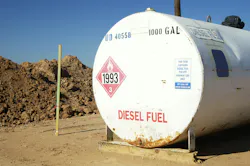
“The biggest problem with fuel in the winter is going to be gelling,” says Olson. “You’ll get wax crystals forming in the fuel, and then the fuel will thicken up and start plugging filters and you’ll get poor performance in the engine. So that’s why winterized fuel starting in the fall is going to be really important to help prevent all of those problems. Because once you start getting that wax buildup, it just starts compounding and once you get it, it’s really hard to come back from it. So preventative measures as far as fuels go are really important.”
Talk with your fuel supplier in the fall. Act smart, and ask about the fuel’s cloud point — when wax crystals begin forming — and its cold filter plugging point — which estimates when those crystals could restrict fuel flow through a filter.
“Most contractors will carry on hand some form of anti-gel to ensure they don’t have issues with gelling in the cold,” notes Morford. “Winter fuel alone should be sufficient, but just in case it’s OK to use an additive to help with cold-weather flow. Just make sure you are following the OEM recommendations and discussing it with your fuel supplier. Remember, more is not better.”
Some machines can be upfitted with hydraulic oil or fuel heaters to help keep things flowing, but it’s not just the cold. Freeze-thaw conditions can create water and other contamination issues. Water can settle in tanks, collect in fuel-water separators, and freeze as temperatures fall. That ice can restrict fuel flow just like wax.
“I think the biggest thing you should do to reduce the potential for water contamination is to have your tanks tested twice per year once just before winter and once again as it gets into the dog days of summer,” says Morford. “It can be very hard to pinpoint where water can get in so it’s best to test and attempt to eliminate the issue before it becomes one.”
Drain separators and filters at the OEM-recommended intervals, which might be daily. Also, investigate what comes out. What the heck is that stuff?
DEF freezes, and that is normal

Diesel exhaust fluid freezes. DEF also expands by about 7 percent when it turns to ice, so don’t fill your tanks up to max during the winter. Luckily, DEF remains usable after it thaws. Modern SCR systems use heaters and controls designed for cold use. Equipment pros should also note how warming up the machine affects aftertrement systems overall, including the diesel particulate filter (DPF), which requires high temperatures to work properly. Back to DEF…
“Well, DEF freezes at 12°F so while it is lower than water, it still has a lot of challenges when in cold climates,” explains Morford. “Make sure it is stored properly, if that is in a heated building or in a heated tank outside, you must make sure it does not crystalize. Most vehicles have DEF warmers on them but make sure you allow equipment adequate time to warm up and avoid short stops so the systems can reach operating temperature is key.”
Operators should allow the machine to complete its shutdown purge as well. Cutting battery power too soon may leave DEF in lines that the system intended to empty. Patience.
There’s always more

Winter fluid and filter management is an ongoing exercise. Start with the OEM requirements. Match viscosity to the temperature range. Prepare the right fuel. Warm up machines. Do your daily filter checks. You got this.
Oil Innovations
This section was written by Gene Jensen, lubricants trainer at Chevron.
Equipment design and lubrication technology are in a constant back-and-forth, and that dynamic isn’t going away. As machines run hotter and oil sump sizes shrink to meet tighter engineering tolerances, the pressure moves toward synthetics and lower-viscosity fluids that can keep pace with those changes. New diesel specifications are introducing 0W-20 into heavy-duty engine oil, which is a clear example of that shift already underway, since a lighter oil flows better at cold start without sacrificing protection once the machine is running.
Lubricant innovation will continue to track equipment engineering closely, with antiwear, extreme pressure, and antifoam additive packages evolving alongside tighter machined tolerances. But the most important takeaway isn’t really about a future breakthrough. As one of our formulation experts, with 42 years in the industry, put it: if the right fluid is in the right place and it’s clean and dry, he’s never once been able to blame a failure on the lubricant. That principle will outlast any single innovation, and it’s the foundation contractors should build their winter prep around regardless of what comes next.
About the Author
Keith Gribbins
Keith Gribbins is the head of content at Construction Equipment, where he leads editorial strategy across print, digital, video, and social channels. An award-winning journalist with more than 20 years of experience, Keith has won 17 national and regional editorial awards and is known for his hands-on reporting style, regularly visiting manufacturers, operating equipment, and covering major industry events worldwide.