Video: Let's Take a Walk Around John Deere’s New 40 P-Tier Mini Excavator
Key Highlights
- It stays under 10,000 pounds. The 40 P-Tier pairs transport-friendly weight with a 42-horsepower turbocharged engine and conventional tail swing.
- Hydraulic options expand the tool kit. An optional second aux circuit lets operators control a thumb and another hydraulic attachment from the cab.
- Feeling lazy? Just watch the video. These AI-style summaries won't convey the awesomness of our latest video. Descend below and watch the magic.
Emily Pagura is a Construction Equipment favorite. The John Deere product marketing manager is always ready to sit down for an interview or jump on a video to teach us about off-highway machinery. We recently got to hang with Pagura and friends at a press event held at John Deere’s enormous Dubuque Works facility in Iowa. Spanning 3.9 million square feet, the Dubuque factory produces a diverse range of machinery from backhoes to compact track loaders. We were actually there to see the company’s newest mini excavator — the 40 P-Tier — and Pagura was kind enough to give CE a first-look walkaround.
“We’ve been working on this machine for quite some time,” says Pagura in the video above. “And we are thrilled to be getting it out to you and out into the market to show off all of the awesome features and the power and performance that this machine provides in addition to the attachment versatility.”
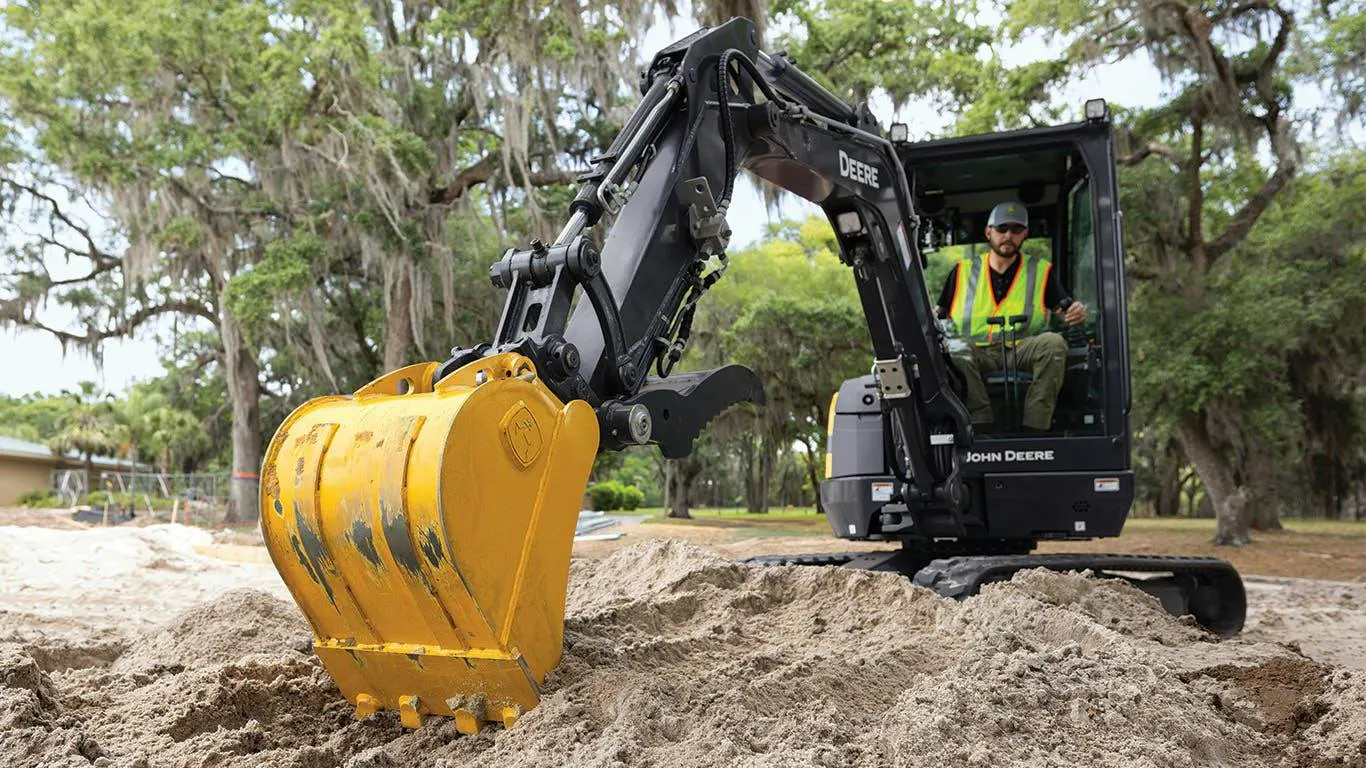
Pagura takes us around the new 40 P-Tier, from its coupler to its cab controls. The video was filmed at the Dubuque Works’ Demonstration Site, which is in the middle of the giant facility. Pagura explains how the 40 P-Tier weighs less than 10,000 pounds and runs a 42-horsepower turbocharged engine. She notes how the unit pairs that transport-friendly weight with a conventional tail swing, which adds counterweight behind the machine for work with heavier attachments; the brand is pushing mulchers with this unit. So, let’s dig into what this new 40 is all about.
John Deere 40 P-Tier at a glance

The 40 P-Tier represents a popular size category in the market — that 4-metric-ton unit that is a favorite with both contractors and rental houses. At the event, the messaging behind this new machine was: It transports like a 35 but digs like a 50.
Here are the highlights:
- Operating weight: Under 10,000 pounds
- Engine: A 42-horsepower turbocharged diesel
- Digging setup: Conventional tail swing adds counterweight for lifting and working
- Hydraulics: One auxiliary circuit comes standard. Optional factory-installed second circuit
- Attachments: Bucket and coupler choices include an optional hydraulic pin-grabber coupler and factory-installed thumb. Deere also introduced the compatible ME28 mulching head
- Attachment Manager: Standard software saves and recalls attachment settings, including auxiliary flow and pressure
- Blade: Choose a straight or optional angle blade
- Operator station: Open canopy or enclosed cab
- Cab features: heat, air conditioning, 8-inch touchscreen, Bluetooth radio, and Deere’s CommandARM
- Lighting: A protected LED boom light illuminates the work area
- Camera: A rearview camera is available
- Fleet management: JDLink comes standard
You got options for the hydraulic setup

In our video, Pagura starts with the working end of the excavator. Deere offers several coupler and bucket configurations, plus a factory-installed thumb. There are hydraulic choices as well. With one auxiliary circuit, a diverter valve lets crews keep a thumb and another hydraulic attachment connected. An operator must step out with a wrench to switch hydraulic control between them. Deere also offers an optional second aux circuit.
“I recommend that [second auxiliary circuit] for anybody who is running a lot of hydraulic attachments because here’s the benefit that gives you,” says Pagura. “You can still keep your thumb if you had one plumbed into this first auxiliary circuit. You’re then going to put your attachment on that second circuit. With that, you’re not going to need to come out here to adjust which one of those is getting hydraulic control, right? You can control both from within the cab. And we’ll look at the cab controls here in a little bit, but that’s going to give you the opportunity to switch back and forth between controlling those two things without needing to get out of the cab.”
The machine also comes standard with Attachment Manager. Operators can save hydraulic flow and pressure settings for compatible attachments on the 8-inch touchscreen, then recall them when they change tools. Deere also offers the new ME28 mulching head for the 40 P-Tier, adding fence lines and rights-of-way to its potential job list. Mulching continues to be an important application category for both mini excavators and compact track loaders.
What Are John Deere's Most Popular Mini Excavator Models?
The new 40 P-Tier enters one of construction equipment’s busiest categories. When we asked manufacturers to name their most popular compact excavators for a recent market roundup, John Deere pointed to its smaller 17 P-Tier and 26 P-Tier. Both emphasize easy transport, attachment options, and operator comfort. The 40 P-Tier brings Deere’s latest pitch to a larger size class: It weighs less than 10,000 pounds, packs 42 horsepower, and offers a factory-installed second auxiliary circuit for crews running multiple hydraulic tools.
How does that combination compare with the machines contractors already buy? Read our compact excavator roundup for Deere’s earlier entries, popular models from other manufacturers, and practical buying tips on hydraulics, tail swing, service access, and more.
Small details might make the difference

One of the cool things you’ll see in the walkaround is the well-positioned LED light inside the crook of the boom. That location helps protect it from contact along a trench wall.
“The other thing that maybe isn’t as obvious until you are operating at dawn or dusk doing utility repair work overnight,” says Pagura. “All of that work that doesn’t stop when the sun goes down and you really need this light to work well for you, because it’s nested in the middle, you’re not getting shadows cast to either side of the machine.”
Then there’s the blade. Buyers can choose a straight blade or an optional angle blade. At the rear, Pagura opens the engine compartment. She also details a second, lockable service compartment on the side of the unit. The latter houses the fuel fill, battery disconnect, and JDLink modem. Standard JDLink sends machine information to John Deere Operations Center, giving fleet managers access to telematics (location, machine health, tons of data, etc.).
“It’s going to feed information from this machine right into that digital tool [Operations Center],” says Pagura. “It’s going to make it easier for you to manage your entire fleet to keep track of everything you’ve got — where it is, how much it’s working — and really just have a complete view of everything that you’ve got out there.”
What changes inside the cab?

The 40 P-Tier comes with a cab or open canopy. In the cab, Deere has moved swing control from a foot pedal to the left joystick. On machines with the second auxiliary circuit, a button switches the joystick rocker between swing and auxiliary control. Deere kept pilot controls for the boom and arm while using electrohydraulic controls for the auxiliary functions.
“Our auxiliary hydraulics are EH hydraulics, which gives us that flexibility, the adjustment, and the ability to change how our controls are working to be best suited for the attachment,” says Pagura. “And all of that’s enabled by Attachment Manager, which is a software that you’re going to find in this large touchscreen primary display here.”
Pagura also notes the CommandARM, touchscreen, and front window, whose lower panel slides into the upper panel before both move overhead. There is a lot to assess here, so watch Pagura’s full walkaround. Then go subscribe to our YouTube channel. We’ve got lots more great videos just like this one.
About the Author
Keith Gribbins
Keith Gribbins is the head of content at Construction Equipment, where he leads editorial strategy across print, digital, video, and social channels. An award-winning journalist with more than 20 years of experience, Keith has won 17 national and regional editorial awards and is known for his hands-on reporting style, regularly visiting manufacturers, operating equipment, and covering major industry events worldwide.