How to Keep On- and Off-Road Assets Rolling
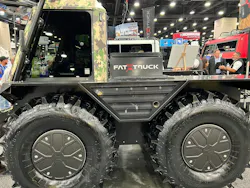
Tires (off- and on-road) are a big part of a fleet’s costs, so proper selection and maintenance cannot be ignored. The more you know, the longer your assets will keep rolling, and hopefully, the more the accounting department will stay out of your inbox.
Buying tires for in-the-dirt iron is a little different than buying for your on-road pickups, dump trucks, service trucks, and equipment haulers, but both require a keen eye that looks past simple up-front cost.
"For off-road applications, tire selection should be driven by the total cost of ownership rather than the initial purchase price alone," says CEAT Specialty (Camso) president Ryan Loethen. "Managers should evaluate the specific operating environment, including terrain conditions, load requirements, travel distances, and machine utilization rates."
Pete Kearney, Titan International’s director of OTR Tires and Wheels, agrees.
“One of the biggest mistakes fleets make is treating off-the-road tires like a commodity purchase,” he says. “In reality, the smarter decision starts with choosing a partner who understands the machine, the load, the haul profile, and the jobsite environment well enough to recommend the right solution, whether that is a bias or a radial.”
Tire dealers are your friends
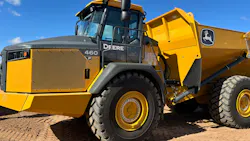
It’s a good idea to look at a tire manufacturer’s dealer or distributor as you would your heavy equipment dealer – like a partner that can do more than just sell you a product.
“The best starting point in the market for new construction tires is to assess your total tire footprint,” says Mike Tsakiries, Bridgestone’s director of OTR marketing.
“Tire manufacturers continually innovate and develop new features that enable optimal performance across a wide range of applications, so having a clear understanding of the equipment you use at your jobsite and the daily work they perform helps determine which tires could be right for your operation.”
Tsakiries recommends that all customers should work through this process with Bridgestone’s extended dealer network, sales representatives, and field engineers.
How to care for trailer tires
“While premium tires may have higher upfront costs, they typically last longer and deliver optimal performance throughout their use,” Tsakiries says. “This results in fewer tire replacements and installation expenses, ultimately leading to increased operational uptime and lower total cost of ownership.”
Titan's Kearney says the familiar word "utilization" also applies to dealer and manufacturer resources.
"In many cases... [fleets] are simply underutilizing the expertise available to them," Kearney says. "Too often, tire buying and maintenance are treated as transactional decisions when they should be approached as part of a broader operating strategy."
"The greatest opportunities often come from leveraging available expertise, whether through tire manufacturers, dealers, field specialists, monitoring tools, or training resources," he says. "These resources can help fleets make smarter decisions throughout the tire lifecycle and build more reliable, safer, and cost-effective operations.
Buying advice
CEAT Specialty's Loethen provides his off-road key considerations:
- Application fitment: Tires should be matched to the machine type and duty cycle. A wheel loader operating in a quarry has very different requirements than a telehandler on a construction site.
- Durability and cut resistance: OTR tires often operate in harsh environments where punctures, cuts, and impact damage can lead to costly downtime.
- Load-carrying capacity: Tires must be capable of handling the machine's operating weight and payload without compromising performance or safety.
- Traction and stability: Proper tread design improves productivity, machine control, and operator confidence across varying surfaces.
- Service life: Longer tread wear and stronger casing construction help reduce replacement frequency and lower operating costs.
- Fuel efficiency and rolling resistance: Tire design can influence fuel consumption, particularly on machines that travel significant distances.
- Dealer and manufacturer support: Access to technical expertise, warranty support, and tire availability is critical for minimizing downtime.
For on-road fleets, Loethen says the priorities shift somewhat from pure durability to a balance of durability, fuel economy, ride quality, and regulatory compliance.
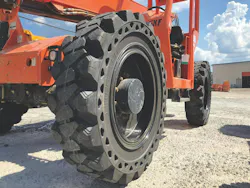
When to consider solid, flat-proof tires
Fleet managers should focus on:
- Tread life and wear consistency: Predictable wear patterns help optimize replacement schedules and lower operating costs.
- Fuel efficiency: Low rolling resistance designs can contribute to measurable fuel savings across large fleets.
- Load ratings: Tires must be appropriately specified for payload requirements and operating conditions.
- Retreadability: High-quality casings can extend tire life through multiple service cycles.
- Ride comfort and noise levels: Driver comfort contributes to productivity and can reduce operator fatigue.
- Traction and braking performance: Particularly important for dump trucks and trailers that may encounter mixed road and jobsite conditions.
- Durability under mixed-service use: Many fleets transition between highway travel and off-road work zones, requiring tires capable of handling both environments.
"The best tire choice is one that balances purchase price, expected service life, fuel consumption, maintenance requirements, and uptime performance throughout the tire's lifecycle," Loethen says.
Retreading benefits
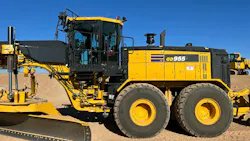
Retreading, or recapping, could be called an on-road life extension strategy.
For truck and other on-road radial tires, the use of retreads provides economic and environmental benefits, according to Tsakiries.
"Retreaded tires perform like new tires, but for a fraction of the cost resulting in significant savings over time," he says. "In addition to the savings, retreads offer multiple tread patterns to customize your tire program to fit your operation’s unique needs, maximizing your fleet’s performance."
There's more, and it's "green."
"Environmentally, retread tires help fleets and tire manufacturers consume fewer resources. Creating a Bandag retread tire, for instance, uses 30% less energy compared to manufacturing a new tire. Incorporating retreads into your operation also reduces tire waste from prematurely entering waste streams," Tsakiries says.
"Integrating retreading into your tire program can significantly reduce your tire cost. For medium-to-large construction fleets with a substantial number of on-road vehicles, a full new tire/retread program can provide many benefits to your operation," Tsakiries says. "For smaller operations, buying retreaded tires can be a good option to reduce your operating cost."
Maintenance tips
Tire inspection should be part of your daily machine walk-around because safety and uptime hang in the balance.
Tire blowouts on construction equipment — even with smaller equipment like skid steers — can be dangerous for multiple reasons.
There’s not only the chance for the equipment to veer suddenly or drop a heavy load, but also the rapid release of air from a tire can act like an explosion throwing sharp pieces of heavy-duty rubber and metal shrapnel with enough force to cause severe injury to bystanders.
And any flat tire on a jobsite means lost productivity, which means lost money. The folks at tire manufacturer OTR Engineered Solutions have a comprehensive plan worth following (see below the sidebar).
Buy Tires, Add Monitoring Later?
Digital tire monitoring delivers measurable business impact. By maintaining proper tire pressure, fleets can reduce fuel consumption, extend tire life, and significantly decrease tire-related roadside incidents, lowering the need for costly and disruptive emergency service calls.
In an effort to advance digital tire monitoring, Continental Tires offers Sensor Ready tires that feature an integrated sensor pocket and a sidewall logo to help fleets with identification.
This means techs can install sensors quickly so that tire monitoring will be faster, simpler, and more reliable for fleets of all sizes.
The integrated sensor pocket that is engineered directly into the tire during curing. Each tire is clearly marked with a Sensor Ready logo on the sidewall, allowing fleets, dealers, and retreaders to instantly confirm compatibility — no guesswork required.
The integrated pocket securely holds Continental’s tire sensor, a core component of the ContiConnect ecosystem, which measures and transmits critical data such as tire pressure, temperature, and mileage. With this system, fleets can move from manual processes to a seamless, digital solution that improves uptime and operational control.
Unlike traditional installations that required manual gluing and preparation, Sensor Ready tires reduce installation time from up to approximately 14 minutes to just a few minutes, lowering labor requirements at both fleet maintenance facilities and retread shops.
The integrated design also increases installation consistency and reliability, helping ensure the sensor remains securely in place under normal operating conditions, according to the company.
The Sensor Ready logo serves as a simple but powerful visual cue across the tire lifecycle, enabling faster decision-making in the yard, workshop, or retread plant.
Fleets can also choose the level of integration that best suits their operation, either purchasing tires with sensors pre-installed from the factory or selecting Sensor Ready tires for quick sensor installation at any time without specialized tools or adhesives.
During the retread process, the integrated pocket remains part of the tire, eliminating unnecessary steps and reducing turnaround time. Only the sensor itself needs to be removed and reinstalled, helping retreaders operate more efficiently without impacting casing performance or durability.
Visual cues (and some feel, too)
The first step in a good tire maintenance plan is a daily, pre-shift visual inspection, which is quick and easy to do.
Additionally, when operating machines, pay attention to traction and how often your tires are spinning or losing grip. This can be an obvious sign that a more in-depth inspection is warranted or that new tires are needed.
When checking tread wear, identify what the original (new) tread depth was and use a tread depth gauge to accurately determine both the amount of wear so far and the remaining tread depth.
Tread depths should always be taken at the center of the tread. Do multiple readings to detect any irregular wear patterns.
How to maintain skid steer tires
Beyond the tread, do a visual inspection of the sidewall and shoulder area to determine the overall condition of your tires and determine if an injury or cut needs to be addressed.
Key issues to look for include penetrations (nails, screws, or large stones embedded in the tread), impact damage (bulges, bumps, or separation), sidewall cuts (gouges or abrasions that expose the internal belts or cords), mismatched wear (bald spots, scalloping, or uneven tread wear), and wheel damage (pitted, bent, or cracked rims as well as missing lug nuts).
Minor sidewall cuts and damage should be expected given the application, but anything more serious should be addressed.
When operating a machine with pneumatic tires, a routine check of air pressure will prevent accelerated wear or unnecessary damage. The more your machine is used, the more often you should be checking the pressure.
Also, tires should be rotated every 50 to 100 hours.
If operating a machine with foam-filled or solid tires, maintenance requirements are significantly reduced, but operators should still perform routine inspections and rotate tires as needed. Like with pneumatic tires, rotations are typically done every 50 to 100 hours to maximize tire life.
Conducting daily, pre-shift inspections of all tires on all equipment iss not just a smart practice, OTR says, but it’s mandated for most off-road construction equipment by OSHA.
Operators have an important role to play, as well.
Beyond routine maintenance, it makes sense to put a little effort into educating operators about easy ways to avoid unnecessary tire wear and maintenance. Here are some guidelines:
- Keep all four tires on the driving surface. This is particularly relevant with skid steers, but going up on only two tires when scraping, digging in hard-packed dirt, traveling with a raised load, etc., will result in uneven wear.
- Avoid overloading the machine.
- Avoid overly spinning the tires as you engage material.
- Avoid turning the machine while stationary.
About the Author
 Frank Raczon
Frank Raczon
Frank Raczon has covered and influenced the equipment industry for 35 years, including 15 years as senior editor of Construction Equipment, and marketing, advertising, and public relations work with the industry's top manufacturers. In addition to authoring "Caterpillar: Modern Earthmoving Marvels" (Motorbooks, 2015), he has won numerous awards in his career, highlighted by nods from the Construction Writers Association, the Association of Equipment Manufacturers, the Business Marketing Association, and BtoB magazine. Raczon has also won a number of awards from publishing peer groups such as ASBPE and TABPI.