Proper Care of Trailer Tires
Key Highlights
In this article, you will learn:
- What stresses affect tire performance.
- How to select trailer tires.
- How to manage heat, load, and wear on tires.
- Maintenance routines for trailer tires.
- Advances in tire materials and testing.
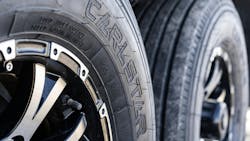
For many equipment fleets, trailers are the unsung heroes of the job site—responsible for moving machines, materials, and tools where they need to be, day after day. Yet managers often overlook one of the most critical components of trailer safety and reliability: the tires.
High-speed trailer tires aren’t just another maintenance item; they’re the foundation that keeps the operation running efficiently and safely. When a trailer tire fails, the result can range from lost time to costly equipment damage or even roadside accidents. Understanding how to choose, maintain, and monitor trailer tires can dramatically improve uptime, safety, and overall performance, especially as today’s hauling demands evolve.
More on safe equipment transport
- How to haul heavy equipment.
- Safe trailering for compact equipment.
- How to safely transport equipment.
In construction, attention naturally goes to the heavy hitters: skid steers, excavators, and other construction equipment. But none of those machines reaches the job site without a trailer and its tires. And all too often, the tires doing that hauling go overlooked.
That’s a mistake. Trailer tires experience stresses different from passenger or light truck tires. They endure prolonged static loads, repeated high-temperature cycles, and rough conditions like gravel lots, debris-laden job sites, and long highway runs. Unlike drive tires, they don’t benefit from the cooling effect of rotation during braking or acceleration—meaning they’re more prone to heat buildup and early wear if not properly specified or maintained.
How to select a trailer tire
The first step in preventing failure is choosing the right tire for the job. It sounds simple, but it’s one of the most common areas where equipment managers go wrong.
When selecting trailer tires, start with the trailer’s axle rating and gross vehicle weight rating (GVWR). The total load the trailer carries—including its own weight and the payload—should never exceed the GVWR. From there, divide that weight evenly between the tires on each side. This calculation helps ensure the load rating of each tire matches the real-world conditions it will face.
People often assume that choosing a tire with the highest load rating automatically means better performance. In reality, if that tire isn’t compatible with the trailer’s axle specifications, it can lead to uneven wear, blowouts, or suspension stress. The goal isn’t just to handle more weight; it’s to match the tire, trailer, and towing vehicle as a system.
Speed rating is another important consideration, particularly for fleets that cover long highway distances between jobs. Modern high-speed trailer tires are now commonly rated up to 87 mph. Although most trailers won’t be traveling that fast, these ratings indicate how well the tire can handle heat—one of the leading causes of failure in trailer applications.
Manage heat, load, and wear on trailer tires
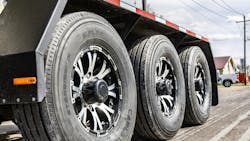
Heat is a tire’s worst enemy. Excessive temperatures break down compounds, accelerate tread wear, and increase the likelihood of blowouts. For construction trailers that may sit in the sun all day, often loaded down, managing heat becomes even more critical.
Proper inflation is the first line of defense. Always operate tires at the manufacturer’s recommended maximum PSI listed on the sidewall. Underinflation causes excessive flexing, which generates heat and reduces tread life. Overinflation can create a harsh ride and increase the risk of impact damage or uneven wear.
Overloading is another common issue, and it’s not just about weight. Uneven loading or hauling equipment that shifts during transport can put extra strain on one side of the trailer. That imbalance shortens the life of all tires on the trailer and increases the risk of failure.
Finally, construction environments introduce a constant hazard: road debris. Screws, nails, and tools can easily puncture treads. The best protection is vigilance, which can include regular inspections and keeping the trailer area clear when loading or unloading equipment.
Maintenance routines for trailer tires
The difference between a trailer that runs smoothly for years and one that’s constantly in the shop often comes down to maintenance habits.
Contractors should perform visual inspections before and after each haul. Look for punctures, cracking, bulges, or uneven wear. Even a small puncture can worsen over time, especially under heavy load or high heat.
Check tire pressure daily or at least several times per week. Tires naturally lose air over time, and trailers parked for long periods can develop flat spots that worsen when underinflated. Using high-quality pressure gauges (and keeping a portable air source on hand) makes this task easier on busy jobsites.
Wheel integrity is another key factor. Loose or damaged wheels can cause misalignment, vibrations, and even wheel separation. Train crew members to torque lugs properly and recheck them after the first 50 to 100 miles of use, particularly with new or recently serviced wheels.
It’s also a good idea to rotate tires periodically, especially for multi-axle trailers. Even wear distribution extends lifespan and ensures consistent handling.
Even the best maintenance program won’t work if operators aren’t trained to recognize early warning signs. Trailer “hopping” or sway, for example, can indicate overinflation, and a trailer that feels sluggish or drags could point to underinflation or misalignment.
Encourage crews to report anything unusual immediately and to know when to pull over before a minor issue becomes a roadside emergency. Simple habits like walking around the trailer before every trip and feeling for unusually hot tires after a haul can prevent downtime and accidents.
The future of trailer tires
The demands on trailer tires are changing fast. Contractors are hauling heavier loads, over longer distances, and at higher speeds than ever before. Tires must keep up—not only through stronger materials and higher speed ratings but also through improved heat management and compound durability.
Modern tires designed for construction hauling undergo rigorous testing, often well beyond minimum government standards. Although the industry requires roughly 47 hours of endurance testing, many manufacturers test up to 200 hours or more to simulate years of real-world use. Advanced compounds and reinforced tread structures are helping tires last three to four times longer in high-heat, high-load conditions.
At the same time, education remains one of the biggest gaps in the market. Although passenger and light-truck tire information is widely available, guidance specific to trailer tires is harder to find. As fleets rely more on trailers to move expensive equipment, filling that information gap becomes an industry priority.
The trailer tire may not be the flashiest part of a fleet of construction equipment, but it’s one of the most essential. With proper selection, inflation, and inspection habits, equipment managers can drastically reduce failures, prevent costly downtime, and ensure machines arrive where they needs to be—safely and reliably.
After all, an operation is only as strong as what keeps it rolling.