10 Ways to Get More Work from Your Articulated Dump Trucks
Key Highlights
- Match the machine to the mission. Payload capacity, excavator size, haul distances, and material density all influence ADT productivity.
- Technology can improve hauling efficiency. Onboard weighing, automatic traction control, and telematics help operators and fleet managers.
- Just read the story already. 🤷♂️ We've got 10 tips, three ADTs worth considering, and expert advice on keeping your trucks running. What more do you want?
Moving dirt is relatively easy, but moving dirt efficiently for profit takes a lot of planning, skill, and increasingly technology. Articulated dump trucks are a good example of this. ADTs essentially have one job: hauling heavy material across rough, off-road terrain. But these machines are not cheap. A new articulated dump truck can easily cost $500,000 to $650,000, so contractors and fleet managers need to get the most out of these six-wheeled workhorses — and that requires more than a powerful engine and a big dump body.
Luckily, today’s ADTs come in a variety of sizes and capacities, with increasingly sophisticated onboard technology. Selecting the right combination of truck and tech will be key the success of your haul operation. It’s all about the right questions. How many passes does your excavator need to fill the truck? How much fuel are you burning per ton moved? Are rough haul roads eating through your tire budget? These questions will make a big difference in your operating costs. Before investing in your next ADT, maybe consider these 10 factors.
10 ways to maximize ADT productivity
1. Match payload capacity to the application. Let’s start with a no-brainer. Bigger isn’t always better — even for ADTs. A larger ADT will carry more material per trip, true, but its size might not fit the jobsite, loading equipment, or your haul route. Consider the material being moved, road conditions, and expected haul cycle (see No. 3) before selecting a payload class.
2. Get the excavator-to-truck match right. Loading efficiency will make or break your haul operation. Just like your ADT needs to be sized correctly (see No. 1), your excavator or wheel loader needs to be sized for your cycle time objectives. That means matching bucket capacity to truck payload. Onboard payload weighing systems can increase success.
3. Calculate the whole haul cycle. Fleet managers should account for loading, loaded travel, dumping, maneuvering, and the empty return trip. Factor in the grade of the road, haul distances, and loading conditions. This will all affect how much material can be moved per hour. GPS tracking, telematics, fleet management software, and onboard payload weighing systems can all help improve haul cycle efficiency.
4. Keep those haul roads in good condition. This isn’t a monster truck rally. ADTs are designed for rough terrain, but that doesn’t mean navigating wild forest roads full of standing water and deep ruts. Poor haul roads increase rolling resistance and eventually destroy machines. Suggested reading: Caterpillar’s “9 Ways to Ensure Haul Roads are an Asset.”
5. Pay attention to tire selection and inflation. Tires represent one of the top operating expenses for ADTs. Picking the right tire and keeping the correct pressure will be important. We discussed this in our recent story “Tires and Articulation Joints Key ADT Maintenance.” E3 tires generally suit earthmoving applications with longer haul cycles, while heavier-duty E4 tires provide additional protection in rocky quarry environments. Wider tires can improve flotation in soft ground. Match tire selection and inflation pressure to load, speed, and operating conditions.
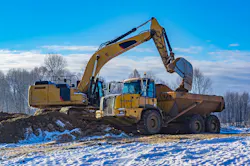
6. Measure fuel consumption per ton moved. Gallons per hour is a useful measurement, but a truck that burns more fuel hourly may still move more material per gallon. Volvo Construction Equipment suggests using tons moved per gallon as a key measurement for your articulated hauler comparisons. Check out this Executive Institute article, “A Guide to Optimizing Fleet Utilization,” written by Volvo CE.
7. Understand material density and body capacity. A truck’s rated payload and dump body volume measure two different things: weight and space. A full dump body doesn’t necessarily mean a full payload, especially when hauling lighter materials. On the flip side, dense materials can push a truck beyond its rated capacity before the body is full. Fleet managers need to consider both measurements for each application.
8. Evaluate serviceability before buying. This is another no-brainer. Of course, see how easy each machine is to service before buying. Compare maintenance intervals, ground-level service access, filter locations, and lubrication requirements. Ask the sales rep to walk you through a daily service check. Ask whether technicians can complete common service tasks without a lot of specialized tools. Then consider how that fits into your buy, lease, or rent equation.
9. Please consider operator comfort. We probably should have put this at No. 1 because ADT operators spend long shifts traveling over uneven terrain, so give them a better operator experience. Give them thoughtful cab ergonomics, heated or cooled air-ride seating, great visibility, useful safety tech, and intuitive controls (for starters). Automatic traction control can simplify driving, while hill assist, downhill speed control, and camera systems can also make tense navigation easier to manage.
10. Put telematics data to work. Modern haul operations are all about the numbers. Fleet management systems can help analyze that data — utilization, haul cycles, idling, fuel consumption, maintenance, safety, security, and onward. Use those insights to identify bottlenecks and improve operations. Compare cycle times across machines and jobsites. Maybe read our “Construction Equipment Telematics Guide: Compare OEM Fleet Management Platforms.”
Four ADTs you should consider
Hyundai HA30 and HA45 ADTs
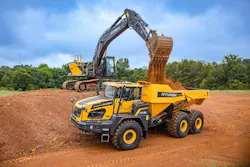
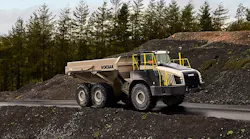
The recently updated HA30 and HA45 model articulated dump trucks from HD Construction Equipment Hyundai North America incorporate intuitive controls, great visibility to the worksite, and an easy-to-see, easy-to-operate touchscreen command center that make Hyundai’s ADTs among the easiest to operate. Easy operation starts with the 12.5-inch touchscreen for quick access to payload info, performance data, diagnostics, camera views, and machine settings. A redesigned color-coded keypad further simplifies machine operation. The redesigned cab combines productivity with comfort. Larger front and side windows improve visibility, while a heated air-suspension seat, automatic climate control (heat and AC), and ergonomic positioning of key interfaces and controls make long shifts more comfortable. A new “auto squat” feature lowers the truck’s front end for easy entry and exit. The automatic brake-hold system smooths loading cycles, and integrated payload weighing and gradient monitoring improve productivity and safety. With a rated payload of 45 tons, the HA45 features a 489-net-horsepower Scania engine, while the HA30 offers a 30-ton payload with a 367-net-horsepower Scania engine. For more info, visit Hyundai’s website.
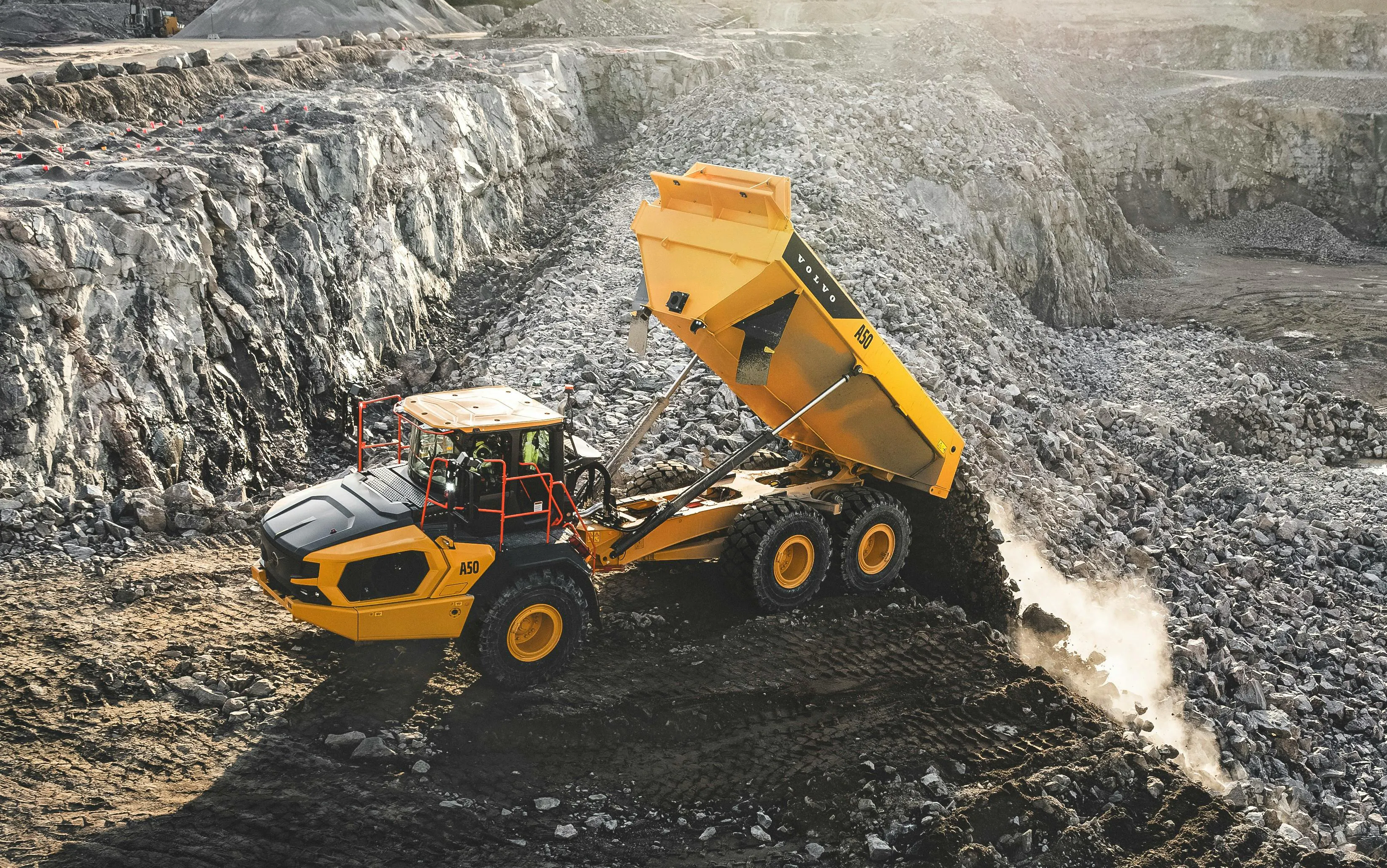
Volvo CE A50 ADT
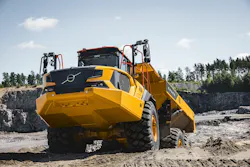
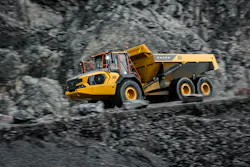
For heavy earthmoving and quarry operations that want to maximize productivity with a step up from the A45 but who don’t want to go as large as an A60, the A50 is a great alternative to increase productivity with an extra 3yd3 body over the A45 and 5yd3 over the A40. Volvo built the A50 ADT to fit that sweet spot, delivering a true 50-ton payload capacity on a nimble, six-wheel-drive articulated platform. That extra capacity allows you to move more material every day without sacrificing off-road mobility. To manage that heavy payload smoothly, the Volvo A50 features fully automatic traction control that continuously monitors wheel slip and engages diff-locks on the fly to protect the drivetrain and minimize tire wear. Combined with a terrain-equalizing bogie and hydro-mechanical steering, the A50 gives your operators complete control and stability under maximum load, keeping high-volume jobs on schedule. The A50 features a full Volvo Powertrain (Volvo engine, transmission, dropbox, and axles), Volvo Dynamic drive, Volvo ATC, and hydrotechnical self-compensating steering with feedback rod. In North America, Volvo also offers a lifetime guarantee for the front frame, rear frame and articulated joint. For more info, visit Volvo’s website.
Liebherr TA 230 ADT
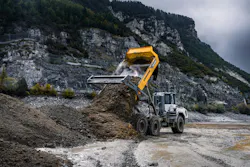
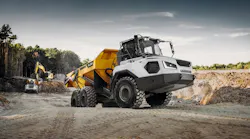
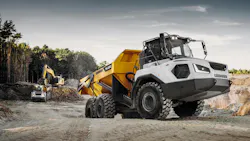
In the highly competitive 30-ton articulated dump truck segment, the TA 230 stands apart by combining rugged performance, operator comfort, smart technology, and practical serviceability. Its 61,700-pound payload, 360-horsepower Liebherr D956 engine, eight-speed powershift transmission and top speed of 35 mph deliver the power and productivity needed for demanding off-road applications. A 45-degree articulation angle, strong ground clearance, and robust pivot joint give it excellent maneuverability and durability in challenging terrain. The low loading edge supports fast, efficient loading, while the extended body chute helps reduce material loss. From a driver’s perspective, excellent visibility and speed-dependent steering help make long shifts more comfortable and controlled. Inside the cab, drivers will find features that simplify repetitive cycles and enhance productivity, such as an automatic differential system, onboard weighing, hill-start assistance, and speed maintenance, helping them work confidently on challenging jobsites. For more info, visit Liebherr’s website.
Smart haul truck habits that protect component life
This section was written by Tyler Smith, product manager of articulated haulers at Volvo Construction Equipment.
Getting the longest life out of your articulated dump trucks usually comes down to small habits in the driver’s seat. Here are three simple adjustments your operators can make to reduce wear on high-cost components like brakes, tires and suspension systems:
- Leverage the retarder over the service brakes: Relying heavily on engine retarders during downhill runs keeps service brakes cool, preventing premature friction pad wear and costly thermal damage.
- Keep haul roads maintained: Rough, rutted haul roads do a number on suspension components and tires. A quick pass with a blade on major haul routes keeps the drive smooth and pays off in fewer tire cuts and longer chassis life. Keeping haul roads in good condition also improves operator comfort, which in turn can boost the operator experience and increase productivity since they can travel at a faster speed.
- Smooth out acceleration under load: Mashing the accelerator pedal while climbing out of a soft pit creates wheel slip and overheats hydraulic diffs. Gradual throttle input maintains traction and saves drivetrain stress.
Proactively protecting your equipment doesn’t require sacrificing productivity. What small adjustments could your haul team make today to keep your trucks out of the shop and on the roads.
About the Author
Keith Gribbins
Keith Gribbins is the head of content at Construction Equipment, where he leads editorial strategy across print, digital, video, and social channels. An award-winning journalist with more than 20 years of experience, Keith has won 17 national and regional editorial awards and is known for his hands-on reporting style, regularly visiting manufacturers, operating equipment, and covering major industry events worldwide.