Showcase: Choosing the Right ADT For the Job (Part 2)
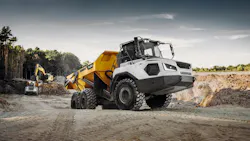
Size isn't everything. Hopefully you don't hear that a lot.
When it comes to ADT choices, size is important, but there is much more to consider. Think of it as part of a total equation.
There's also payload capacity, matching the loaders and/or excavators already in your fleet to achieve the fewest passes, and even dump body configuration.
Volvo Construction Equipment product manager Tyler Smith points to site conditions and job site layout, as well. "As for the site, you need to account for ground conditions, slopes, and travel distances. For rough terrain, full hydraulic suspension or front hydraulic suspension will provide the smoothest ride.
Showcase: ADTs prioritize traction, safety (part 1)
"In muddy conditions, you want a truck with wider tires for better flotation," Smith said. "For long travel distances, you might want a bigger truck to optimize how much material is moved with each trip."
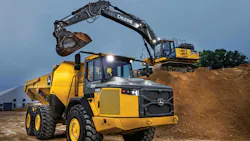
ADT buying factors
"The main factors to consider are job duration, loading tools, and those site conditions and layout," Smith said.
"If a job is short, it might not be practical to move the biggest possible ADT to the site because of transport costs and logistics. Typically, trucks with 50-ton payloads or below can easily be moved on a lowboy," he said.
Volvo offers seven ADTs with payload capacities from 28 to 60.6 tons.
"It’s important to size your haul truck to the wheel loader or excavator that will load it so that passes and cycles are not wasted," Smith said.
"If your loading machine and its bucket are too small for your ADTs, it will take more passes to fill the trucks, wasting time and fuel. On the other hand, if the ADTs are too small, it will be easier for the loading tool to overfill them, which is a safety concern and accelerates wear and tear," Smith said.
"That setup will also require more trucks or more trips to reach production targets."
Smith also had pointers for spec'ing.
"You should also consider factory-fitted options like spill guards, sideboard extensions, and tailgates, which can increase payload capacity and dumping efficiency. An overhung tailgate is the most popular configuration, while an underhung tailgate helps for larger materials like stumps and boulders that could get stuck in an overhung," he said.
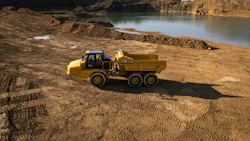
Volvo has a pairing guide on its website to help you determine the right ADT for your loader or excavator.
Caterpillar's Thomas agrees on the important of pass matching. "Properly matched loading tools help achieve consistent loading in the fewest passes, improving productivity while reducing spillage, fuel consumption, and long‑term wear. We like to stay between 4-6 pass match for better efficiency," Thomas said.
Dump bodies
"Dump body configuration plays a direct role in job site productivity by aligning the truck to the material being hauled and the job’s performance goals," said Lauren Meyer, Deere's product marketing manager for ADTs.
"Optional steel liners help to protect the dump body when handling harsh or abrasive materials. A tailgate option can increase capacity of the dump bed. And in cold, sticky, or wet conditions, optional bin heat is available to help reduce carryback," Meyer said.
Bed heaters are standard in Develon's ADTs.
"Standard truck bed heaters, which divert the engine exhaust through the channels in the dump body, help loosen sticky material to minimize carryback and reduce cycle times," said Develon product manager Jay Patel. "Body liners and side extenders are also available to minimize wear and tear on the truck bed."
Patel also pointed out that the company's ADTs have a sloping bed design that traps material weight toward the center, lowering the unit's center of gravity. "This improves stability, safety, and traction through equal weight distribution."
Komatsu product marketing manager Kwanju Cho also keyed in on design. "On the HM460, the dump body configuration enhances productivity by maximizing payload through the use of lightweight, high-strength materials while preserving durability through a rigid, box-shaped rear frame design.
"By reducing structural weight without sacrificing strength, the HM460 is designed to carry more material per cycle, operate efficiently and maintain high availability," Cho said.
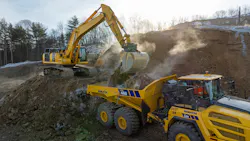
Ejector bodies
Caterpillar offers ejector bodies on two of its seven ADT models, the 730 EJ and 740 EJ.
"Ejector models unload without raising the body, improving stability and allowing controlled material placement," Thomas said. "[Ejectors] can do all that a standard articulated truck can do, such as dump in a pile, and so much more. Static dump with an ejector is as simple as initiating the hoist lever and watching it all come out the rear of the bed. So, by eliminating the need to hoist, we are taking the risk out of that part of the load, haul, dump, return."
Thomas said ejectors also eliminate carryback. "No more need to clean out the bed with an excavator when wet sticky material builds up in the body – saves time and resources."
Ejector bodies can also reduce or eliminate support machines. "If the job allows and you can spread on the go, then maybe that 815 or 825 [scraper] can handle the fill, or the motor grader," Thomas said.
Productivity also sees a boost.
"If you can spread on the go, you can eliminate 30-40 seconds per cycle," Thomas said. "You can work underground, on highways where height restrictions with bridges are a concern, and in buildings."