A Guide to Optimizing Fleet Utilization: Idle Machines Are Killing Your Margins — Here’s How to Fix It
High interest rates, fluctuating fuel prices, and the persistent labor crunch have changed the math on fleet management. Today, success isn’t measured by how much iron you own, but by how hard that iron works and how little it costs you to keep it moving. When maintenance costs spiral or machines sit idle, you’re bleeding margin. Real fleet optimization is about moving away from putting out fires and toward a strategy where every hour on the meter is justified by the bottom line. By leveraging tools like right-sizing guides, telematics and flexible procurement models, managers can stop the financial leak and turn their fleet into a high-efficiency operation. Here’s a look at some technology and strategies currently helping the most successful fleets shore up their bottom lines.
Calculators as decision engines
It’s as important as ever to consider the Total Cost of Ownership (TCO) of a machine rather than just its sticker price. While many look at the initial purchase, true TCO is the sum of what it costs to own and operate that unit over its entire economic life, typically expressed in dollars per hour.
TCO ($/Hr) = Annual Owning Costs + Annual Operating Costs
Annual Operating Hours
- Owning costs are your fixed expenses: the purchase price (minus residual value), interest, insurance and taxes.
- Operating costs are the variables that start the moment you turn the key: fuel, wear parts, preventive maintenance and repairs.
For those in production-heavy environments like quarries, you can take this math a step further to find your unit cost by dividing your TCO by your production rate (tons per hour). This allows you to compare the true value of dissimilar machines based on what they actually produce. A lot of OEMs and dealers now offer digital calculators that can run these sensitivities for you. These tools are essential for procurement because they help you determine if a machine’s projected utilization justifies the investment before you ever sign a contract. Other calculators that OEMs and dealers sometimes make available allow you to work out payments, machine quotes, fuel consumption and even charging and runtimes for electric equipment.
Financial calculators are especially useful for determining whether a machine’s projected utilization rate justifies the monthly payment. Similarly, fuel burn calculations can help you decide whether it’s time to upgrade to a more efficient model. Another valuable but often overlooked tool is a machine pairing guide. In any earthmoving operation, your efficiency is dictated by the pass match — the number of bucket cycles it takes for a loader or excavator to fill a haul truck.
If your machines are mismatched, you’re either leaving a truck idling while it waits for a slow loader or wasting fuel using a massive excavator to fill a small truck. A pairing tool takes the guesswork out of this by helping you synchronize your cycle times to ensure neither machine is sitting idle. Here’s an example from the pairing tool Volvo CE offers, which matches excavators or wheel loaders with articulated dump trucks:

After selecting a machine type, model, bucket capacity and material type, the tool populates a list of paired options. In the screenshot, you can see that for the EC500 excavator, the tool notes the exact number of passes and the bucket cycle time. It even provides the fleet productivity sh tn/hr — the critical figure needed for the unit cost math we discussed earlier.
It’s worth your time to do this research before jumping into a significant purchase like heavy equipment. And even if you already have machines paired up, it can’t hurt to check a right-sizing tool to ensure that you’re using your current equipment efficiently.
Actionable data from telematics
When telematics first came onto the market, it was largely about knowing where your machine was at all times. Now, it’s more about knowing how your machines are being used. The most valuable telematics data for fleet utilization tracks idle time, operating behaviors, maintenance needs and early warning signs of potential problems before they cause a breakdown.
Here’s an example of idle time’s impact on fleet efficiency. Let’s say you have two of the same machines doing the same work on the same jobsite, but Machine A runs with 50 percent idle time and Machine B is idling at 33 percent. Over the course of a year, Machine A will run for about 2,000 hours, while Machine B will run for about 1,500.
That may not seem like a big difference at first but watch how it adds up: After five years, Machine A has accumulated 10,000 hours with a true working time of 5,000 hours. Machine B has only accumulated 7,500 hours for the same true working time of 5,000 hours. That difference of 2,500 lifetime hours can cut thousands of dollars from Machine A’s resale value, not to mention all the extra fuel that was burned to get there.
With some advanced telematics systems, you’ll get reports that clearly identify excessive idling so you can address any operator behaviors or site conditions that are causing the problem. And speaking of operators, telematics data can point out other valuable training opportunities too.
The top five problems telematics reports can alert you to
Under- or overloading haul trucks — Undersized loads waste time because it will take more cycles to reach targets, and oversized loads can cause unnecessary wear and tear for both equipment and haul roads.
Unnecessary idle time (including turbo shutdowns) — While newer machines often have auto-shutdown programming to ensure the turbo cools down properly before the engine stops, this still results in intentional idling. Telematics can help you distinguish between a necessary cool-down and a machine that’s left running because of site bottlenecks or habit, both of which burn fuel and add non-productive hours to the meter.
High-speed shifting on wheel loaders — Over time, this can cause driveline failure. If you need to replace a transmission, that can cost upwards of $100,000.
Excessive use of service brakes and differential locks on haulers — These behaviors burn extra fuel and accelerate component wear. When a set of tires for a mid-sized hauler can easily exceed $30,000 and fuel prices remain volatile, these habits slash your margins faster than almost any other operator error.
Misuse of excavator work modes — Some operators think the highest work mode means the highest productivity, but that’s usually not the best approach. In many cases, they could accomplish the same amount of work in a lower work mode and burn up to 50% less fuel, saving thousands of dollars per year.
With definitive data that highlights these behaviors, you can address them right away with your crew and see improvements across subsequent reports. And of course, you can’t overstate the value of uptime. With telematics, it’s much easier to keep track of machine health, which allows you to schedule repairs during planned maintenance downtime rather than react to a costly failure. With advanced telematics, you can also get clear, concise alerts in real time to prioritize urgent service needs and prevent bigger, more expensive issues.
Connected solutions that optimize traffic
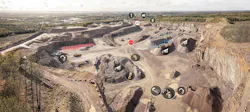
There’s a growing number of software programs that can optimize a worksite before a project begins, but the real value lies in the ability to spot bottlenecks and adjust in real time once the dirt starts moving. One way to do this is with an intelligent positioning technology. (At Volvo CE, we call it Connected Map.) This is most often used on large projects like quarries, mines and expansive construction sites. Every vehicle equipped with a tracker — from a service pickup to a massive haul truck — is represented on a digital map accessible via in-cab displays or smartphones.
This gives every operator on-site real-time visibility into the location and movement of the surrounding fleet, transforming a chaotic worksite into a coordinated, transparent operation.
Important site info can be communicated to all users to improve safety and traffic flow. For example, if a section of haul road becomes slippery after rain, a site manager can note it on the app, and it immediately shows up for everyone else’s awareness.
You can also establish speed limit zones for safer downhill travel, restricted zones if a portion of the site needs to be closed off, and even points of interest like the office or restroom for visitors who are unfamiliar with the site. All of this optimizes traffic for the shortest cycle times and safest conditions, which also reduces fuel consumption and emissions.
Some of these technologies can take it a step further and provide real-time production, fuel efficiency and cycle time data as well. (At Volvo CE, this is called Performance Indicator, and it works alongside Connected Map.)
When a fleet or site manager has access to live data, they can make adjustments to ensure targets are hit within the current shift, rather than reacting to yesterday’s data to compensate for today’s losses. Whether the data suggests you need to add haul trucks or reveals a bottleneck caused by a downed machine, the ability to monitor the entire site and its live productivity provides a level of operational control that was previously impossible. This real-time visibility allows for proactive management that directly protects the day’s margins.
The procurement spectrum

Your acquisition model is just as critical to fleet utilization as the machines themselves. Traditionally, the rule of thumb has been to buy if a unit’s annual utilization exceeds 60 to 70 precent and rent if it falls below that threshold. However, the spectrum has expanded. Between traditional leasing and the emergence of Equipment as a Service (EaaS), managers now have more nuanced ways to align their monthly spend with actual machine productivity*.
Let’s break down the pros and cons of each.
- Buying (CapEx): Best for building equity and long-term economy on high-utilization machines. However, the owner carries full responsibility for maintenance scheduling, repair costs and determining the optimal disposal point.
- Renting (OpEx): Ideal for short-term needs, testing new technology (like electric models) or supplementing a core fleet without long-term commitment. The trade-off is higher monthly payments, potential damage fees and being limited to the rental house’s current inventory.
- Leasing (CapEx): Offers lower monthly payments than renting and access to the latest machine features without a massive upfront investment. It requires a fixed time commitment, and miscalculating contract hours can lead to penalty fees or leftover money on the table.
- Equipment as a Service (OpEx): A pay-as-you-go model where you purchase hours of use rather than the iron itself. Because the dealer or OEM manages all maintenance, their profit is tied directly to your uptime, making it a highly predictable cash-flow model for high-volume operations.
Don’t forget that you can use a mixture of these procurement models. It might seem a little more complex on paper, but it ensures that your expenses are as precisely tuned as your utilization.
The fleet optimization roadmap
As you can see, there are many paths to explore on your way to a fully optimized fleet. And it’s not a one-time journey. It’s a continuous loop of simulating, operating, analyzing and refining. A strong relationship with your dealer and OEM will make the journey smoother. Whether you start with one machine or one jobsite, there are many tools and technologies available to help you navigate. Perhaps you begin by calculating the TCO of your least-utilized asset today and let that data guide your next move.
Matthew Fogtman is the head of fleet management operations at Volvo Construction Equipment.
*Under IFRS 16/US GAAP