Grade Control for Excavators: A Fleet Manager’s Guide to 2D, 3D, Automation, and Onward
Key Highlights
- 🎯 Match the tech to the work: It could be simple 2D guidance. It could be automated 3D machine control. Calculate which system pays you back.
- 🦾 Today’s systems are pretty badass: Machine control can reduce grade checks, prevent over-digging, minimize rework, and almost automate the digging cycle.
- 🧠 We called in the experts: Product pros from Develon, Volvo, Bobcat, CNH, Komatsu, LiuGong, and more share advice on grade control, productivity, data, and buying smarter.
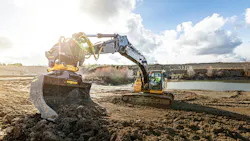
There are few things more satisfying than watching a good excavator operator work. Boom, arm, and bucket all act as one. A trench suddenly appears. A slope begins to take shape. Ah, art. But these days, it can be hard to tell where the artist’s skill ends and the excavator’s begins.
That line is getting blurrier as grade control becomes more accessible. Grade control (a type of machine control) is a technology system that helps operators dig or grade to the correct depth, slope, or elevation using sensors on the machine, cool positioning technology, and in-cab guidance via monitors, lights, and sounds. Grade control has evolved from expensive tech reserved for big earthmovers into approachable options for all types of machines and sizes — factory-installed systems, aftermarket kits, and cheap-ish basic guidance tools.
On excavators specifically the technology now stretches from mini excavators digging footings to production excavators working with complex 3D digital site models. Availability today is not a problem. It’s what level of technology can help your crew become more efficent. So, what tier of grade control do you actually need? And where should fleet managers start? Let's dig in.
Buy the grade control your work requires
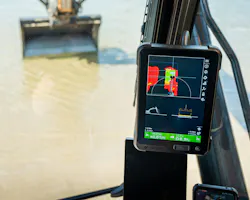
I’ve written a lot of grade control stories over the years. Here's my first piece of advice: Maybe don't buy the coolest system. Buy the system your jobs can actually pay for. Cause this stuff ain't cheap. Machine control on an excavator can range from $4,000 for a basic 2D grade guidance upfit to over $50,000 for an automated 3D system. After considering those costs, my first questions would be:
- What positioning or correction service does it require, and what does that cost? This matters especially with 3D GNSS systems.
- Will this work with other grade control systems in my fleet?
- Can displays, receivers, or other components move between machines?
- Can I start at a basic level and upgrade later?
- How easy is data collection and export?
- What are the ongoing software and subscription costs?
- How much setup and calibration does it require? How often?
- Will it work with the buckets, tiltrotators, and other attachments I already use?
- Can I demo or rent the system before making the investment?
Don’t cheap out on training, either. A $30,000 technology package isn’t particularly productive if only one person knows how to set it up and use it. Finally, measure what happens after you install it. Don't settle for, “Well, Steve likes it." Compare passes, machine hours, fuel, material movement, and job completion times. Grade control should produce a measurable business advantage. That means you should be able to measure it. Tell Steve to do it.
I guess in finale (for my section), the fanciest 3D system isn't automatically the best investment. Neither is the cheapest. So, figure out which one works best for your operation and then measure the results to prove its cost.
5 ways to dig smarter with advanced grade control
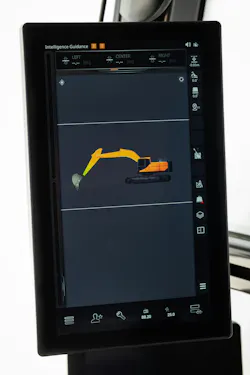
This section was written by Brian Kim, excavator product manager at Develon.
- Deploy 2D grade control for basic trenches and simple slopes. Use sensor-based 2D systems for straight-line excavation to hit exact depths and slopes on your first pass without waiting for manual grade checks.
- Upgrade to 3D systems for complex site models. Leverage GPS, GNSS, and digital site models on intricate projects like highway ramps to automatically guide the excavator bucket along detailed engineering designs.
- Trust in-cab real-time displays to eliminate rework. Rely on instant visual feedback inside the cab to cut and fill accurately the first time, drastically cutting down on repeated passes and adjustments.
- Reduce operating costs by cutting machine hours. Finish jobs in fewer passes to lower fuel consumption, minimize engine wear and tear, and extend the overall operational lifespan of your equipment.
- Prevent over-digging to save on material and trucking fees. Stick strictly to digital depth boundaries so you avoid excavating too deep, saving thousands on hauling away extra dirt or buying unnecessary backfill.
Smart excavation tactics for faster utility runs
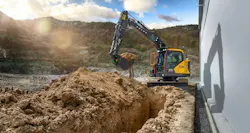
This section was written by Wade Turlington, head of compact equipment product management at Volvo Construction Equipment.
Shaving seconds off every excavation cycle is the easiest way to keep a utility installation on schedule. But hitting those tight daily footage targets requires a shift in how your operators approach the trench. The most efficient crews rely on smart positioning and material management to keep the project moving safely without relying on raw machine speed.
One of the most practical ways to accelerate a cut is to work with gravity rather than fighting it. Positioning your excavator utilizing a benched setup allows gravity to assist the bucket on its downward pass, reducing hydraulic effort and saving fuel. Similarly, operators should always bench or pile excavated spoil at least two feet away from the trench edge. This simple practice prevents loose dirt from rolling back into the cut, eliminating the need to clean out the trench floor multiple times before placing the pipe.
Bucket selection also plays an important role in speed. Using a bucket that’s wider than necessary forces the machine to move excess material, which slows down cycle times and burns extra fuel. Selecting a narrower trenching bucket designed specifically for the utility’s dimensions allows for faster, smoother sweeps and keeps the engine running in its sweet spot. By combining these smart positioning habits with the right attachment, you can dramatically increase your daily production while protecting the stability of the trench.
More grade control coverage
Want to dig deeper into machine control and grading technology? Here are a few more stories from the Construction Equipment archives:
- Grade control for compact track loaders: Explore 2D and 3D systems, buying tips, grading attachments, and the latest CTL tech.
- Grade control for milling machines: See how 3D grade control helped improve milling accuracy on an airport runway.
- Machine control for dozers: See how machine control can boost dozer productivity, reduce rework, and improve accuracy.
- How grade control technology works in general: Learn how IMUs, positioning technology, and sensors help machines hit grade accurately.
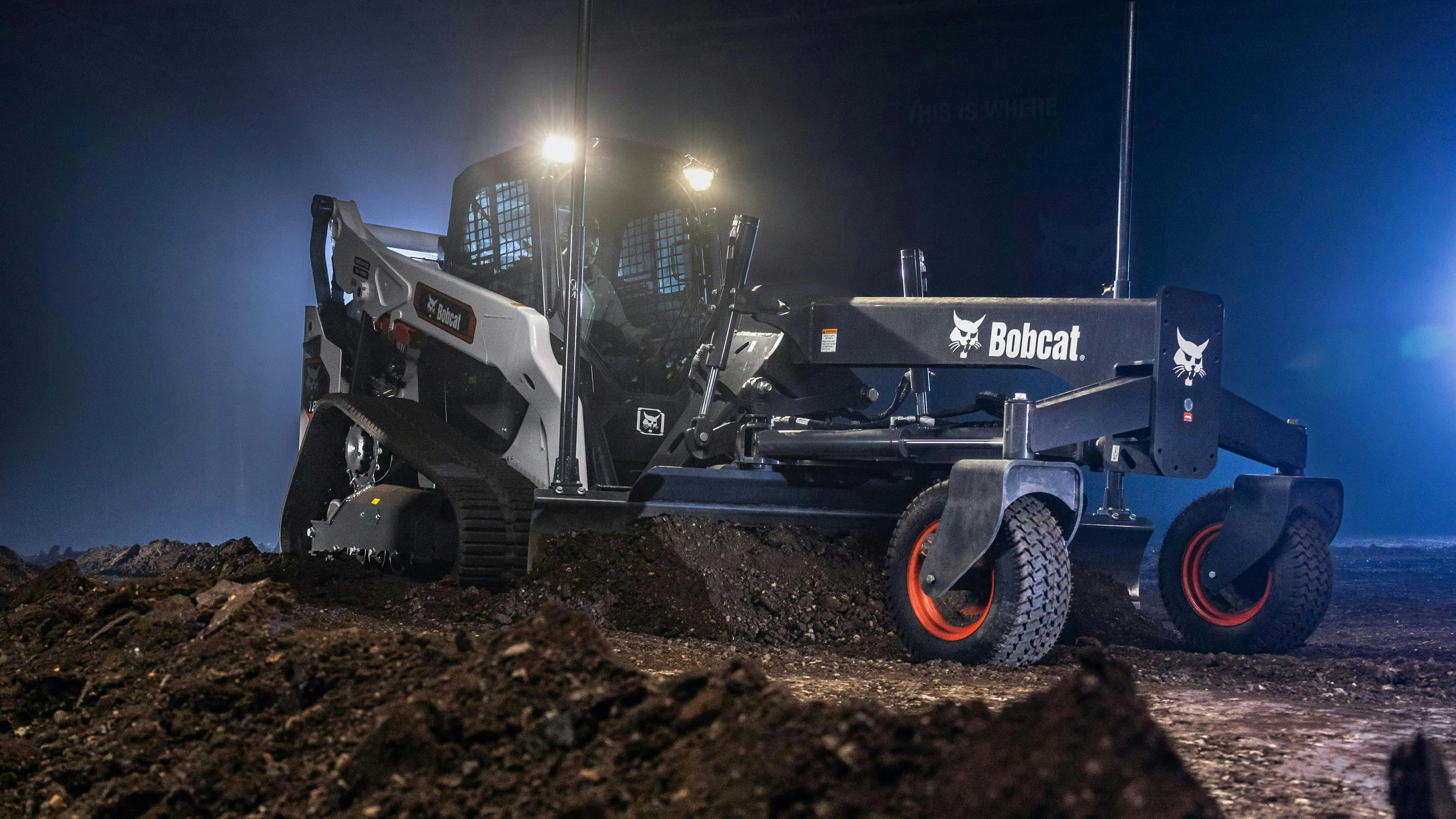
Where grade indicate technology fits best
This section was written by Eric Dahl, product manager at Bobcat.
Grade indicate systems are designed to help operators maintain target depth and slope without the complexity and cost associated with full machine control systems or 3D grade control systems. Rather than automating machine movement, these operator-assist technologies provide real-time feedback that helps operators make more informed digging decisions while remaining in full control of the machine.
These systems tend to deliver the greatest value in applications where depth and slope accuracy are critical, work is repetitive, and crews need to increase efficiency while improving accuracy. Utility trenching, drainage installation, residential foundations, and commercial site preparation are common examples where operators can benefit from reduced manual grade checks and more consistent, accurate results.
For many compact excavator applications, 2D grade indicate systems provide a practical balance of simplicity, cost, and performance. They typically require minimal setup and help operators maintain grade through a selected benchmark or laser reference. By comparison, many full machine control and 3D grade control systems use GNSS/GPS positioning and digital terrain models, making them better suited for larger projects involving complex contours, multiple elevations, and survey-driven workflows.
Ultimately, selecting the right solution comes down to matching the technology to the machine, application, and level of precision required. Understanding the differences between grade indicate systems and full machine control or 3D grade control systems helps contractors invest in the level of technology that best supports their work.
Weighing the purchase: 2D and 3D machine control
This section was written by Kevin Scotese, head of precision sales at CNH Construction.
2D and 3D machine control technologies have transformed the way earthmoving equipment operates, allowing contractors to complete projects faster, more accurately, and at a lower overall cost.
Knowing the fit
2D machine control is ideal for jobs requiring consistent depth, slope, or grade, such as trenching, foundations, utility installation, road preparation, and drainage work. Operators receive real-time guidance directly from the machine display, eliminating the need for constant grade checks and reducing the dependence on survey crews. This allows operators of all experience levels to achieve greater accuracy while minimizing over-excavation and material waste. No site setup, survey, or correction/satellite signal needed.
3D machine control builds upon these capabilities by utilizing GNSS positioning, digital site models, and real-time positioning to guide the machine anywhere on the jobsite. This makes it especially valuable for large-scale earthmoving, commercial site development, highway construction, land grading, mining, and infrastructure projects. Operators can work directly from digital design files, accurately placing material to final grade without stakes or grade hubs, resulting in fewer rework cycles and improved project coordination.
Holistic productivity is the payoff
The productivity gains of machine control are substantial. Contractors can move more material per day, reduce surveying costs, decrease fuel consumption, minimize wear on machines, and complete projects in fewer passes. Improved first-pass accuracy also enhances jobsite safety by reducing personnel exposure around operating equipment and minimizing unnecessary machine movement.
The return on investment is typically realized through labor savings, increased machine utilization, reduced material costs, and shorter project timelines — upward of 50 percent in time savings. Even a small reduction in rework or fuel consumption can generate significant savings over the life of the machine. For contractors facing labor shortages and increasing project demands, investing in 2D or 3D machine control provides a competitive advantage by delivering higher quality work, improving profitability, and enabling projects to be completed on schedule and within budget.
Machine control's next advantage: Putting excavation data to work
This section was written by Komatsu.
Excavator machine control has become an established way to improve digging accuracy, reduce grade checks, and help operators work more efficiently. But one of its most valuable capabilities often receives less attention: the data it generates while work is being completed.
Every bucket movement guided by a digital design creates as-built information that documents what was actually excavated. That data is extremely valuable and can help contractors be more productive and efficient, in the field and in the office.
When as-built data is incorporated into a digital project management platform, it can provide an up-to-date picture of progress without waiting for additional surveys or manually collecting information from the field. Project managers can compare completed work against the design, verify quantities, monitor production, and quickly generate reports using information that's already being captured during excavation. Some systems generate updates every hour.
This process also helps improve communication between the field and office. Everyone works from the same project information, enabling faster decisions when plans change or progress needs to be reviewed. As digital construction continues to evolve, the conversation is shifting from individual technologies to a more connected way of planning, building, and tracking projects — it's becoming a source of project knowledge that supports better decisions from groundbreaking through project completion.
Excavator grade control solutions
Excavator grade control keeps getting smarter, easier to use, and more available. Here’s a look at machine control solutions from a variety of technology and machine specialists.
Topcon MC-Max excavator grade control
The Topcon MC-Max 3D machine control system for excavators provides operators with an in-cab display of real-time bucket position and grade information. The combination of GNSS positioning and IMU sensors with proprietary algorithms allows MC-Max to track the boom, arm and bucket angles, resulting in accurate cut and fill data — without the need for time-consuming manual grade checking. When a tiltrotator is added to an excavator, it provides the ability to cut complex or connected slopes in a single pull and allows the excavator to cut and shape features that previously were left to other machines. MC-Max with slope control adds automation to tiltrotators, allowing the tool to automatically adjust to the slope during the pull — no matter the machine’s position — so that the grade is correct. For more info, visit Topcon’s website.
Liebherr and Leica grade control
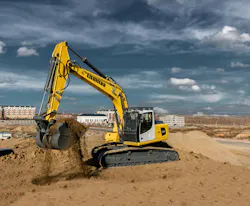
As grade control technology becomes an essential productivity and accuracy tool for civil construction and earthmoving contractors, Liebherr Generation 8 excavators are designed to keep operators ahead of the curve. Every Generation 8 excavator comes factory-equipped with the Leica 2D grade control system as standard, providing immediate access to precise excavation guidance without the need for aftermarket installation. For customers requiring advanced machine control capabilities, the system can be seamlessly upgraded to Leica 3D ready, full Leica 3D grade control, or Leica semi-automatic functionality, delivering greater precision, efficiency, and reduced rework on the jobsite. Recognizing that contractors may have existing technology preferences, Liebherr also offers factory-installed preparation kits that enable compatibility with alternative grade control manufacturers. This flexible approach allows customers to integrate the technology solution that best fits their fleet while benefiting from a clean, factory-integrated installation and the quality, reliability, and support expected from Liebherr. For more info, visit Liebherr’s website.
New Holland Construction SiteControl solutions
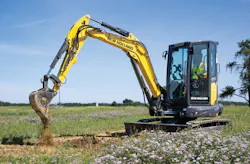
New Holland Construction’s SiteControl guidance by Hemisphere for mini and midi excavators provides owners and operators an added level of profitability, all while keeping safety, efficiency, and accuracy at the forefront of jobsite operations. The SiteControl laser and 2D solutions for New Holland Construction’s 4- to 5-metric-ton mini excavators (E42D and E50D) and 8- to 9-metric-ton (E85D) midi excavator classes, help increase jobsite safety by removing grade checks directly from the trench. The 2D solution offered by New Holland Construction is compatible with all makes and competitively priced at a fraction of the cost of traditional grade control solutions. Simplistic installation, fast calibration, and an easy-to-navigate software ecosystem make day-long precision operation a stress-free environment, even for novice operators. Basements, footers, foundations, and utilities are an easy match with SiteControl 2D, which may be upgraded to a 3D solution for greater precision and jobsite functionality. The SiteControl product offering is currently available at New Holland Construction dealers, while the factory grade control systems will begin arriving in 2027. For more info, visit New Holland Construction’s website.
John Deere grade control options
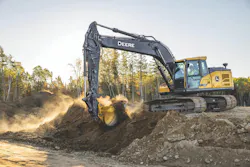
John Deere offers a range of grade control solutions across its excavator lineup designed to help operators improve accuracy, productivity, and ease of operation on the jobsite. Depending on the machine and application, customers can take advantage of 2D grade control capabilities or more advanced 3D solutions. The new P-Tier midsize excavators feature John Deere 2D grade control, including a new auto laser catch feature that automatically assists the operator when the machine’s laser catcher breaks the plane of a rotating jobsite laser. This eliminates the need to stop and press a joystick button to maintain a vertical reference, improving productivity and ease of use. For customers requiring more advanced capabilities, the 2D system can be upgraded to optional 3D SmartGrade with either Topcon or Leica, providing flexibility to match specific jobsite and grading needs. These flexible technology offerings allow customers to select the level of grade control that best matches their operation, application, and jobsite needs. For more info, visit John Deere's website.
Komatsu Smart Construction
A pioneer in grade control, Komatsu offers two excavator solutions that help contractors reduce grade checks, minimize over-excavation, and complete precise excavation faster. For new machines, Komatsu intelligent machine control (IMC) excavators feature factory-integrated hardware and software to provide semi-automatic operation, enabling operators of all skill levels to excavate efficiently to design without over-digging. Smart Construction 3D Machine Guidance is a retrofit solution that provides precise real-time bucket position via an in-cab tablet, bringing digital grade guidance to excavators of virtually any brand — great for mixed fleets, legacy excavators, or contractors seeking a lower-cost entry point. Both solutions use the same connected digital workflow. Design files can be pushed wirelessly to the machine, while as-built data is automatically captured and can be shared with Smart Construction Dashboard to provide progress tracking, proof of completed work, and fast reporting throughout the project. For more info, visit Komatsu’s website.
Bobcat Depth Check
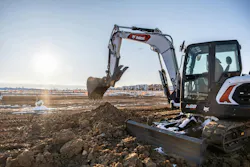
Bobcat's Depth Check system helps compact excavator operators efficiently achieve target depth, grade, and slope while reducing the need for repeated manual grade checks. Using sensors mounted on the boom, arm, bucket linkage, and house, the system continuously tracks bucket position and displays real-time digging information on the integrated 7-inch touchscreen display. Visual and audible alerts notify operators as they approach, reach, or exceed a preset target, helping reduce over- and under-digging without leaving the cab. Recent enhancements expand the system's capabilities beyond basic depth indication. Built-in slope functionality helps operators create finished grades for applications such as sewage installation, septic installation, non-pressurized water lines, landscape finish grading, and concrete slab preparation. Machine level indicators provide visibility to excavator pitch and roll during grading work, while automatic benchmarking with an optional laser receiver helps maximize operator speed and efficiency on large or irregular projects requiring high precision. Depth Check can also be used with a variety of attachments, including augers, trenchers, and plate compactors, extending grading awareness and measurement capabilities across multiple excavation applications. For more info, visit Bobcat’s website.
Volvo Active Control
Imagine pulling back on a single joystick and watching your excavator automatically carve a flawless slope with centimeter-level precision. That’s the reality of Volvo Active Control, a factory-integrated, steer-by-wire system that takes the manual muscle memory out of finish grading. Instead of requiring an operator to constantly micro-adjust the boom, arm, and bucket angles simultaneously, this technology automates the heavy lifting. Once the operator sets the target grade on the in-cab Volvo Co-Pilot display, the system automatically manages the boom and bucket cylinders. The operator only needs to control the arm’s retraction speed. This automation cuts grading times by up to 45 percent. It also features customizable boundaries — like depth and swing limits — to prevent utility strikes or overhead contacts, ensuring high-speed accuracy remains completely safe. For more info, visit Volvo Construction Equipment’s website.
Develon grade control for excavators
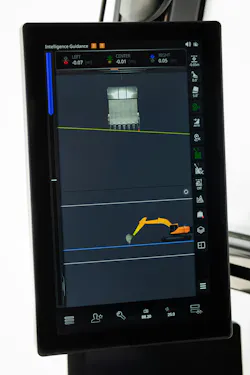
New Develon -9 Series heavy excavators — launched earlier this year at Conexpo — deliver high-precision jobsite performance with factory-integrated 2D machine guidance and machine control technology. Built directly into the excavator’s architecture, these smart solutions simplify complex earthmoving tasks, enabling operators to achieve accurate results faster while dramatically reducing jobsite operational expenses. Key operational advantages:
Accuracy: Real-time bucket positioning and automated grade assistance eliminate over-excavation, ensuring exact target grades on every pass without guesswork.
Boosted efficiency: Intuitive guidance features minimize operator fatigue and reduce reliance on manual grade checkers, allowing your crew to accomplish more work in significantly less time.
Lower operating costs: Faster cycle completion cuts fuel consumption and equipment wear, directly improving project margins and overall site profitability.
Whether digging trenches, shaping complex slopes, or grading foundations, the Develon factory-designed grade control systems transform demanding operations into simple, highly productive routines. For more info, visit Develon’s website.
Case 2D and 3D guidance
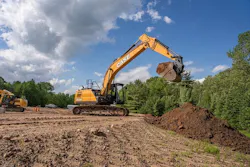
Case Machine Control, which entails 2D and 3D machine control, is one of the most comprehensive precision construction product offerings in the industry. All solutions are factory supported and range from basic lasers to 2D and 3D machine control solutions powered by Hemisphere. The proprietary precision positioning offering that is part of the Case Machine Control portfolio includes 2D guidance, 2D automation, 3D guidance, and 3D automation powered by Hemisphere. The Case Machine Control offering is built to improve site efficiency, lower manpower requirements, and increase profitability for fleet owners and their operators. For more info, visit Case Construction Equipment’s website.
Buy productive hours, not just a machine
This section was written by Christopher Watts, marketing and PR at LiuGong North America.
Buying heavy equipment is often reduced to horsepower, operating weight, features, and purchase price. Those numbers matter, but they do not tell the whole story.
The better question is: What will this machine actually do for my business?
Start with utilization. A machine matched to its primary application will generally outperform a more powerful machine that spends its time waiting, idling, or working outside its ideal operating range. Consider the jobs you perform most often, site conditions, attachment requirements, transportation limitations, and operator experience.
Then calculate the real cost of ownership. Fuel or energy, maintenance, financing, insurance, transportation, parts, and resale value all matter. But there is one cost buyers often underestimate: downtime.
Here is the thing I recommend every buyer ask before signing a purchase order: Show me what happens when this machine breaks on a Tuesday morning.
Who answers the phone? Where are the parts? How quickly can a technician respond? How does a warranty work? What happens if the repair takes three days instead of three hours?
A $300,000 machine that stays productive may generate considerably more value than a $250,000 machine that spends days waiting for parts, service, or a warranty decision. The purchase price happens once. Downtime compounds. Ultimately, you’re not really buying an excavator, loader, forklift, or dozer. You’re buying productive hours. The smartest equipment purchase is the machine whose capability, operating cost, and support network maximize those hours with the least cost.

About the Author
Keith Gribbins
Keith Gribbins is the head of content at Construction Equipment, where he leads editorial strategy across print, digital, video, and social channels. An award-winning journalist with more than 20 years of experience, Keith has won 17 national and regional editorial awards and is known for his hands-on reporting style, regularly visiting manufacturers, operating equipment, and covering major industry events worldwide.