Contractor Embraces Grade Control, GNSS for Precision Work
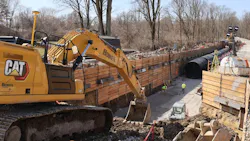
It doesn't matter when you come to the party on grade control, the important thing is that you get there.
I've heard dozens of stories of companies making calculations, using stakes, grade-checkers and the like, only to have the proverbial light bulb go on after a visit from a tech provider or OEM, the subsequent demo, and a little practice.
The rewards are many, from precision to less rework to safety to reducing costs.
They go from light bulb to floodlight.
Take Indianapolis-based Bowen Engineering, a municipal and industrial contractor specializing in essential water, wastewater, industrial and energy facilities, Bowen self-performs about 80% of its work.
That can mean a lot of pressure — there are fewer subs to blame if something goes wrong. Things have to be right.
Fifteen years ago, the firm did not have a long-term commitment to technology, but it realized it needed a digital transformation focused on connecting field operations to boost safety, productivity, and data management.
First, it tried GNSS (Global Navigation Satellite System) for surveying, which naturally evolved into GNSS-guided heavy equipment. Through its partnership with SITECH of Indiana, Bowen tested Trimble GCS900 grade control systems, leading to a broader adoption of the Trimble Earthworks grade control platform with Trimble Business Center (TBC) software.
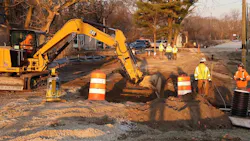
Hi tech, welcome to the fleet
Today, Bowen operates 14 GNSS-enabled machines. The results have been a hit with their operators, who appreciate how the technology helps them complete tasks with accuracy and minimal rework. As one operator noted, the technology has been particularly beneficial for digging pipe trenches, allowing him to stay on elevation and produce a consistent, level dig.
On a recent 80-acre project in Glendale, Kentucky, Bowen used TBC to elevate linework and create design models for their machines, a process that streamlined the creation of subgrade and finished grade models for drainage and roads.
The team also used a drone to conduct a topographic survey, inputting the data into TBC to discover they could redirect extra dirt spoils rather than hauling them offsite.
Need a drone survey? There's a drones on demand service
This simple data management move resulted in considerable cost savings for both Bowen and the project owner.
Similarly, for an underground water storage project in Lafayette, Indiana, the technology was critical. The job required excavating a 30,000-cubic-yard conical tank base with a 22,000-square-foot bottom. With grade control, the crew achieved a perfect 1.5:1 side slope and a precise 2% grade on the tank bottom.
Set the Wayback machine and explore a horse-drawn grader
The adoption of grade control systems has not only improved project outcomes but also energized Bowen’s workforce. According to Scott Heinzelman, a survey controls engineer with Bowen, this technology gives the company a competitive edge in today's challenging labor market by enabling a high level of efficiency and quality in the field.
The GNSS-enabled equipment also created a safer work environment by eliminating the need for someone to constantly check grades on dangerous slopes. The technology's ability to save crew time on both grading and backfilling has been a significant win.
"The digital data generated by these machines also provides added value to partners, strengthening relationships and helping Bowen assemble the best teams for any project," Heinzelman says.
About the Author
 Frank Raczon
Frank Raczon
Frank Raczon has influenced and covered the equipment industry for 35 years, including 15 years as senior editor of Construction Equipment, and marketing, advertising, and public relations work for the industry's top manufacturers. He authored "Caterpillar: Modern Earthmoving Marvels" (Motorbooks, 2015), and has won numerous awards in his career, highlighted by nods from the Construction Writers Association, the Association of Equipment Manufacturers, the Business Marketing Association, and BtoB magazine. Raczon has also won awards from publishing peer groups such as ASBPE and TABPI.