Trimble Looks Into Its Crystal Ball
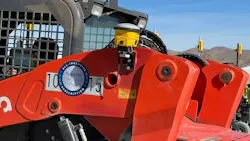
You know Trimble primarily for how its technology helps you with GPS, machine control, and grading. Perhaps you use its job planning and financial software as well.
But the company touches far, far more than the dirt universe. There is geospatial, marine, government, utilities, and more, which make it well qualified to give insight on trends and business conditions going foward.
As part of its 2027 industry outlook and just before its Dimensions trade show (Las Vegas, November 8-11), the company is out with comments on the jobsite of the future and AI, construction's new infrastructure, hybrid skill development, and tech for small- and medium-sized contractors. Let's take a look at some highlights.
The jobsite of the future
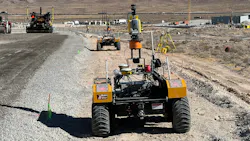
Elwyn McLachlan, VP, civil construction product & strategy for Trimble says intelligent automation, field robotics, and physical AI will drive efficiency for the jobsite of the future.
"We will continue to see the evolution of the jobsite driven by advancements in automation and robotics, with physical AI providing the spatial data that enables humans and machines to work safely together in real-world environments," McLachlan says.
Autonomous equipment creeps closer to conventional jobsites
"Expect to see advancements in autonomy move beyond machine-level automation to site-level automation, with human-operated and autonomous machines working side-by-side. Watch for advancements in AI to continue to deliver enhanced intelligence that allows machines to react to unforeseen obstacles and changing site dynamics quickly and easily."
McLachlan says that the combination of better-connected, more autonomous jobsites together with the power of AI will make it easier for site superintendents to adjust to everything from equipment issues to bad weather on the fly, which means more efficient and more profitable jobsites.
The new infrastructure depends on connection
"The construction sector is undergoing a shift in infrastructure construction as expectations and requirements continue to change," says Scott Crozier, Trimble's SVP, civil construction.
"The rapid growth of AI is driving investment in data centers, fiber networks, renewable energy, and next-generation nuclear power, while infrastructure needs are growing and changing, requiring better technology for long-overdue repairs to aging roads, bridges, and other infrastructure assets," Crozier says.
"Contractors will increasingly rely on connected digital processes for real-time visibility, collaboration, and data sharing and analysis to improve efficiency and productivity, protect already-thin margins,and keep complex projects on track."
Tech for small- and medium-sized contractors
It's going to increasingly level the playing field, according to Trimble SVP for construction management solutions Lawrence Smith.
"The technology gap between large and small contractors will continue to narrow as connected solutions, subscription pricing, and intuitive, mobile-first applications make enterprise-level capabilities more accessible," Smith says.
"In the past, high-tech tools like high-precision GNSS, drone mapping, and laser scanning — as well as machine guidance and sophisticated project estimating, operations, and management — were often too complex and cost-prohibitive for most smaller businesses," he says.
"Today, these technologies are highly intuitive, accessible, and built specifically for smaller contractors."
Smith says subscription-based purchasing models will continue to replace large upfront technology investments, making the cash flow and ROI equation more favorable for smaller contractors.
"This can range from specialized construction financial and accounting platforms to field-focused project management systems tailored for growing SMB contractors, helping them adopt connected capabilities incrementally, paying only for what they need as their businesses grow.
"This broader accessibility will have important implications for the industry," Smith says. "Smaller contractors will be able to grow faster and complete larger, more complex projects with access to similar levels of operational technology and visibility, financial control, and connected processes that larger contractors deploy."
Hybrid skill development and tech integration
These will reshape the construction workforce, says Ian Warner, director of industry workforce and innovation for Trimble.
"The construction industry’s labor shortage and skills gap challenges are pushing construction companies to completely revamp their approach," Warner says.
"To attract new talent, they will increasingly position jobs around cutting-edge technology, such as operating autonomous equipment, incorporating AI agents, supervising automated geomatics capture, and using augmented reality for site layout as they move away from traditional recruitment channels to partner directly with tech academies, career technical educational pipelines, and universities."
At the same time, Warner thinks companies will rely on AI-guided training and immersive virtual reality simulations to upskill current workers, shortening the time required to master complex machinery and modern assembly techniques.
Dozer machine control: What contractors need to know
"Ultimately, technology integration will be the primary strategic imperative for companies to maintain capacity and deliver projects on schedule," Warner says.
Watch this space for our coverage of Trimble Dimensions.
About the Author
 Frank Raczon
Frank Raczon
Frank Raczon has covered and influenced the equipment industry for 35 years, including 15 years as senior editor of Construction Equipment, and marketing, advertising, and public relations work with the industry's top manufacturers. In addition to authoring "Caterpillar: Modern Earthmoving Marvels" (Motorbooks, 2015), he has won numerous awards in his career, highlighted by nods from the Construction Writers Association, the Association of Equipment Manufacturers, the Business Marketing Association, and BtoB magazine. Raczon has also won a number of awards from publishing peer groups such as ASBPE and TABPI.