Dozer Machine Control: What Contractors Need to Know in 2026
Key Highlights
- 2D and 3D have different jobs. 2D remains common on smaller dozers and simpler grading work, while 3D is increasingly found on midsize machines and more complex projects.
- Machine control is becoming standard equipment. Contractors increasingly expect grade technology on dozers, especially as machines move into more precise applications.
- There’s lots more, but you can’t be lazy. Factory systems, aftermarket options, APIs, GNSS, remote support, Proactive Dozing... c’mon, just go read the article already. It’s all below.
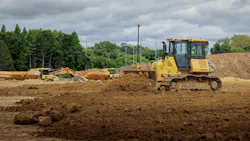
Dozers were perhaps the first machines to benefit from machine control. They were simpler to configure than an excavator or motor grader. They’re still comparatively simple machines with comparatively simple machine control, but there are things worth noting.
The shift to mastless machine control
For one, the shift to mastless is nearly complete. There are legacy models still toiling away with prominent masts clearly visible and occasionally a new machine comes off the dealer’s lot sporting masts, but the dozer market has become predominantly mastless. Manufacturers offer multiple levels of machine control, from simple indicate systems to 2D (slope) and 3D (slope with elevation) GNSS systems. Going from indicate to 2D or 3D is a big jump as indicate has almost none of the sensors and communication components required for those. Bridging from 2D to 3D still requires additional hardware but is more direct than trying to elevate an indicate system to either GNSS mode.
Who needs 2D and 3D machine control?
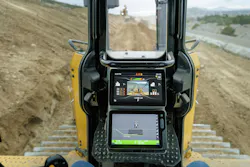
Who needs it? The only market that can exist happily without machine control is probably mass excavation. 2D is more common on small dozers; 3D more common on midsize machines. The acquisition cost is scaled to the host machine and the applications for which those machines will likely be used. Some projects use both. Subdivision streets are done with 3D but building lots can be levelled with 2D.
As with most equipment, rental heavily influences OEMs’ design and marketing efforts. Beyond that, the rental market is a good way for smaller contractors to get equipment with a known history of regular service for much less than buying the same machine new. Ideally that machine has on it the machine control features the customers want; if not, aftermarket systems are widely available.
As-built data becomes a requirement
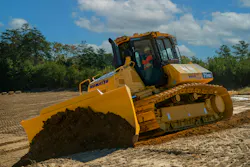
“As-built” has crept into almost every contract recently, and everyone benefits. The contractor has a record of material moved, number of passes, and a host of other performance data. The customer gets documentation of how the work actually turned out, not merely the contractor’s assurance that they met spec. As-built also logs change orders, the causes and consequences, which can otherwise be immense headaches for the contractor. Many customers, especially government agencies and customers receiving government funding, require as-built files. When properly configured, GNSS machine control can automatically gather all this information and output it in the preferred file format.
Key technology allowing all this to happen rests on two primary points. The first is XML (eXtensible Markup Language), which provides the architecture for data exchange. The second is API (application programming interface), a standardized way for software systems to communicate with each other. There is no single XML or API, but rather many of each designed to work within certain parameters.
The challenge of reference networks
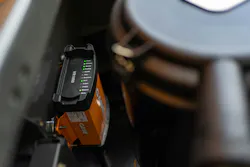
Europe’s NTRIP is the envy of every American contractor. Reference networks do exist in the U.S. but tend to be in urban settings. Customers at rural worksites find the tiny errors at the source multiply over the miles to create unacceptably low levels of accuracy. Let’s move on to key insights from specific OEMs.
Non-GNSS
A host of systems do not rely on GNSS. These include robotic total stations, rotating lasers, LiDAR, machine kinematics, and others. These are generally established technology and are not covered in this article, which is focused on the current state of tech.
Case Construction Equipment
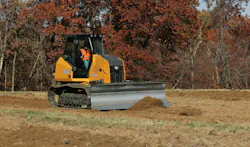
Rob Maybry, leader of product management for construction digital solutions at CNH, says 3D machine control in midsize dozers has grown significantly. “CNH is preparing to launch a proprietary 3D machine control system factory-installed, marking a significant expansion in the company’s precision technology strategy.”
“Smaller contractors typically place a higher priority on affordability, driven by both budget considerations and established purchasing habits.” He says CNH is intent on lowering the barriers to adoption of technology while also educating customers about the benefits technology provides.
He says compliance with ISO 15143 is assured as CNH scrutinizes the XML and API requirements to do so. “It’s an area in which CNH has extensive skill and experience,” Maybry says, “since agriculture has around 40 API solutions and CNH has a major presence in the ag market.”
Maybry says subscription-based 2D and 3D machine control offerings could provide rental customers with flexible, on-demand access to precision technology. Rather than making a substantial upfront investment, contractors would be able to use machine control when project requirements justify it, creating a more accessible path to technology adoption.
John Deere
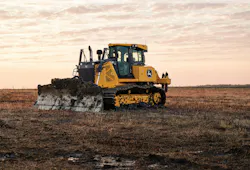
SmartGrade was launched on a 700K dozer in 2016 and continues to evolve. The current iteration has a larger, more responsive monitor that can display 2D and 3D at the same time.
Deere has nine dozers, eight of which are P-Tier. There is also the 850 X-Tier E-Drive, but no G-Tier models. All accept SmartGrade. EZ Grade comes standard on all small- and midsize dozers and uses sensors on the chassis and D-frame to provide pitch and roll information. John Deere 2D SmartGrade Ready offers simple slope control and compatibility with laser and sonic systems. It also accepts total station robotic control to achieve millimeter accuracy.
3D SmartGrade has become very popular, says Mark Colvin, senior product manager, grade management. “It’s rare to see a site now with a dozer that is not equipped with it, and if several dozers are on site at least one will have 3D.” He says the utilization rate is high for 3D on dozers equipped with that feature.
John Deere Operations Center includes machine data but also tracks progress from GNSS data. It allows fleet managers to see how many dozers are on site, how many are equipped with SmartGrade and of those, how many are using SmartGrade at a given time. There is an RDA (remote display access) feature so that a technology specialist can see the dozer display in real time, as well as RDC (remote display control) allowing a tech spec to take control of the monitor. Operations Center communicates via a phone, tablet, or other wireless device.
Komatsu
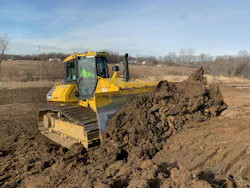
Komatsu first offered factory-integrated, fully automatic blade control on a dozer with the introduction of the D61i-23 in 2013. Today, Komatsu has 11 “i” models in its 37-model online dozer lineup, from the D39EXi-24 to the D71PXi-24, the “i” indicating a factory-integrated machine control system. At Conexpo 2026 they introduced the D61PXi-25 as a replacement for the D61PXi-24 and the D175AX-10, the first of Komatsu’s next generation of dozers.
Ron Schwieters, senior manager, customer solutions, says Komatsu Smart Construction Remote provides three essential features for using machine control with dozers: remote file transfer, support, and machine locate on a map interface. “Smart Construction Remote provides a fast, convenient way to ensure all operators are working from current design files while also allowing them to get prompt assistance from experts when they encounter an issue without those experts having to be on site.”
Mike Nixon, senior manager, customer solutions, says Komatsu Proactive Dozing allows operators to use machine control 100 percent of the time.
“Typically, operators run the dozer manually until they approach finish grade, then switch on machine control,” he says. “Proactive Dozing learns as it goes so it can be used from the first pass to the last, always making refinements based on the work that’s already been done.”
The current iteration is v 2.0; Proactive Dozing 3.0 debuted on the new D61PXi-25 at Conexpo 2026.
Topcon
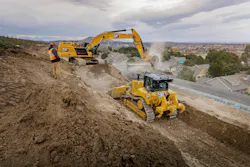
Nick Martin, sales director, Topcon says that while factory-integrated proprietary machine control systems are good, “third-party systems such as those available from Topcon are more robust, configurable, and transferable.” They’re also scalable, as Topcon has a full catalog of machine control systems so customers aren’t hemmed in by limited choices. The argument exists that OEM systems are better integrated with OEM machines. Martin says Topcon goes to great lengths to ensure their systems are fully functional with the equipment with which they’re paired, regardless of configuration.
“We’ve been out with our engineers doing testing in real-life jobsite environments, so that we can ensure that this machine in this configuration with this Topcon configuration will perform optimally,” says Martin.
Topcon has a select group of beta testers to help ensure objectivity in this process. Topcon is a leader in mastless technology, often developing the necessary hardware.
“To go mastless successfully you needed IMUs [inertial measurement units] that would include the kinematics of the dozer in determining the position of the blade in a system that was ruggedized to meet the demands of the construction environment,” explains Martin. “Often those pieces were not already in the marketplace, so in many cases we had to develop not just the machine control system but also the individual components for that system.”
ISO 15143 compatibility
Since published in July 2010, ISO 15143 has undergone a number of refinements to further facilitate the sharing of information and data on construction sites. Machine control systems are intended to integrate seamlessly with ISO 15143, which can add another layer of complexity to their design and implementation.
About the Author
 Richard Ries
Richard Ries
Richard Ries began his free lance journalism career in June, 1985, calling on his experience as a service manager at a Honda motorcycle dealership to place his first article. When the motorcycle market collapsed in the late 1980s, he moved to the booming bicycle market. Finding that market lacked the professionalism he sought, he moved to construction in 1995 and has remained there ever since.
His countless clients have included entities in Australia, England, France, Germany and Scotland. He has written for trade and consumer periodicals, equipment and component manufacturers, government agencies and non-governmental organizations. Clients have also commissioned him for photography and videography work, either stand-alone or as part of package of text and images.