Who's on Top? The Latest OEM Electrification Rankings
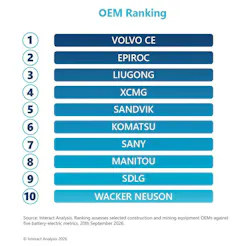
The UK research firm Interact Analysis is back with the latest worldwide research on construction OEMs and electrification, and this one ranks which firms are leading the category.
Who's number one?
Ask yourself, "Which manufacturer has hyped electrification the most?" and you'll have the answer.
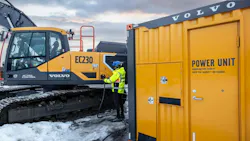
It's not quite that simple. Yes, Volvo Construction Equipment (Volvo CE) backs it up with an impressive number of models across four machine categories, including a 23-ton medium excavator, the EC230 (pictured above getting juiced up), and forthcoming ADTs. But there's more.
"For the first time, we've built a framework to assess, in an unbiased way, the companies that are the leading OEMs in off-highway electrification," says Chloe Mason, market analyst for Interact.
Electric metrics
Each OEM was assessed against five core metrics:
- Electric portfolio breadth; measured by the number of commercially available electric models relative to the OEM’s overall off-highway portfolio.
- Battery-electric unit sales in 2025.
- The presence and strength of a measurable electrification target (i.e. has the OEM committed to a target).
- In-house powertrain capabilities, including making their own battery packs, motors, inverters, and overall system integration.
- Infrastructure provision, including fixed chargers, mobile charging energy solutions, and supporting services.
China leads in scale
If leadership were determined purely by unit sales, Chinese OEMs would dominate the ranking. Liugong, XCMG, Sany and SDLG can be viewed as ‘scale leaders,' Mason says.
Their positions are supported by large electric portfolios, strong domestic adoption in China, and high production volumes. For these companies, electrification is arguably less a future target and more a structural feature of the Chinese market.
Volvo CE ranks as the overall leader because it combines strategic commitment, product breadth, and ecosystem capabilities, according to Mason.
Electric equipment users weigh in
"Its approach extends beyond electric machines in construction and roadbuilding applications to include charging solutions, and has set a clear target of 35% of machines sold to be fully electric by 2030."
This combination of machines, infrastructure, and measurable commitment gives Volvo greater ability to influence how customers adopt electrification.
Mason describes another group as "specialist leaders" — Wacker Neuson was an early electrification pioneer and continues to score well for the proportion of its portfolio that is electric, although it has not maintained the same momentum as some newer leaders.
"Just missing the top 10 ranking, FirstGreen gets a special mention for having an entirely electric product portfolio, despite its model range being limited to compact loaders," Mason says.
There are a limited number of pure-electric OEMs such as FirstGreen, leaving room for other short-line specialists to differentiate themselves by being electric only.
Who the heck is Avant Tecno?
Mason also mentions that Epiroc and Sandvik have built significant expertise around electrification in underground mining applications, where charging, energy management, and machine integration are particularly important.
We don't see the machines, but they're down there.
"Their experience highlights that electrification leadership is not simply about the number of electric models offered, but also the ability to integrate those machines into the wider operating environment," Mason says.
Notably missing from the rankings are our ubiquitous North American brands, Caterpillar and John Deere. When contractor acceptance of EVs improves here, if it ever does, you can bet they will be quick to catch up.
The fine print
The benchmark assessed 28 construction and mining OEMs with commercially available electric machinery across a global scope. The analysis covered excavators, wheel loaders, telehandlers, road-building equipment, underground mining machines, haul trucks, and articulated dump trucks.
Product availability was assessed as of 20 September 2026. The five benchmark metrics were weighted equally. Qualitative indicators, such as target strength, were assessed based on their measurability, timeframe, and level of ambition.
The 2025 unit sales combine publicly reported results with Interact Analysis’ estimates where OEM-level figures were not available. Data were available for all vendors across all five benchmark metrics, so no unavailable data required adjustment.
About the Author
 Frank Raczon
Frank Raczon
Frank Raczon has covered and influenced the equipment industry for 35 years, including 15 years as senior editor of Construction Equipment, and marketing, advertising, and public relations work with the industry's top manufacturers. In addition to authoring "Caterpillar: Modern Earthmoving Marvels" (Motorbooks, 2015), he has won numerous awards in his career, highlighted by nods from the Construction Writers Association, the Association of Equipment Manufacturers, the Business Marketing Association, and BtoB magazine. Raczon has also won a number of awards from publishing peer groups such as ASBPE and TABPI.