Avant Tecno Brings Its Biggest Electric Articulated Loader Yet to America
Key Highlights
- Big ole electric option: The Avant e727 brings a 27-kWh battery and approximately 3,000 pounds of lift capacity to the company's popular 700 Series platform.
- Built for attachment work: A new electric powertrain, Autoshift, and dedicated auxiliary hydraulics target landscaping, construction, snow removal, and material handling.
- SAL category keeps growing: The e727 arrives as compact articulated loaders continue expanding beyond Europe and gaining traction with North American contractors.
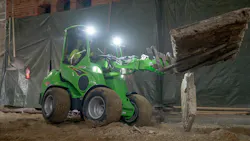
Electrification is ideal for compact construction equipment. Categories like mini excavators, compact wheel loaders, and stand-on tool carriers are prime candidates for battery power because of their size, duty cycles, and tendency to work in urban settings. Small articulated loaders are also an emerging sub-category of wheel loaders that seem fit for electrification. These machines are some of the smallest sit-down tool carriers on the market — engineered with a seat and usually a ROPS, four tires, an articulating frame, and the ability to take attachments (often using a universal skid steer/compact track loader quick-attach system).
Let me point you to Avant Tecno USA’s latest launch. The company has officially introduced the e727, a fully electric small articulated loader designed for the North American market. The new model slots into Avant’s popular 700 Series, replacing diesel power with a 27-kWh battery. From the press release:
“Bringing a fully electric, sustainable loader that’s as powerful and reliable as our diesel models to the U.S. market has been a long time coming,” said Beau Slavens, president of Avant Tecno USA. “The e727’s advanced features, like the Autoshift and its enhanced powertrain, allow operators to enjoy the same power and performance they expect from Avant machines, but with the added benefits of lower noise and environmental impact.”
Why go electric?
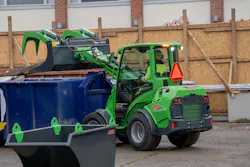
Battery-powered compact equipment continues to gain momentum in applications where low noise, zero tailpipe emissions, reduced exhaust odors, and lower operating costs outweigh the need for all-day, high production work. Compact equipment often works in urban areas with start/stop production cycles where the operator jumps off the machine to perform other tasks. Runtime is not the problem. The challenges are price (it’s expensive) and charging infrastructure (both availability and charging time).
A closer look at the e727
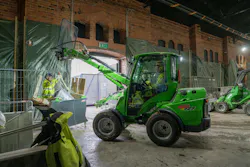
The e727 looks just like any other Avant 700 Series loader. Under the hood, power comes from a 27-kWh Avant OptiTemp lithium-ion battery, built by Avant Power, which is the company’s battery manufacturing division. The same battery is used in Avant’s other more compact e527 electric model. The battery powers a new drivetrain featuring a single electric motor, a variable-displacement drive pump, and two dedicated auxiliary hydraulic pumps. The loader offers approximately 3,000 pounds of lift capacity and a lift height just over 10 feet. I could see this unit spearheading indoor pallet handling, loading trucks at a zoo, snow removal around a hospital, or any type of attachment-intensive work where emissions or noise are a factor. Travel speeds top off at 8.7 mph.
One of the most interesting technologies on this unit is the Autoshift. Instead of requiring the operator to manually choose between low and high range, the system automatically shifts based on machine demands. That’s kind of cool. The machine also features a two-speed drive system, hydrostatic four-wheel drive, and the same articulated steering geometry that has made Avant loaders popular in everything from tree care to agriculture.
Avant Tecno e727 key specs
- 27-kWh Avant OptiTemp lithium-ion battery
- Approximately 3,000-pound lift capacity
- Lift height of just over 10 feet
- Single electric drive motor
- Variable-displacement hydraulic drive pump
- Two auxiliary hydraulic pumps
- Automatic Autoshift transmission management
- Two-speed hydrostatic drive
- Quiet, zero-emission operation
- Compatibility with Avant's extensive attachment lineup
Why compact articulated loaders keep growing
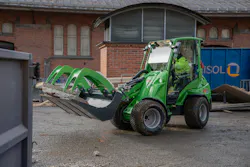
The e727 also lands at an interesting point in the evolution of American compact equipment. For decades, American contractors largely chose between skid steers and compact track loaders for their small loader needs. Meanwhile, European manufacturers like Avant Tecno, which originated in Finland, spent decades refining these small articulated loaders or SALs before bringing them to North America. Now loads of American brands offer them today — Vermeer, Case, New Holland, Bobcat — often via OEM agreements.
One of their biggest advantages is articulation. Instead of skidding across the ground while turning, articulated loaders pivot in the middle. The rear tires follow nearly the same path as the front tires, reducing turf disturbance, tire wear, and rolling resistance. SALs are more approachable for new operators. They feature a steering wheel and pedals, easy step-through entries, and excellent visibility. Attachment versatility is another selling point. Small articulated loaders can power buckets, pallet forks, augers, trenchers, sweepers, snowblowers, and ever onward. Plus, they’re fast. Top speeds can range from 8 to over 20 mph.
Electrification also happens to fit the SAL market particularly well. Many small articulated loader applications involve short travel distances, frequent stops, and hydraulic attachment work instead of continuous heavy digging. That operating profile favors battery-electric equipment, which makes both the e727 and e527 interesting options in the SAL market. Maybe it’s time to go give one a try. And if those don't work, consider Avant offers one of the broadest small articulated loader portfolios in North America. They probably have something you'd like.
About the Author
Keith Gribbins
Keith Gribbins is the head of content at Construction Equipment, where he leads editorial strategy across print, digital, video, and social channels. An award-winning journalist with more than 20 years of experience, Keith has won 17 national and regional editorial awards and is known for his hands-on reporting style, regularly visiting manufacturers, operating equipment, and covering major industry events worldwide.