Research Shows Mixed Bag on EVs With China Ahead
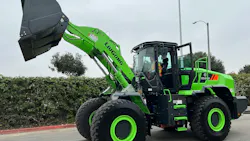
If you thought electric equipment is a bigger deal overseas than it is in North America, as the famous TV sidekick Ed McMahon used to say, "You are correct, sir!"
This is despite our inboxes here at Construction Equipment filling up with news releases and promotion on electric equipment, components, and predictions for the future.
All the major OEMs are in on the act, especially Volvo and Case. Caterpillar and Komatsu are participating, but seem more cautious. From the rest, we've seen mostly compact excavators, smaller MEWPs (particularly scissors), walk-behinds, and prototypes. There are also a number of rollers. ADTs are also on the horizon.
A new study from Interact Analysis confirms suspicions on where the action is, and isn't.
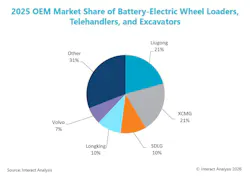
Rating the electric players
"The Chinese wheel loader market is experiencing a particularly rapid shift toward electric powertrains, while the U.S. construction equipment market is practically at a standstill," said Chloe Mason, market analyst for the firm.
Chinese OEMs are leading the global battery-electric machinery market because of the Chinese demand for electrified machinery. They are also making a strategic increase in exports to Europe and other markets, according to the report.
In excavators, Volvo stands out as the clear global leader in battery-electric models, particularly within Europe. However, this leadership exists within a small and relatively slow growth market.
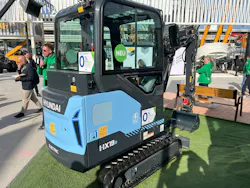
Electric excavator adoption remains largely confined to mini-excavators, and 2025 has seen flat to declining production across most OEMs, Interact Analysis reported (Volvo being a notable exception).
Volvo begins production of electric ADTs
"Competing offerings are often retrofit solutions rather than purpose-built electric platforms, limiting performance and scalability," Mason said.
The wheel loader market, however, has already moved beyond early adoption and into genuine competitive scale, led overwhelmingly by Chinese OEMs.
LiuGong and XCMG lead the global market – and together account for a significant share (approximately 50%) of domestic battery electric loader production – with a tight contest for first place between them.
How a Fleet Master handles electric loaders
Unlike excavators, wheel loaders are not a niche segment, Mason said. We don't really see it here in North America, but multiple OEMs (including SDLG, Sany, and others) are actively competing, creating a dynamic and rapidly evolving landscape.
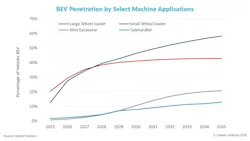
This makes wheel loaders the first segment where battery electric vehicle (BEV) competition is being defined by scale and execution, not early innovation.
"European OEMs are notably lagging behind," Mason said. "In our analysis, Volvo ranked sixth globally for battery electric wheel loader production in 2025, while other European players such as Wacker Neuson, Tobrocco Giant, and Avant remain concentrated in the compact segment with limited production volume.
Telehandlers, by comparison, remain at an early stage. Adoption is limited, geographically concentrated in Europe, and lacks clear leadership.
"Even established players such as JCB are not expected to dominate in 2025, reflecting a broader uncertainty around electrification pathways in this segment, and strategic focus elsewhere," Mason said.
"Instead, Manitou, Merlo, and Wacker Neuson have emerged as the leading players by market share in electric telehandlers to date."
Electrification accelerates first in machines where usage patterns, infrastructure, and regulatory drivers align, according to Mason. Wheel loaders are a prime example: In Europe, electrification has gained traction in compact equipment, particularly smaller wheel loaders used in urban or regulated environments.
These machines benefit from predictable duty cycles and overnight charging, making them well-suited to early electrification.
Chinese strategy
In China, however, the transition has taken a different path. Larger wheel loaders – typically above 55kW – are leading adoption. This is supported by existing charging infrastructure developed for electrified mining equipment, as well as shared battery and powertrain platforms across machine types.
The result is a more scalable and economically-viable electrification model, particularly for high-utilization applications.
There is also a fundamental difference in product strategy. Many European OEMs continue to rely on retrofitted electric machines; adapting diesel platforms by replacing engines with batteries and electric drivetrains.
"In contrast, Chinese OEMs are more likely to develop ground-up BEV architectures, delivering advantages in efficiency, reliability, and overall system integration," Mason said.
Chinese OEMs are moving rapidly from domestic scale to global expansion, bringing fully integrated electric machines into some Western markets. Their presence at international trade shows in 2025 highlighted not only the breadth of their electric portfolios, but also the maturity of their offerings.
Sometimes it seems as if Conexpo is the only place we see the Chinese hee in North America.
Learn the electrics available from some North American OEMs
But now, Chinese manufacturers are working hard at exporting their capabilities. Liugong has already delivered hundreds of electric machines into Europe, as well as to Australia, New Zealand, and South America. Meanwhile, XCMG has secured large-scale agreements in mining, including significant electric haul truck deployments with Fortescue.
This expansion is enabled by a clear gap, namely limited BEV offerings from Western OEMs in several high-power segments, due to battery size and cost issues. Demand is sketchy, too. In these cases, Chinese machines are not just cost-competitive, they are often the only viable electric option at scale.
The implication is that if Chinese OEMs can replicate their success in wheel loaders, they will seek expansion into other machine segments. Excavators seem to be a logical next step for Liugong, while XCMG targets mining, and Sany road building, Mason continued.
To date, Chinese participation in electric excavators has been limited. But given their pace of development, manufacturing scale, and growing global footprint, this is unlikely to remain the case.
Should they enter this segment with competitive, purpose-built machines, the current leadership position of Western OEMs, particularly in Europe, will come under significant pressure.
Who will win?
Understanding electrification in off-highway is not all about adoption rates, Mason tells us; it is about identifying which OEMs will win, where, and why. With leadership fragmented and Chinese manufacturers scaling rapidly beyond their domestic market, the key question is not where electrification will occur, but which OEMs are structurally positioned to capture it.