Three Rituals for Success in Equipment Management
Key Highlights
In this article, you will learn:
- How weekly rituals help shift from reactive to proactive management.
- How to plan and set clear priorities.
- How to foster customer engagement.
- How to make time to understanding fleet financials.

Time moves quickly in an equipment shop. Weeks can slide by in a blur of breakdowns, shifting priorities, and urgent calls from the field—until the whole operation is running on reaction instead of direction. One breakdown turns into three, a missing part stalls a repair, Operations calls with an emergency, and Accounting needs payroll or coding reviewed.
Before long, the entire week has been spent reacting instead of responding or leading, and any new request that comes in is often met with a response of “too busy.”
This “too busy” mentality rarely comes from a lack of skill: It comes from not having a steady routine to rise above the chaos. The strongest equipment managers share one common approach: weekly rituals. These are not extra meetings or added bureaucracy. They are simple, repeatable actions that anchor the week, bring clarity, and keep the work aligned.
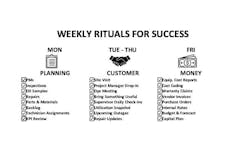
Three rituals create the biggest impact: planning ritual, customer ritual, and money ritual.
When these rituals become part of the weekly rhythm, the shop stabilizes, Operations grows to trust the process, Accounting sees a reliable partner, and senior leaders begin to notice clear direction amid the noise, chaos, and stack of vendor bills.
The Planning ritual
The Planning ritual exists to plan the week before the week plans it for you. It’s the reset button; a chance to step back, look ahead, and decide what the next seven days can look like instead of bouncing from emergency to emergency. Skip this ritual, and the entire team pays for it.
This ritual only takes about 30 to 60 minutes and covers the fundamentals: which services and PMs are due, what inspections are coming up, which repairs carry over, delayed parts, and a quick review of backlog.
It’s also the moment to assign and balance technician workloads and designate a “breakdown tech” or “firefighter”—the person who responds to breakdowns for the week. With one person handling the chaos, the rest of the team stays productive. And in the rare week without emergencies, that same person can work on backlog or lower-priority tasks without disrupting the plan.
Timing is simple: Do it when data is the freshest and focus is the highest. Many shops choose Friday afternoon to close out the week, or Monday morning to align the crew before work begins. The specific day matters less than the consistency of doing it.
Tools can be simple: ERP or CMMS dashboards are great if available, but basic spreadsheets, whiteboards, notepads, or even the back of a parts invoice work just as well. The goal is clarity and communication, progress not perfection.
When the week starts with a real plan, everything runs smoother. Technicians know their priorities. Downtime drops because the right work is scheduled at the right time. Operations immediately feels the benefit, as outages, PMs, and repairs stop being surprises. A solid Planning ritual won’t eliminate chaos, but it significantly reduces it and gives control over what remains.
Depending on the operation, this ritual may include others such as a foreman, planner, or master mechanic—anyone central to scheduling and workflow. Keep it small and focused; this is a working session, not a corporate meeting. A brief huddle with the right people often prevents hours of confusion later in the week.
The Customer ritual
More on equipment operations
- How to build a training matrix for an equipment shop.
- A smart approach to profitable equipment operation.
- How to make a business case for capex.
The Customer ritual centers on the people who rely on equipment to do the work: most often the Operations team that moves dirt, drills holes, or breaks rock. As the Planning ritual organizes the shop, this ritual connects the equipment team to how the iron is actually used.
Operations is expected to hit production targets; Equipment must keep machines available so those targets can be met. This ritual closes that gap.
It doesn’t need to be long or formal. It might be joining an existing operations call for 10 minutes, walking a job site with a superintendent, riding along with a truck driver, or grabbing coffee with a project manager. The rule is simple: Go to them. Being present in their world builds understanding and trust faster than any email.
Show up with something useful: a utilization snapshot, upcoming PM outages, updates on major repairs, or anything that affects their project schedule. Keep it short, and relevant, and listen more than talk.
Just remember: The field manages safety, quality, production, labor, materials, billing, clients and contracts; equipment is only one piece of that picture, even though it is one of the largest costs.
The real value of this ritual is communication and trust. Consistent updates reduce panic calls, eliminate surprises, and encourage Operations to give notice instead of last-minute demands. The shop gains context—the “why” behind requests—which improves prioritization and reduces friction.
Often, the strongest relationships are built in the simple moments: A mid-week check-in on a job site or even a quick coffee or donut run can strengthen partnerships more than any phone call or meeting ever could. Over time, this ritual shifts the equipment group from “the department that spends money” to a reliable partner supporting the field.
This ritual lands best mid-week—Tuesday thru Thursday—when work in the field is steady and distractions are fewer. Keep the format flexible, stay prepared, follow-up and stay accountable. Trust is the equipment team’s most valuable asset, and this ritual is how it’s built.
The Money ritual
The Money ritual is the one most fleet managers avoid, yet it’s the one that changes careers the fastest. Equipment is too expensive to manage blindly. This ritual is about spending at least 30 minutes each week looking at the financial health of the fleet. Not quarterly. Not “when Accounting emails.” Every single week.
The focus of this ritual is simple: Review equipment cost reports, vendor invoices, warranty recovery, internal rates, cost coding, capital plans, and any financial activity that touches the fleet. No one needs to become an accountant; just understand the numbers well enough to make informed, responsible decisions. Most financial issues in fleet management aren’t money problems, they’re visibility problems.
Timing matters. Many managers perform this ritual on Fridays or Mondays, when data is freshly updated or when preparing for the week ahead while things are running smoothly in the shop. Send yourself a recurring meeting to block at least 30 minutes in the calendar, more if the fleet is large or systems are complex. Any tools work—ERP, CMMS, spreadsheets, P&L reports, transaction data, etc. The format doesn’t matter; clarity does.
And if reviewing dollars sounds boring, make the ritual fun. Give it a name like Money Monday or Finance Friday. Put on some music. Grab a coffee. Treat it like a weekly “date” with the financial side of your equipment business.
When something doesn’t make sense, ask Accounting to explain it. They won’t judge you, they’ll respect you for wanting to learn. The better the understanding of the money, the stronger and more impactful the equipment leader becomes.
With consistency, financial surprises are reduced. Issues are caught early. True equipment costs become clear. Decision-making improves. And the financial impact of repairs, PMs, rebuilds, and overtime ratios on the company’s cashflow and bottom line becomes clear. This is how the role shifts from simply “fixing iron” to leading one of the largest cost centers in the business.
Breakdowns, delays, and field emergencies will always be part of the business, but these rituals create the stability needed to handle them. With consistency, these habits reduce stress, prevent surprises, improve communication, and strengthen relationships across the company. They make the entire shop run smoother.
Consistency beats complexity, every time.
About the Author
 Craig Gramlich
Craig Gramlich
Craig has extensive experience in equipment management across transportation, heavy lifting, civil projects, mining, and construction sectors. Driven by a passion for cost and data analysis, he excels in enhancing equipment accounting, rate modeling, and developing programs for rate escalation and transfer pricing.
Through Lonewolf Consulting, Craig effectively unites Equipment, Operations, and Accounting departments, leveraging his extensive field experience to help companies streamline operations and find cost savings, significantly boosting ROI.
He holds a Bachelor of Commerce from the University of Alberta and a Certified Equipment Manager (CEM) certification, along with a variety of professional development courses, showcasing his commitment to ongoing professional growth.