Survey Says: Proper Tire Pressure Saves Money
We've covered tires pretty extensively, and even without us, you know wear and tear and premature replacement costs the fleet money.
But not everyone thinks of the correlation between proper tire pressure and fuel efficiency. It is real and it also adds up.
The folks at Continental Tire commisioned a study to quantify the connection.
Continental's analysis found that keeping tires within the recommended pressure range improved fuel economy by 4.5%. The study also indicated that higher levels of underinflation have an even more dramatic impact on fuel economy.
How the study rolled
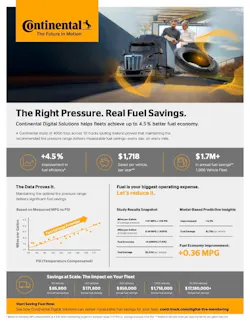
The study analyzed 4,000 trips across 10 trucks (pulling trailers) over a six-month period, comparing fuel economy at different tire pressures. On average, the trucks ran at 106 psi, below the target pressure of 110 psi. Bringing pressure into that target range corresponded to a fuel economy gain of about 0.62 mpg – from an average 7.87 mpg to 8.49 mpg, or roughly 7.9%.
Based on the predictive model, for a single vehicle, that improvement, translates into an estimated $1,718 in annual fuel savings, assuming 80,000 miles driven per year and a fuel cost of $4.05 per gallon.
Larger fleet, larger savings
The effect grows quickly across larger fleets. Based on the same assumptions, Continental estimates annual fuel savings of approximately $85,900 for a 50-vehicle fleet, $171,800 for 100 vehicles, $859,000 for 500 vehicles, $1.72 million for 1,000 vehicles, and more than $17 million for a fleet of 10,000 vehicles.
Just as you see with air temperature changes affecting tire pressure on your personal vehicles, tire pressure tends to drift gradually and can fall outside the optimal range without being noticed between manual checks.
Proper care for trailer tires
Continental offers its own tire pressure monitoring system called ContiConnect. By continuously monitoring tire pressure and temperature through sensors inside the tire, the system gives fleet operators ongoing visibility and automated alerts when values move outside defined thresholds. This makes it easier to keep tires in the range where fuel savings are realized, while also supporting tire life and uptime.

“With fuel prices staying high and volatile, fuel economy has become one of the most important factors in a fleet’s bottom line — and that’s only going to intensify in the years ahead,” says Renato Sarzano, SVP Truck Tires Americas, at Continental.
“Tire pressure is one of the few cost levers fleets can control directly, but staying on top of it shouldn’t be another thing operators have to worry about."
About the Author
 Frank Raczon
Frank Raczon
Frank Raczon has covered and influenced the equipment industry for 35 years, including 15 years as senior editor of Construction Equipment, and marketing, advertising, and public relations work with the industry's top manufacturers. In addition to authoring "Caterpillar: Modern Earthmoving Marvels" (Motorbooks, 2015), he has won numerous awards in his career, highlighted by nods from the Construction Writers Association, the Association of Equipment Manufacturers, the Business Marketing Association, and BtoB magazine. Raczon has also won a number of awards from publishing peer groups such as ASBPE and TABPI.