Allu’s New Concrete Bucket Turns Excavators into Jobsite Recyclers
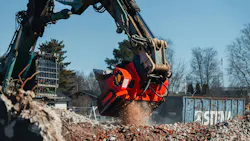
Just a few weeks ago, Allu shared one of the more practical sections in our Weird and Wild Side of Construction Attachments showcase. The company outlined how contractors can get more from their crushing and screening attachments with some choice tips — matching drum configurations to materials, sizing hydraulics correctly, and keeping material flowing instead of overloading the attachment. Now, Allu has introduced a new product that puts those ideas into practice: the Allu concrete bucket. The new attachment combines crushing and screening into a single excavator bucket, giving contractors another way to do more work with the machines they already own. From the press release:
“Our goal has always been to develop equipment that enables customers to process materials where the work is taking place,” said Peter Grönholm, chief executive officer of Allu Finland. “The Allu concrete bucket continues that commitment by helping contractors improve efficiency, reduce unnecessary material handling, and recover valuable materials directly on-site."
So, instead of hauling jaggedy concrete across town, operators can recycle it at the project, or at least make it more manageable. Processing the material saves truck trips and reduces material handling. I'm pretty sure (checking math) that equals more efficiency.
Let's break down the Allu concrete bucket
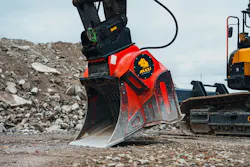
The Allu concrete bucket targets excavators in the 25- to 45-metric-ton range. It accepts demolition material up to 11 inches in size and produces either a 0-to-2-inch or 0-to-4-inch finished product, depending on the counter blade configuration. Under the right conditions, Allu says the attachment can process up to 100 metric tons per hour, or roughly 110 U.S. tons.
Rather than using a traditional jaw crusher design, the Allu concrete bucket is engineered with rotating crushing drums fitted with replaceable carbide picks. The drums work against a counter blade, continuously crushing and screening material as it moves through the attachment. Compatible carriers can also utilize Allu’s Drain Line Eliminator hydraulic technology. This is an optional tech that removes the need for a dedicated external case drain (leakage return line) on compatible carrier machines. It manages internal motor leakage oil, simplifying the physical installation of heavy attachments like this concrete bucket.
How would you use it?
Picture this: A big excavator's breaking up an old concrete parking lot. It drops a giant hammer and switches to the Allu concrete bucket, which then eats the broken slabs into reusable aggregate. Or maybe a demolition contractor removes a concrete warehouse in a tight downtown jobsite. Instead of placing awkward debris into haul trucks, the excavator processes the pulverized concrete, making loading easier and more efficent.
What can the Allu concrete bucket process?
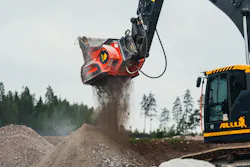
The bucket is designed to process pulverized concrete, reinforced concrete, brick, asphalt fragments, and mixed demolition debris. Here’s a cool feature: The attachment has been engineered to perform effectively in reinforced concrete applications where steel contamination is encountered. Steel and rebar pass through or separate during processing, allowing operators to continue crushing stuff.
What contractors should know
- Designed for 25- to 45-ton excavators
- Accepts feed material up to 11 inches (300 mm)
- Produces 0-to-2-inch or 0-to-4-inch aggregate
- Processes up to 110 U.S. tons per hour under suitable conditions
- Handles reinforced concrete, including material containing steel and rebar
- Combines crushing and screening into one excavator attachment
Cutting hauling instead of adding equipment
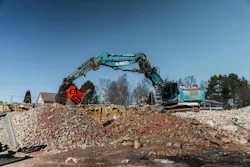
Field testing provided Allu with an opportunity to evaluate the attachment in real demo applications. From the press release:
“The concrete bucket has been developed to provide contractors with an efficient and practical way to process demolition materials directly where the work is taking place,” said Antti Rautamies, head of research and development at Allu. “As project requirements continue to evolve, we remain committed to developing solutions that improve productivity, simplify material handling, and support responsible resource management.”
About the Author
Keith Gribbins
Keith Gribbins is the head of content at Construction Equipment, where he leads editorial strategy across print, digital, video, and social channels. An award-winning journalist with more than 20 years of experience, Keith has won 17 national and regional editorial awards and is known for his hands-on reporting style, regularly visiting manufacturers, operating equipment, and covering major industry events worldwide.