The Weird and Wild Side of Construction Attachments
Key takeaways:
- Today's attachments do far more than dig and lift. Specialized tools now let contractors crush concrete, split rock, clear vegetation, install utilities, and even automate work at height.
- The right attachment can eliminate equipment, labor, and hauling costs. Modern implements help contractors complete more work with the machines they already own.
- Attachments are getting smarter — not just stronger. Robotics, AI, automation, and connected technologies are transforming attachments into intelligent tools that expand what construction equipment can do.
Buckets and forks. Blah. So boring. Gimme like an extendable tree saw or a deep hole quarry drill. I want a gnarly attachment on the end of my boom, and then let's go do some work.
Every year, manufacturers introduce specialized tools that tackle odd jobs most contractors don’t think about until they’re standing in front of it. From crushing concrete and cutting steel to unrolling fencing and reclaiming vegetation, these attachments help a single machine do much more than its original job description.
In this showcase, we highlight some of the weirdest, wildest, and most interesting attachments to cross our desks of late. These products demonstrate just how creative equipment makers have become in squeezing more productivity and value out of the machines already in your fleet. But before we get into the implements, let’s talk about…
Getting the most from your screening and crushing attachment
This section was written by Maimee Henderson, marketing coordinator, Allu.
Every jobsite is different, but the key to efficient material processing remains the same: use the right attachment configuration. Whether screening topsoil, processing demolition debris, recycling asphalt, or handling contaminated material, selecting the right setup and operating it correctly can make a significant difference in productivity and operating costs. Start by choosing the right drum or blade configuration for the material being processed. Different materials require different screening or crushing characteristics, and matching the attachment to the application helps improve throughput while producing a more consistent final product.
Carrier compatibility is equally important. Hydraulic flow, pressure, and machine size should align with the attachment's requirements to achieve optimal performance. An attachment that is properly matched to the excavator, wheel loader, or skid steer will operate more efficiently while reducing unnecessary stress on both the carrier and the attachment. Routine inspections are another key to maximizing uptime. Checking wear parts, hydraulic connections, and cutting components before each shift helps identify issues before they become costly repairs. Replacing worn components at the recommended intervals also helps maintain production capacity and consistent material quality.
Operators should also focus on maintaining steady material flow instead of overloading the attachment. Allowing material to move naturally through the screening or crushing process improves efficiency, reduces blockages, and minimizes unnecessary wear on internal components. Finally, take advantage of the versatility that screening and crushing attachments provide. Processing material directly on-site reduces hauling, minimizes material handling, and turns waste into reusable resources. With the right setup, proper maintenance, and good operating practices, contractors can improve productivity, lower operating costs, and maximize the return on their attachment investment.
Why proper fork length matters for safe material handling
This section was written by Eric Espelien, product specialist, Ignite Attachments.
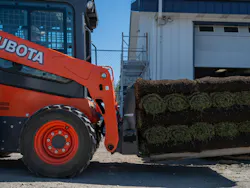
Pallet forks are among the most frequently used attachments on construction jobsites, yet fork length is often treated as an afterthought. While standard forks are suitable for many palletized loads, the materials commonly handled in construction — such as lumber, pipe, steel and precast products — can present unique challenges when they extend beyond the fork tips.
When a load is not adequately supported, weight shifts farther from the machine, affecting stability and increasing the potential for load movement during lifting, transport and placement. Unsupported materials may flex, bow or become unbalanced, requiring operators to make additional adjustments to maintain control. These corrections can slow down productivity and create additional safety concerns.
Selecting the appropriate fork length helps ensure more of the load is supported throughout the lift. Better support promotes even weight distribution, improves load stability and reduces the likelihood of shifting materials. It can also help minimize product damage caused by excessive flexing or uneven loading. Fork length should always be evaluated alongside carrier specifications and the types of materials most frequently handled. Longer forks are not necessarily the right choice for every application, but when operators routinely move oversized or extended loads, additional support can improve both safety and efficiency.
Weird and wild attachments
Some of the construction industry’s biggest innovations don’t come on wheels or tracks. They hang from the end of a machine boom. Today’s attachments continue to push machines into new applications — crushing concrete on-site, splitting solid rock in confined spaces, welding autonomously from a boom lift, or installing fiber beneath sidewalks. Let’s take a look at some of the more interesting attachment options floating around the market right now.
Darda’s C20 rock splitter
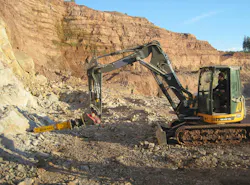
Darda offers the powerful C20 rock splitter attachment for 5- to 7-ton carriers. It’s ideal for situations where contractors encounter hard rock during excavation and need an efficient splitting solution with a small footprint. Darda offers two C20 mounting options: chain suspended for vertical splits or a bracket and hydraulic rotator to split in every direction. Regardless, the C20 provides high productivity thanks to the integrated pressure booster. It only requires an input connection of 2,500 to 3,200 psi but delivers 7,250 psi operating pressure, producing up to 1,800 tons of splitting force. Another advantage is the integrated lubrication system that ensures the wedge set gets grease at every split, eliminating manual greasing. When the grease container is empty, the splitter automatically stops working. Finally, the C20 does not get stuck in rock because it provides maximum power when extracting and retracting the wedge. For more information, visit Darda’s website.
Liebherr sorting grabs
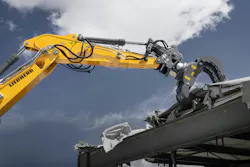
Liebherr sorting and demolition grabs are designed for both recycling and demolition applications, enhancing excavator versatility across any construction site. They enable efficient loading and feeding of sorting, shredding, and processing systems while ensuring precise material separation. Equipped with an endless turning device, these attachments deliver excellent control, high clamping force, and a robust design suited for demanding environments. Available in multiple sizes with various shell configurations, they can be tailored to match specific machine types, materials, and job requirements. Stone tongs, as an extended version of the sorting grab, further improve performance by allowing safe and efficient handling of stones and boulders through specialized shell shapes and serration. Built for compatibility with common coupler systems, these attachments can be utilized on a wide range of OEM excavators, maximizing flexibility, utilization, and overall jobsite productivity. For more info, visit Liebherr’s website.
JLG boom lift with robotic end effector
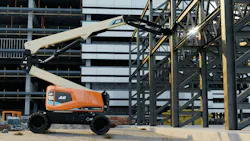
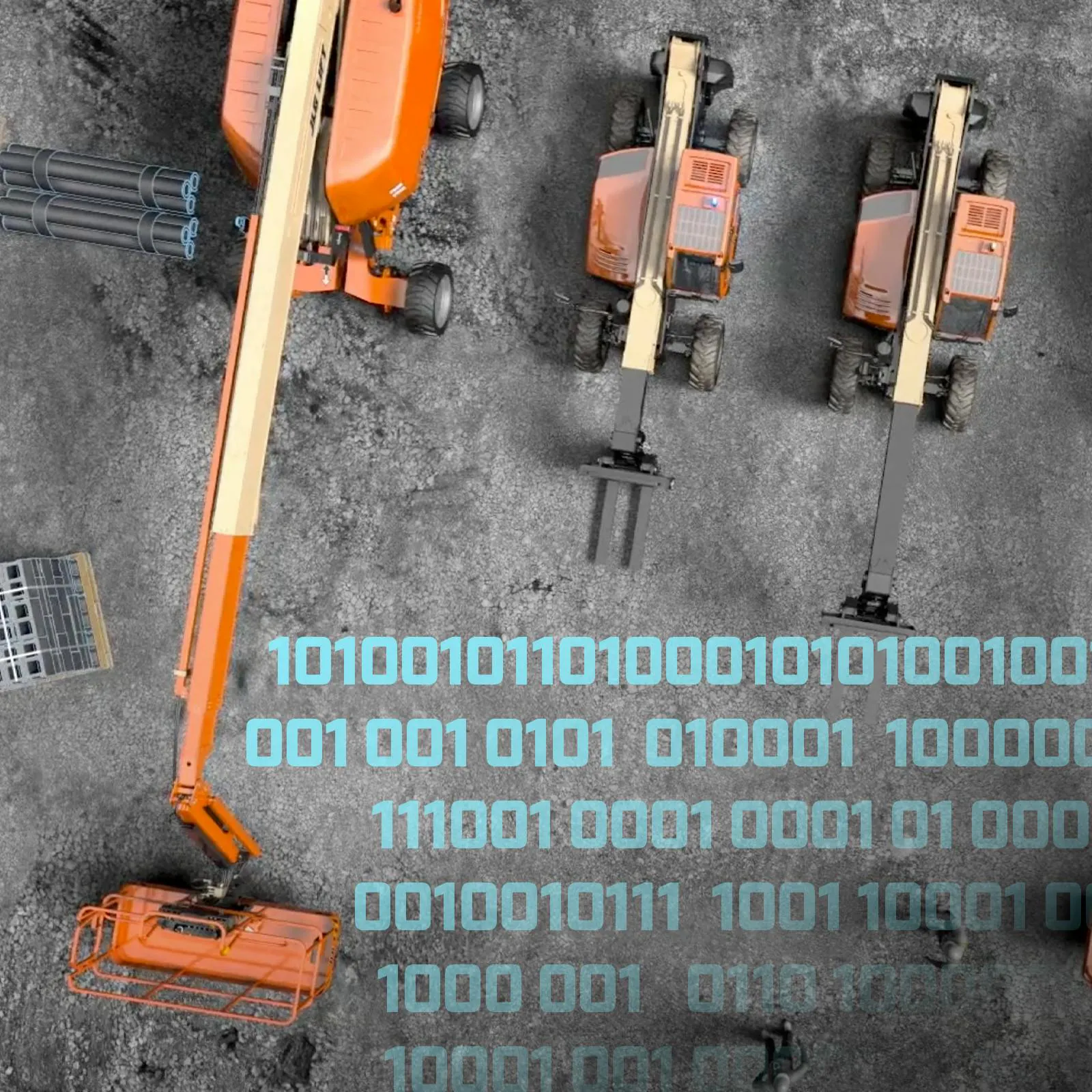
The JLG boom lift with robotic end effector offers a look at how traditional lift equipment can be transformed into autonomous, job-performing robots capable of executing complex elevated tasks such as welding, inspection or installation. Designed for industrial environments, the JLG Boom Lift with Robotic End Effector combines robotic manipulators, AI-guided control and multi-sensor perception into a rugged, mobile platform. It autonomously navigates, positions and performs work at height with precision, either independently or in coordinated fleets. The system integrates with digital twins and jobsite management platforms, creating a scalable robotic solution for connected, semi-structured outdoor environments that redefines what is possible in construction robotics. For more info, visit JLG’s website.
Vermeer microtrencher
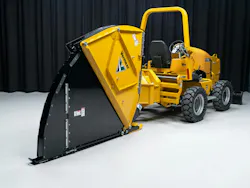
Fiber installation continues to drive equipment demand across North America. Vermeer is heavily vested in the sector — even more so with the launch of the MTR726 microtrencher attachment for its RTX750 ride-on tractor platform. The new attachment cuts trenches up to 27 inches deep and 3 inches wide. That extra depth separates the MTR726 from Vermeer’s existing MTR516, which handles installations up to 17 inches deep. Contractors dealing with stricter depth-of-cover requirements now have another option without jumping into larger trenching equipment. The attachment includes welded polycrystalline diamond cutter teeth designed for fast asphalt cutting. A fully shrouded cutting wheel helps contain debris and improve vacuum suction during trenching operations. Operators also get single-lever depth control and up to 24 inches of right offset capability for cutting near curbs. Serviceability received attention too. Crews can reportedly change blades in as little as 25 minutes thanks to a dual-hinged access panel design. Multiple bolt-in wear plates are field-serviceable, and the spoil outlet works with either 4- or 6-inch vacuum hoses. For more info, visit Vermeer’s website.
Toro floor scraper
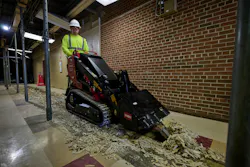
After Toro brought the CUL class to North America, it focused on tailoring the Dingo to fit the needs of contractors, landscapers and homeowners. Not only has Toro developed 14 different Dingo models, but also more than 35 attachments to aid in a multitude of tasks both outside and indoors. Here are four unique to Toro attachments. One of the most unique is the floor scraper. This attachment is designed for unparalleled productivity and flexibility for flooring removal jobs. Featuring an all-steel construction, the scraper attachment simplifies the removal process for vinyl, quarry, ceramic tile, carpet squares, paint, glue, asphalt, and more. A floating blade holder keeps the scraper level even when traversing uneven ground. Toro offers multiple types and sizes of blades for the attachment. Changing between them is quick and easy thanks to the built-in quick-attach mounting plate. For more info, visit Toro’s website.
John Deere material boom
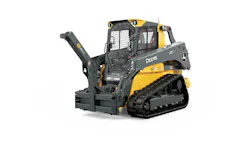
The John Deere MB60 material boom expands the versatility of compact equipment by transforming compatible skid steers and compact track loaders into efficient material-handling machines. Designed for lifting, placing and transporting heavy materials around the jobsite, the MB60 is ideal for moving trusses, pipe, pallets, equipment and other bulky loads with precision. Its rugged construction and optimized boom geometry provide dependable lifting performance while maintaining excellent operator visibility for improved confidence and control. The attachment installs quickly using John Deere’s universal attachment interface, helping crews minimize downtime and maximize productivity between tasks. Whether supporting construction, utility, agricultural or landscaping applications, the MB60 Material Boom gives contractors another practical way to get more value from a single machine. Built to John Deere’s durability standards and backed by the company’s extensive dealer network, the MB60 is a reliable solution for jobs that demand safe, efficient material handling. For more info, visit John Deere’s website.
ALLU concrete crushing and screening bucket
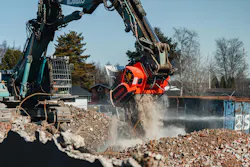
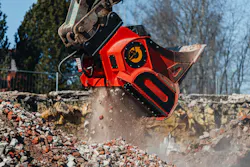
ALLU recently introduced its new concrete screening and crushing bucket, an excavator-mounted attachment designed to process demolition waste directly where it is generated. Built for 25-to-45-ton excavators, the bucket crushes and screens concrete, brick, asphalt, and rebar-contaminated demolition material, helping contractors reduce hauling, minimize reliance on separate mobile crushers, and produce reusable material on-site. The attachment features a changeable counter blade system that allows operators to produce either a 0-2 inch or 0-4 inch final product, with production capacities reaching up to 110 U.S. tons per hour, depending on material. Its heavy-duty construction, reversible drum rotation, and carbide-tipped crushing drums are engineered to handle demanding demolition applications while maintaining consistent material flow, even when processing reinforced concrete containing steel or rebar. For more info, visit ALLU’s website.
EZG Mfg. has a lot of unique and cool attachments
Fence Hog
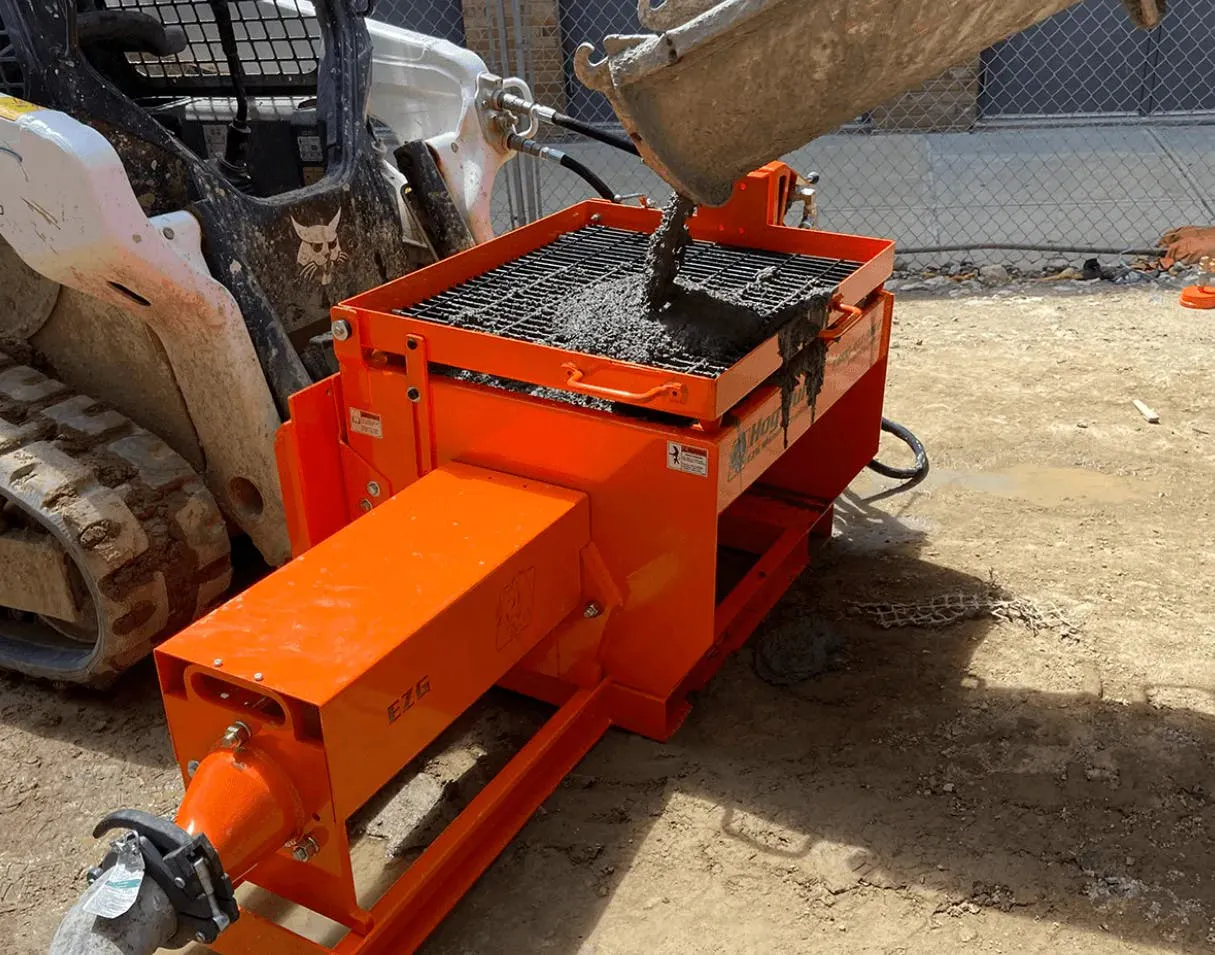
EZG Manufacturing developed the Fence Hog with input from professional fence builders and designed it to effortlessly handle cumbersome rolls of chain link fence. Powered by the hydraulics of a skid-steer loader, its uniquely designed cage mechanism opens and tilts to retrieve fence rolls from the ground. No more unrolling by hand or requiring extra manpower to stand it up. Choose from three models: the 36- and 24-inch Fence Hog for larger projects, and the compact Mini Fence Hog for residential fences. Attachments and accessories are also available, ensuring seamless customization for any project. Say goodbye to manual labor and hello to efficiency with chain link dispensers. For more info, visit EZG’s website.
Hog Pump
Experience unmatched performance and versatility with the HP-38 Hog Pump 3/8 Special for up to 3/8-inch concrete aggregate. Powered by a Kohler 38-horsepower engine, this pump excels in various applications such as block fills, driveways, sidewalks, and flat work. Its agile design accommodates EZG Hog mixers, ready-mix trucks, or continuous mixers attached to a silo. Available in towable, skid-mounted, and skid-steer-mounted options, the HP-38 ensures you’re equipped for any job. Suitable for shotcrete, block fill, insulated concrete forms, and more, it features a progressive cavity pump and is ideal for filling block walls with grout or pea-rock. Don’t miss out on the enhanced capability offered by the HP-38 Hog Pump. For more info, visit EZG’s website.
Ditch Witch Roto Witch
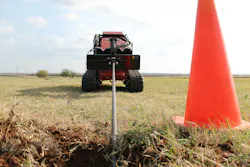
The Roto Witch attachment gives contractors a fast, efficient way to install utilities beneath sidewalks, driveways and other surface obstacles without the disruption of open trenching. Designed for use with Ditch Witch stand-on skid steers, the Roto Witch delivers reliable boring performance in a compact, easy-to-operate package. Ideal for installing conduit, irrigation lines, electrical cable and small-diameter utility pipe, the attachment is purpose-built for short bores where precision and minimal surface disturbance matter. By boring underneath hardscapes instead of cutting through them, contractors can significantly reduce restoration time and jobsite cleanup. The Roto Witch attachment can bore and backream holes up to 12 inches (300 mm) in diameter, giving crews the flexibility to tackle a variety of underground utility crossings quickly and efficiently. For contractors looking to maintain productivity while minimizing costly surface repairs, the Roto Witch provides a practical solution for tight jobsite conditions. For more information, visit Ditch Witch’s website.
Manitou swing carriage
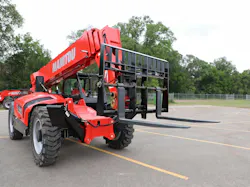
Equipped with heavy-duty 2.0-inch shafts, Manitou swing carriages use hydraulic cylinders to pivot the forks left or right, allowing operators to swing loads off center for placement in open windows or to the side of the machine. The attachments’ angle of pivot/swing is controlled with a hydraulic auxiliary boom function and there are two models of swing carriages available. One offers a rotation of 45 degrees left/right of center for a total of 90 degrees of swing, while the other provides a rotation of 90 degrees left/right of center for a total swing of 180 degrees. The two models are both 66 inches wide with a backrest that is 45 inches tall. For more info, visit Manitou’s website.
Toku crushers and pulverizers
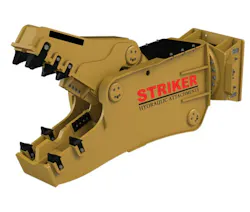
Toku America has expanded its Striker demolition attachment lineup with new crushers, pulverizers, and shears designed for concrete demolition, recycling, and scrap processing. The additions include the RS Series Rotating Crusher, featuring dual hydraulic cylinders, 360-degree rotation, and a pressure relief valve (PRV) to protect against hydraulic pressure spikes. The RV Series Rotating Pulverizer combines 360-degree rotation, interchangeable teeth, reversible blades, and a speed valve to improve crushing performance and cycle times. The FPV Series Fixed Pulverizer is built for groundwork and recycling, with interchangeable wear parts, an energy recovery system, and a bolt-on wear plate for easier maintenance. Toku also highlighted its SH Series Shears, designed for cutting structural steel, pipe, and tanks with 360-degree rotation and replaceable blades. Built primarily from Hardox steel, the attachments are designed to improve durability, productivity, and service life while expanding Toku’s portfolio beyond hydraulic breakers for demolition contractors and equipment dealers. For more info, visit Toku’s website.
Blue Diamond road saws
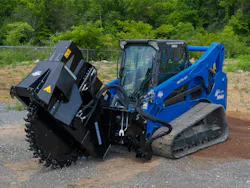
Blue Diamond Attachments has expanded its lineup of roadwork tools with the new Extreme Duty Road Saws, built to help skid steers tackle precision trenching in asphalt, concrete, and rock. Available in two models, the attachments offer cutting depths from 6 to 17 inches or 8 to 24 inches, with interchangeable tooth plate kits that create trenches 2 to 8 inches wide. A hydraulic depth adjustment lets operators control blade depth from the cab, while an available hydraulic side shift moves the blade up to 18 inches for precise positioning. The saws also feature a trench-clearing scraper blade, a material flow diverter that removes debris from the cut, and a depth gauge for consistent trench control. Designed for skid steers up to 65 horsepower, the road saws require 21 to 42 gallons per minute of hydraulic flow and use a universal skid steer mount compatible with a wide range of machines. For more info, visit Blue Diamond’s website.
Bobcat Brushcat rotary cutter
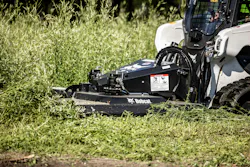
Built to handle demanding vegetation management tasks, the Bobcat Brushcat rotary cutter delivers powerful and efficient brush-clearing performance. Ideal for construction sites, agricultural operations, municipalities and parks-and-recreation settings, this attachment cuts through dense grass, heavy undergrowth and trees or saplings up to 3 inches in diameter. Dual offset motors paired with dual blades are designed to deliver consistent cutting performance under typical operating conditions. A lightweight, compact deck design allows the attachment to be paired with a broad range of carrier machines. Its superior deck oscillation is designed to allow the cutter to better adapt to uneven terrain and slopes, supporting more consistent cut results across varying ground conditions. Front-mounted discs help the attachment move more smoothly over rough surfaces, helping improve operator comfort. Available in five cutting widths — 44, 54, 66, 72 and 80 inches — along with optional high-flow configurations for increased torque, the Brushcat rotary cutter is well suited for trail maintenance, land reclamation and efficient jobsite preparation. For more info, visit Bobcat’s website.
Ignite Attachments 72-inch pallet fork teeth
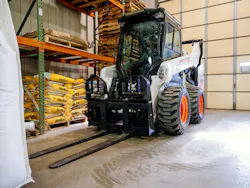
Oversized materials can quickly expose the limitations of standard pallet forks on construction jobsites. Ignite Attachments’ 72-inch pallet fork teeth provide the additional reach needed to safely and efficiently handle long, bulky and uneven loads. Rated for 6,000 pounds and designed for heavy duty and severe duty pallet fork frames, the teeth are manufactured from a single piece of high-strength steel to deliver dependable performance in demanding applications. The extended length helps improve load balance and stability while reducing the need to reposition equipment around trailers, material stacks and laydown yards. By eliminating the need for bolt-on fork extensions, operators can simplify setup and maintain productivity throughout the workday. Ideal for contractors managing a wide range of materials, the 72-inch pallet fork teeth help maximize equipment versatility, improve material handling efficiency and support smoother jobsite operations. For more info, visit Ignite’s website.
Montabert Lehnhoff SQ-V quick coupler system
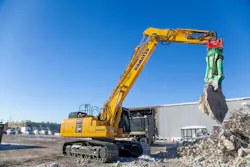
Today's excavators are expected to do more than ever, and Lehnhoff SQ Series fully hydraulic couplers help make that possible. Designed around the globally recognized S-standard, these fully hydraulic quick couplers allow operators to change compatible attachments in as little as 20 seconds without leaving the cab. This helps reduce downtime while promoting zero harm. Unlike conventional quick couplers, the symmetrical SQ design allows buckets to be rotated 180 degrees for greater versatility. The SQ-V models maintain full hydraulic functionality, even when attachments are reversed. Patented short-stroke valves maximize hydraulic flow yet decrease back pressure for improved attachment performance and reduced heat buildup, and an integrated system continuously monitors proper attachment locking from the cab. Compatible with a wide range of buckets, breakers, grapples, shears, compactors and other tools, the Lehnhoff SQ-V quick coupler system transforms an excavator into a highly efficient, multi-purpose machine, ready for your jobsite challenges. For more info, visit Montabert USA's website.
The jobsite of the future: Where connected machines execute work
This section was written by Shashank Bhatia, chief technology officer and global vice president of Engineering, JLG.
The next generation of construction equipment is doing more than lifting people and materials — it is becoming an active participant in completing work. At the center of this evolution are robotic end effectors, perception systems, connectivity and automation. Working together, these technologies transform equipment into intelligent systems capable of executing repetitive tasks while skilled workers supervise operations, validate quality and intervene when judgment is required.
For example, a boom lift equipped with a robotic end effector can position itself using perception systems and AI-guided control, identify an intended weld location, perform the weld consistently, capture validation data and then move to the next point. The operator remains essential but shifts from physically performing each repetitive task to overseeing the process.
Connectivity extends these capabilities even further. Rather than operating independently, connected machines communicate their location, task status and intent, allowing work to progress through coordinated workflows. Micro-sized scissor lifts with Leader-Follower technology can transport and position materials before signaling a boom lift to begin the next operation. This machine-to-machine orchestration helps digitize jobsite sequencing and reduce manual coordination.
These capabilities represent more than incremental improvements. They illustrate how construction equipment is evolving from enabling work at height to helping execute work at height through connected, automated systems. As these technologies continue to advance, equipment will become even more capable through over-the-air software updates, allowing machines to improve after purchase. Combined with robotics, perception systems and connectivity, these innovations represent a vision for the jobsite of the future — one where intelligent equipment assists skilled workers, increases consistency and productivity, and helps contractors accomplish more with the workforce they have.
About the Author
Keith Gribbins
Keith Gribbins is the head of content at Construction Equipment, where he leads editorial strategy across print, digital, video, and social channels. An award-winning journalist with more than 20 years of experience, Keith has won 17 national and regional editorial awards and is known for his hands-on reporting style, regularly visiting manufacturers, operating equipment, and covering major industry events worldwide.