Caterpillar Jolts Mining With Its Biggest Electric Drive Dozer Yet
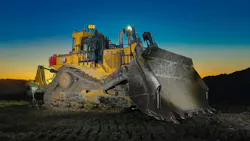
It's been a long road for Caterpillar's electric drive dozer line, time-wise.
From the groundbreaking D7E (2008) to the D6 XE (2019) to the D8 XE (2026), it's been 18 years, but I wouldn't read anything into that.
It's simply because Cat doesn't release something until it is sure of its customers' needs and the iron is thoroughly tested and just right.
Now Caterpillar is extending its electric drive dozer line with the D11 XE, which Cat says delivers up to 25% less fuel consumed per unit of material moved and moves 5% to 10% more material per hour than the next generation (diesel) Cat D11. It's aimed squarely at the mining industry.
Dozer machine control: What operators need to know now
Because of the electric drivetrain, it has 60% fewer moving parts than a mechanical drive system, helping simplify service and lower owning and operating costs over the life of the machine.
Helping drive the D11 XE’s productivity are upgrades throughout the machine’s powertrain and major systems. The Cat C32B engine provides diesel assistance at a lower high-idle speed to help the D11 XE deliver up to 20% longer life between rebuilds than the traditonally driven D11.
For the techs and the Greenies
Planned component repair intervals for the engine, final drives, and hydraulic systems increase from 15,000 to 18,000 hours, aligning with the electric drive’s 18,000-hour rebuild centerline. I don't know anyone who wouldn't take one period of downtime over two.
The result is the most efficient and productive D11 model to date according to Cat, consuming up to 20% less fuel per hour and producing 20% to 25% fewer greenhouse gas (GHG) emissions. And the first D11N debuted in 1986.
How Cat electric drive works
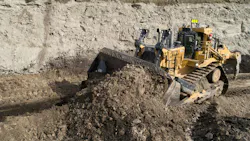
The electric drive system eliminates the bevel gear used in mechanical drive systems. The engine drives a generator that sends power through an inverter to two motors, delivering consistent power to the tracks.
There's more addition by subtraction.
With no gears to shift, the D11 XE electric drive system simplifies operation. A dedicated drive motor at each track provides power-turn capability for strong maneuverability and pryout force. By powering both tracks throughout the turn, the system enables smoother, sharper maneuvering and helps operators push more material through the turn, Cat says.
Comfortable and easy operation
The suspended undercarriage absorbs impact and reduces shock load transfer to the undercarriage by up to 50%, helping create a smoother, more comfortable ride.
Accessible, low-effort electronic steering, ripper, and dozer controls support precise maneuvering, while the primary multifunction touchscreen gives operators a clear view of machine performance and convenient access to operating settings. Together, these features help operators work more consistently and productively throughout the shift.
Robust guts
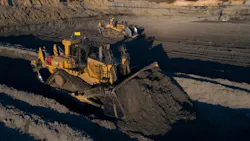
The Cat C32B engine delivers the same power and performance as the Cat C32, with heavier-duty internal components. Compared with the D11, the D11 XE can achieve similar total operating hours with one fewer rebuild over the machine’s life, helping lower total cost of ownership.
The electric drive generator and motors are designed to last through two machine lives with only rebearing and resealing, reducing the investment required during every other rebuild. A modular design allows major components to be removed independently, helping streamline service and minimize downtime.
Cat teams with BHP, Rio Tinto for electric haul truck testing
A new radiator guard and upgraded case and frame help improve durability, extend machine life and reduce maintenance downtime. Larger lift-cylinder trunnion bearings simplify service. Redesigned pin joints with replaceable bearings eliminate the need for line boring and simplify bearing-insert replacement on the ripper, blade, and push-arm trunnions.
Up to 85% parts commonality with the D11 further supports serviceability through shared components and a familiar modular design.
Onboard Cat technology
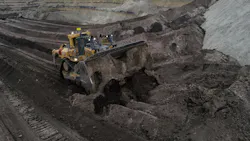
As you would expect from Caterpillar, multiple integrated technologies are available, including:
- AutoCarry provides automatic blade control during the carry segment to reduce fatigue, help maintain optimum track slip, and increase productivity by up to 15%.
- 3D Grade Control uses dual ROPS-mounted GNSS antennas and blade-mounted inertial measurement unit (IMU) sensors to precisely position the cutting edge without blade-mounted masts or cables.
- Automated Blade Assist uses standard dual-tilt capability to automate blade movement to key pitch positions, helping increase efficiency and reduce operator workload.
- Automatic ripper control automatically adjusts engine speed and ripper depth to maximize productivity, minimize track slip, and reduce machine wear.
For you remote-control operation fans, the D11 XE can also be equipped with Cat MineStar solutions that help you work more accurately, safely, and efficiently. Cat Command for dozing offers multiple levels of remote control and semi-autonomous operation, allowing work away from the cab.
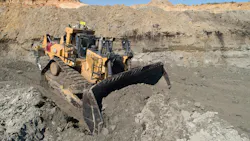
Caterpillar D11 XE Specifications
- Engine: Cat C32B
- Powertrain: Electric drive
- Net horsepower, forward: 861
- Operating weight: 238,796 lb.*
- Blade capacity (Universal): 45 cu. yd.
- Blade capacity (Carrydozer): 57 cu. yd.
*Unit with single-shank ripper, U blade, 28" ES shoes.
Watch Cat product application specialist Luke Fischer in the Cat promotional video below to learn more about the D11 XE.
About the Author
 Frank Raczon
Frank Raczon
Frank Raczon has covered and influenced the equipment industry for 35 years, including 15 years as senior editor of Construction Equipment, and marketing, advertising, and public relations work with the industry's top manufacturers. In addition to authoring "Caterpillar: Modern Earthmoving Marvels" (Motorbooks, 2015), he has won numerous awards in his career, highlighted by nods from the Construction Writers Association, the Association of Equipment Manufacturers, the Business Marketing Association, and BtoB magazine. Raczon has also won a number of awards from publishing peer groups such as ASBPE and TABPI.