Material Handlers 101: Types, Attachments, and Buying Tips
Key takeaways:
- Material handlers are specialists. From scrap yards and recycling centers to ports and rail yards, these machines are designed to grab, sort, and move huge volumes of material efficiently.
- The right configuration matters. Buyers should carefully consider undercarriage type, boom design, attachments, visibility, and safety technology to match the machine to the application.
- Modern technology is changing the game. Features like 360-degree cameras, payload systems, electronic work boundaries, and object detection help operators work faster and safer.
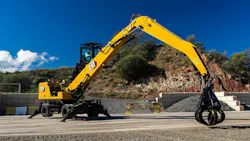
Material handlers are near the top of my list of awesome-looking machines. They're like mutated excavators. Their booms are too long. Their cabs sit crazy high. Instead of buckets, material handlers wield giant orange-peel grapples and magnets to grab and sort mountains of demo, recyclables, construction waste, whatever. Watch them work for a few minutes and you’ll understand their epicness. These machines rise above the yard like metal creatures, spinning and feasting on everything from steel beams to crushed cars. Just stand back and let'em work.
How are material handlers categorized?
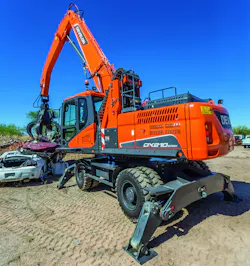
Material handlers are built for a wide range of industries, and there are lots of different types. They work in scrap yards, sorting and loading steel, aluminum, and crushed vehicles. They are found in recycling facilities, moving paper, plastics, and other recoverables. At ports and shipyards, some of the world’s largest material handlers load bulk commodities onto ships. You’ll even find specialized units working in forestry and rail yards.
Material handlers come in all sizes. Some are smaller, nimble machines — yet still very big at 50,000 to 60,000 pounds operating weight. For example, the Hyundai HW250A MH weighs about 58,000 pounds and is designed to maneuver quickly around scrap yards and recycling centers. Others are giants with cabs that rise more than a story off the ground. This Sennebogen 895 E Hybrid is one of the largest material handlers in the world, weighing up to 925,940 pounds and reaching 131 feet into the air. It is available in gantry and rail-mounted configurations for bulk material handling at ports.
Other material handlers use tracks to crawl over rough demo sites and uneven ground. Then there are wheeled models that are geared for paved surfaces and speed. Many wheeled units also feature outriggers for added stability. There are also boom options. Some machines use straight-stick options for maximum reach and lifting capability, while others use drop-nose configurations that improve visibility to the attachment and provide better control when sorting material close to the machine.
Then there are the attachments. Orange-peel grapples gobble up piles of scrap steel. Magnets lift rebar and shredded metal. Demolition grapples can sort concrete to timber. Shears slice through everything like giant scissors. This is a machine you kind'a just want to go play with.
What manufacturers are in the market?
The material handler market is led by a mix of specialists and major construction equipment OEMs. Brands like Sennebogen and Fuchs focus almost exclusively on material handling. Meanwhile, construction OEMs such as Caterpillar, Volvo Construction Equipment, Develon, Liebherr, Komatsu, Kobelco, and Hyundai Construction Equipment also serve scrap, recycling, demolition, and waste markets.
Important selection tips for material handlers
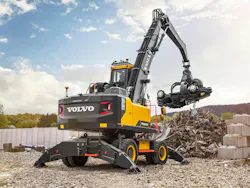
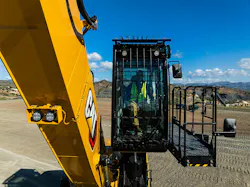
1. Visibility first: A material handler operator spends all day looking over and around, sorting material. Operators need those awesome elevated cabs for productivity and safety. Look for cab risers that provide clear views and easy height adjustment.
2. Undercarriage: Where will you be operating? Tracked machines generally offer lower ground pressure and stability on rough terrain. Wheeled units move faster around scrap yards and transfer stations.
3. The front end: Straight-stick and drop-nose configurations each have advantages. As mentioned, drop-nose designs improve visibility to the attachment, while straight-stick fronts often maximize reach and lifting performance.
4. Counterweights: Don't overlook what's hanging off the back. Counterweights help material handlers stay balanced when lifting heavy loads at long reach. Consider your typical load sizes, attachment choices, and working environment.
5. Attachments: Sometimes the best machine is a specialized, one-job unit. Other times, it's the machine that can do multiple jobs. Consider whether you'll need grapples, magnets, shears, or other tools.
6. Generator: Planning to use a magnet? Most magnetic attachments require an onboard generator to provide electrical power. Even if you don't need a magnet today, consider generator options for the future.
7. Safety technology: 360-degree cameras, object detection, swing limits, and electronic work boundaries are not luxuries. In busy scrap yards and dangerous demo sites, these systems can help protect workers and prevent damage.
8. Operator comfort: Material handlers repeat the same motions for hours at a time. It's all-day work. A quiet cab, ergonomic controls, good sight lines, and low-effort joysticks will go a long way in keeping operators happy.
9. Serviceability: Scrap and waste applications are tough on machines. Ask about guarding, access to filters and service points, telematics, and all the maintenance ins and outs.
10. Total cost of ownership: The cheapest machine rarely stays cheap. Crunch the numbers on fuel efficiency, attachment compatibility, maintenance costs, resale value, and dealer support. Compare that with the initial purchase price. Do the math. What does it tell you?
Work smarter with cool material handler tech
This section was written by Vincent Migeotte, senior global product and sales consultant for specialty and material handler hydraulic excavators at Caterpillar.
Productivity in material handling comes down to precision, consistency, and efficient cycles. Material handlers can help operators deliver on all three with a range of integrated technologies designed to keep every pass productive and controlled.
E-Fence allows operators to set defined working boundaries for the machine’s movement. By keeping boom and stick motion within those parameters, operators can maintain consistent positioning when loading, sorting, or stockpiling to help improve overall cycle times. Cab Avoidance complements this by managing the motion range near the front of the machine, helping maintain smooth, repeatable operation during continuous loading tasks.
The onboard Payload system plays a critical role in maximizing efficiency. With real-time weight estimates, operators can accurately load trucks to their optimal capacity. This helps minimize underloading while helping ensure each truck leaves full, supporting better material flow and fewer loading cycles overall. The result is a more efficient operation with less guesswork and more predictable output.
Together, these features help create a more streamlined workflow. Operators can focus on maintaining rhythm and accuracy, while site managers benefit from improved load consistency and optimized equipment utilization. The integrated technology supports a more productive approach to material handling, helping every load count and every cycle perform at its best.
Best practices for material handler operator safety
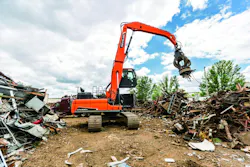
This section was written by Troy Hitchcock, heavy product field manager at Develon.
Inadequate training for heavy equipment operators significantly contributes to jobsite accidents. Because material handlers are highly technical and operate in demanding environments like scrap and recycling facilities, prioritizing comprehensive operator education is vital for safety and efficiency.
1. Leverage training resources: Operators should undergo classroom or hands-on instruction to fully understand machine controls, displays, and indicators before operation. The manufacturer’s operation and maintenance manual, alongside industry safety manuals, should be kept accessible for quick reference. Additionally, operators must review and maintain all safety decals on the machine’s interior and exterior.
2. Follow daily safety protocols: Always wear appropriate personal protective equipment (PPE), including hard hats, safety shoes, glasses, and high-visibility clothing. When entering or exiting the cab, operators should wear tight-fitting clothing and maintain three points of contact using the provided grab handles and steps.
3. Utilize modern safety technologies: Familiarize operators with built-in advanced features. Around-view monitor (AVM) camera systems provide up to 360 degrees of situational awareness to catch hidden hazards. Object detection sensors offer audible alerts when people or obstacles enter the work radius.
4. Conduct routine checks: Pre-operational checks are critical. Operators should inspect walking surfaces, fluid levels, and lighting, while checking for leaks or debris accumulation in the engine compartment. For tracked or wheeled models, examine the undercarriage — tires or tracks — for signs of wear and damage.
5. Understand attachments: Whether utilizing grapples, shears, or magnets, operators must know machine load specifications to ensure proper pairing. Make sure the operator maintains a clear, comfortable line of sight to the attachment at ground level from a normal seated position.
Material handler visibility and safety in high-traffic work zones
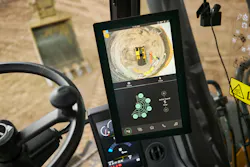
This section was written by Matthew McLean, product manager, Volvo Construction Equipment.
In scrap yards and demolition sites, a material handler is the hub of a high-traffic work zone. With ground crews, smaller loaders, and transport trucks constantly moving in and out of the work zone, maintaining 360-degree awareness from the cab is a significant challenge. While elevated cabs provide a better vantage point for loading, they don’t always eliminate the blind spots immediately surrounding the machine’s footprint.
The benefit of a 360-degree view
To address this, many operations are adopting smart view camera systems that use multiple wide-angle lenses to stitch together a real-time, bird’s-eye view of the machine. Unlike a standard rearview camera, this perspective allows the operator to see all sides of the equipment simultaneously. In a scrap application, this is particularly valuable when swinging the upper carriage, as it ensures the counterweight is clear of obstructions and personnel that might be obscured by the machine’s own structure.
Enhancing site safety
This level of visibility serves two main purposes:
- Protects ground personnel: The operator can see people approaching the machine from any angle, which is critical in noisy environments where backup alarms might be muffled by site activity.
- Prevents infrastructure damage: In tight demolition sites, a bird’s-eye view helps the operator navigate around pillars, walls, or other equipment, reducing the risk of accidental contact.
By integrating this technology into the daily workflow, operators can move with more confidence and speed. The result is a safer jobsite where the risk of collisions is minimized and production remains steady.
Interesting material handlers on the market
The material handler market is packed with specialized equipment. Here are a few notable models from a few different traditional construction OEMs. The metal beasts below are good examples of modern material handlers.
Volvo material handlers
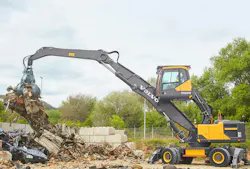
In demolition and scrap handling, the work is dirty, the materials are unpredictable, and the shifts are long. Rather than simply modifying a standard excavator, Volvo designed its material handler lineup specifically to handle these types of harsh environments. A major priority for these machines is the operator’s vantage point. Both models feature a hydraulically elevated cab that can rise nearly 17 feet, giving operators a clear view into a high-sided trailer or over a sorting pile. This visibility helps speed up cycles and is a critical safety feature when working in tight, congested yards. To handle the dust and debris common in waste applications, the machines are equipped with a premium cab and an optional rubber-mounted guard to minimize vibration. Additionally, specialized features like the outrigger-and-blade setup and a factory-installed grapple circuit ensure the machine is stable and ready to work the moment it arrives on the job. For more info, visit Volvo’s website.
Develon DX225MH-5 material handler
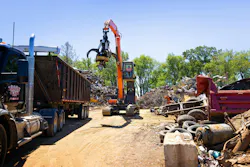
Built for scrap recycling, solid waste, and material handling, the Develon DX225MH-5 material handler maximizes efficiency and site visibility. It features a standard 4-foot fixed cab riser — with optional hydraulic risers up to 6.5 feet — paired with a straight boom and drop nose arm for superior reach, lift height, and container clearance. Engineered for harsh environments, its X-chassis crawler frame enhances ground clearance and maneuverability, while rugged undercarriage guarding protects key drive components. Inside the quiet, ergonomic cab, operators benefit from intuitive joystick controls for precise attachment operation — easily managing tools like a magnet or grapple — and four distinct power modes. This includes a specialized lifting mode that delivers high pump torque at low engine RPMs with an automatic power boost. Furthermore, an included three-year My Develon fleet management telematics subscription streamlines maintenance tracking and equipment monitoring, ultimately reducing overall operating costs and maximizing uptime. For more info, visit Develon’s website.
Hyundai HW250A MH material handler
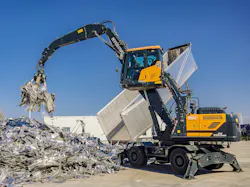
HD Construction Equipment Hyundai North America sells the HW250A MH material handler, designed to give operators better visibility and a more stable working platform. These are two crucial advantages when working in scrap yards and other specialized conditions characterized by tight spaces, heavy materials, and constant wear. Purpose-built for handling scrap and other challenging materials, the Hyundai HW250A MH material handler comes standard with a cab that can be elevated up to 9.5 feet to position the operator above the materials and provide a clear view across the yard. It also features four outriggers as standard equipment, providing stability for a solid working platform. The 170 net horsepower HW250A MH material handler has a net operating weight of 58,422 pounds and a maximum travel speed of 21.7 mph. The Hyundai HW250A MH material handler delivers ease of maintenance and serviceability, productivity and performance, comfort, and safety. For more info, visit HD Construction Equipment Hyundai’s website.
Caterpillar’s MH3032 material handler
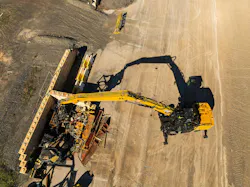
Last year, Caterpillar strengthened its lineup of material handlers with the launch of the Cat Next Generation MH3032 material handler. Positioned to plug the gap between the MH3026 and MH3040, both already on the Next Generation platform, the new MH3032 calls on the same criteria to deliver performance and durability in a no-nonsense 30 MT technology-driven design. With a reach of nearly 49 feet, the MH3032 is available with both drop-nose and straight-stick configurations for maximum versatility. Typical scrap materials are easily handled by the standard Cat orange-peel grapple, which offers 1.3 cubic yards of capacity. For added flexibility, an optional 20-kilowatt generator enables the use of magnet attachments, expanding the machine's capabilities on the jobsite. Ease of operation and optimum productivity are provided by Cat Payload, the built-in technology that allows operators to see how much they’re lifting in each load and to constantly monitor tonnage output. Also fitted as standard on the MH3032 is Cat 2D E-Fence, which keeps the arm within a predefined work area away from the elevated cab, providing greater operator confidence while protecting the machine from damage and helping improve site safety. This is combined with a new Swing Assist feature, which automatically stops the swing motion at an operator-defined preset point. For more info, visit Cat’s website.
About the Author
Keith Gribbins
Keith Gribbins is the head of content at Construction Equipment, where he leads editorial strategy across print, digital, video, and social channels. An award-winning journalist with more than 20 years of experience, Keith has won 17 national and regional editorial awards and is known for his hands-on reporting style, regularly visiting manufacturers, operating equipment, and covering major industry events worldwide.