Concrete Pavers Advance
Key Highlights
In this article, you will learn about:
- GOMACO concrete paver technology.
- Power Curbers integrates Miller Formless.
- Wirtgen technology enhancements.
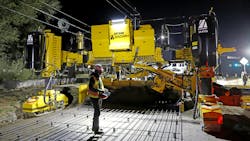
Concrete paver technology continues to advance. We asked three industry leaders for their brand-specific insights.
GOMACO
The GP3 is available as a two-track or four-track concrete paver capable of paving up to 30 feet wide. The 4-track version has rotary-sensored slew drives on the pivot arms of each of the paver’s legs. This allows quick transition between transport and paving and also improves obstacle avoidance during the paving process. The GP3 is 3D machine control capable. Options include GSI (GOMACO Smoothness Indicator) so operators can monitor pavement smoothness in real time and IDBI (Independent Dowel Bar Inserter) system for accurate, automatic insertion of transverse joint bars.
More concrete paving
- Slipform concrete pavers promote quick setup and variable widths.
- Willbee Transit Mix speeds washouts.
- Software speeds continuous improvement for Ajax Paving.
The GP348 is GOMACO’s latest high-production placer/spreader and slipform paver. With its 48-inch belt, the GP348 evenly spreads concrete up to 36 feet wide. Removal of the spreader components converts the unit into a four-track GP3. The GP348 can be run via wireless remote control and can be transported on a single semi-tractor trailer as either a placer or paver.
The GP360 is a two-track placer/spreader with a 60-inch belt capable of evenly spreading concrete up to 36 feet wide. It can be converted to a two-track GP3 paver.
Both the GP348 and GP360 can be equipped with optional sonic sensors that monitor concrete depth behind the placer’s strike-off. With machine-to-machine (M2M) communication provided by GOMACO’s G+ control system, the paver operator can adjust the elevation of the hydraulically operated strike-off of the placing unit to maintain a consistent head in front of the paver for optimal smoothness and uniformity throughout the pour.
Managing this complex of features is straightforward with GOMACO’s G+ Connect closed-loop control system. The G+ control system uses a CAN (control area network) to provide machine operation, performance data, and diagnostics. One example would be control of the GP3’s legs, moving them from transport to paving and back and ensuring accurate steering even with the legs offset by the pivot arms.
G+ has durable dials and push buttons for machine control and a flat-panel, anti-glare 6.5-inch display screen with sensor-modulated backlight controls for optimal visibility in all conditions. G+ Ground Control provides a remote operator’s screen with the same graphical display as is at the operator’s station. Ground personnel can fine tune the machine, make setting adjustments, and monitor operation from the remote station.
The T/C-5600 four-track texture/cure machine is designed to add texture and cure pavement up to 56 feet. The G+ control system provides forward and reverse steering and grade control. It can be guided by stringline or a host of other sensors from GOMACO. Tracks turn 90 degrees for easy transport. The patented walking end car’s tracks turn to walk the car in or out for frame sections to be added or removed. Configurations include a texturing assembly for longitudinal tining, a 10-foot wide transverse tining assembly, or a single-pass texture/cure system with 7-foot tining bar and 7-foot folding spray bar. An optional on-board hot water tank can be used to flush the cure pump and nozzles at the end of the operation.
GOMACO also has a prototype hybrid paver, the GT 3600 Hybrid.
Power Curbers/Power Pavers adds Miller Formless to its portfolio

Power Curbers acquired Miller Formless last year, which completes its catalog, says Stephen Bullock, president. For example, he says the Power Curbers 5700-D curb and gutter machine is ideal for most curb and gutter work, sidewalks, highway safety barriers, and similar linear projects. At first glance, the Miller Formless M-1000 would seem to be a too-similar machine, and the two do have much in common. The M-1000 is more compact and better for tighter projects, Bullock says, and is able to accommodate the 90-degree corners found in parking lots.
One of the key offerings that came with the acquisition was the M-8800, the largest Miller Formless concrete paving machine. It is capable of 102-inch barrier walls and up to 20-foot paving widths in straddle configuration. But it’s not only the capacity that matters. The M-8800 barrier molds have a bifurcated design to allow for single-pass pours of barrier walls that accommodate superelevation differences between traffic corridors, such as adjacent lanes of north- and south-bound traffic.
As existing roads reach maximum carrying capacity, lanes are often added. Although these additional lanes can be added to the outside, there are confounding factors. Accel and decel lanes must be reconfigured at every interchange and exit/entrance. Rights-of-way may not extend far enough to accommodate the additional lanes.
The more expedient way to add lanes is to do so on the inside, but this often gobbles up what had been a grassy median and requires that a barrier wall be erected. In curves, superelevation often puts adjacent travel lanes at significantly different elevations. Even seemingly flat terrain can present differences of several feet.
If the barrier wall were a flat-plane monolith, no problem. But the barrier wall must have faces like those of jersey barriers, with a foot, a section that angles back and a flat wall above that. This design minimizes the risk that loss of control will launch a vehicle over the wall into oncoming traffic and acts to redirect the vehicle back into the travel lane it had been in prior to the loss of control. That multi-plane face must be at the correct height on both sides relative to the height of the travel lanes which likely are at different elevations.
The M-8800 excels at this type of work, according to Bullock. Its versatility is further enhanced with rebar ports where rebar can be fed in as part of the paving process when fixed and rigid steel is not placed before the pour.
The M-8800 is an example of the acquisition bringing new capabilities to products in the lineup. The M-1000 is an example of the acquisition filling in spots between Power Curbers models. The M-8100 offers versatility not found in other models of Power Pavers slipform machines. Power Paver models such as the SF-1700 excel at smaller jobs and congested sites.
Wirtgen

Wirtgen debuted its SP 33 at World of Concrete 2025. The key to the SP 33’s versatility is its modular design, allowing it to pave in offset or Crosspave mode.
Offset paving applications include sidewalks, curb and gutter profiles, rectangular profiles, and concrete barriers up to 52 inches high. The offset can pave up to 7 feet wide with the use of an 8-foot trimmer and can be positioned to either side of the machine.
In Crosspave, the legs can be rotated 90 degrees and a slipform mold mounted underneath for paving up to 10 feet wide. The SP 33 has two crawler units with parallelogram swing legs at the front and a single crawler unit at the back. The track design also allows zero-clearance paving. Paving is still done in the direction of travel, but that direction is perpendicular to the orientation of the operator’s station.
Two conveyor options are available. The auger conveyor works at angles up to 45 degrees and has a high carrying capacity to act as a buffer while feeding the SP 33. The slider bed belt conveyor is designed for maximized carrying capacity with minimal loss; the belt is self-cleaning, and the assembly is designed with fewer wear points for reduced maintenance.
The advanced operator’s station has electronic controls, rather than pilot controls, which allows the entire control panel to be moved from one side of the machine to the other in minutes for optimal visibility. Retractable extensions add up to 14 inches of width to the platform on the left and right sides to further improve the operator’s line of sight.
The operator’s station also has event-driven graphic visualization to take operators step-by-step through transport, setup, and paving operations. This advanced human-machine interface (HMI) provides intuitive access to such operating parameters as speed control and vibrators can be controlled individually or in operator-defined groups. Eight “favorites” buttons can be programmed by the operator.
Optional AutoPilot 2.0 Machine Control was developed by Wirtgen and allows operation without a physical stringline. Digital 3D data models can be generated on the job site. In addition, a standard 3D interface is integrated in the machine to allow use of machine control technologies from leading suppliers.
Wirtgen did away with traditional conical picks on its trimmer in favor of flat picks that they say provide an optimal surface and extended wear life. An optional quick-change system allows faster reconfiguration when going between offset and Crosspave modes. In ECO mode, the SP 33 automatically matches engine output to demand for maximum fuel efficiency.
About the Author
 Richard Ries
Richard Ries
Richard Ries began his free lance journalism career in June, 1985, calling on his experience as a service manager at a Honda motorcycle dealership to place his first article. When the motorcycle market collapsed in the late 1980s, he moved to the booming bicycle market. Finding that market lacked the professionalism he sought, he moved to construction in 1995 and has remained there ever since.
His countless clients have included entities in Australia, England, France, Germany and Scotland. He has written for trade and consumer periodicals, equipment and component manufacturers, government agencies and non-governmental organizations. Clients have also commissioned him for photography and videography work, either stand-alone or as part of package of text and images.