JCB Just Proved Hydrogen Engines Can Go 406 MPH. Now Will They Work on the Jobsite?
Key Highlights
- 🏁 Hydrogen hauls: Two JCB hydrogen engines pushed the Hydromax streamliner to a 406.320-mph world land speed record.
- 💪 Built to take abuse: The 1,600-horsepower setup endured heat, altitude, salt, and repeated 400-mph runs.
- 🚜 The jobsite is the real test: JCB is pursuing U.S. approval, but hydrogen infrastructure remains the big hurdle.
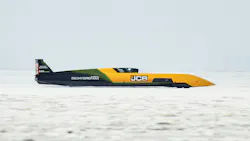
The Bonneville Salt Flats look like another planet — a vast expanse of hard-packed salt stretching across northwestern Utah. Alas, I’ve only seen pictures like that one above. It’s the ancient remains of Lake Bonneville — an Ice Age paleolake. The flats run roughly 12 miles long and 5 miles wide. And as the name might imply, this prehistoric lakebed is also known for being, well, pretty flat (but not necessarily super smooth). That long, flat, white surface has become hallowed ground for engineers and racers — speed freaks like Andy Green — a guy who once broke the sound barrier while still on the ground.
This past week at the Bonneville Salt Flats, Green once again broke another land speed record. On Tuesday, August 11, Green set a FIA world land speed record at 406.320 mph; FIA stands for Fédération Internationale de l'Automobile. What’s extremely cool and unique about this record is that it was set using two zero-emission hydrogen combustion engines. Green once again partnered with British equipment giant JCB, creating the JCB Hydromax. This 32-foot long, ultra-aerodynamic racing streamliner used two JCB hydrogen engines to produce 1,600 horsepower, blasting into the record books.
While hydrogen tech sounds futuristic, JCB’s approach to proving it was old school.
“As a young boy in the 1950s, I remember reading The Eagle and Boys’ Own and being inspired by the daring deeds of the great world record-breakers,” said JCB Chairman Lord Anthony Bamford, during a speech at the event. “People such as Sir Malcolm Campbell and Donald Campbell, Sir Henry Segrave, George Eyston and, of course, Sir Stirling Moss. These were people who pushed machines — and themselves — beyond what everybody thought possible. They captured the imagination of a generation. And now I believe we must add another name to that remarkable list: Wing Commander Andy Green.”
Sadly, Construction Equipment was supposed to be standing on the salt for the attempt. Unfortunately, a canceled flight had other ideas. So, I watched this one from afar, which hurts a little because I’ve been following JCB’s hydrogen engine program for years. I’ve seen the technology operate in actual construction equipment over in England. Now it just powered a 406-mph race car. What does it all mean?
From a snowy quarry to 406 mph
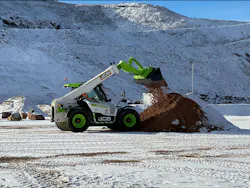
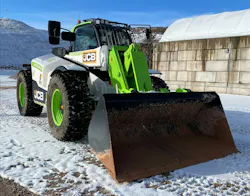
My introduction to JCB hydrogen combustion came under considerably slower circumstances. A few years ago, I traveled to Staffordshire, England, where JCB demonstrated prototype hydrogen-powered construction equipment in a snowy quarry. A backhoe loader and telehandler ran using hydrogen combustion engines that looked like regular engines. To me, that remains one of this technology’s biggest attractions. Instead of completely redesigning a machine around massive batteries or hydrogen fuel cells, JCB has developed a spark-ignited hydrogen engine intended to fit the operating profile of mid-sized equipment. Hydrogen can deliver the refueling speed, duty cycles, and general engine architecture of gas and diesel engines. That familiarity will go a long way with fleet managers and mechanics.
Don’t get me wrong. I think battery-electric equipment absolutely has a place. So does diesel. But large off-highway machines create different challenges, right? Compact equipment is great for batteries. I’m excited to see mini excavators, compact wheel loaders, and small stand-on tool carriers (like a Toro Dingo) get fitted with batteries and electric power. I’m 200% behind that, and I believe it should be incentivized (state and federal grants like California’s CORE program).
Can batteries be upsized to larger equipment?
Yes, they clearly can. We’ve seen introductions of big battery-powered wheel loaders, excavators, and ADTs from the likes of Volvo Construction Equipment and LiuGong. But there are also big challenges. Mid-sized and larger construction equipment work long, non-stop shifts, and they operate far from electrical infrastructure. Also, batteries are heavy and expensive. Then, there’s the whole recharging mindset — a refueling workflow that must completely change.
Hydrogen combustion offers a different emission-free path, using an ignition-sparked combustion engine similar to a gas powerplant. Hydrogen ICE (internal combustion engines) can run on hydrogen gas (like molecular hydrogen in its gaseous state), and they emit mostly just water vapor (although some aftertreatment may be needed). Burning hydrogen at high temperatures can create nitrogen oxides or NOx, which are pollutants.
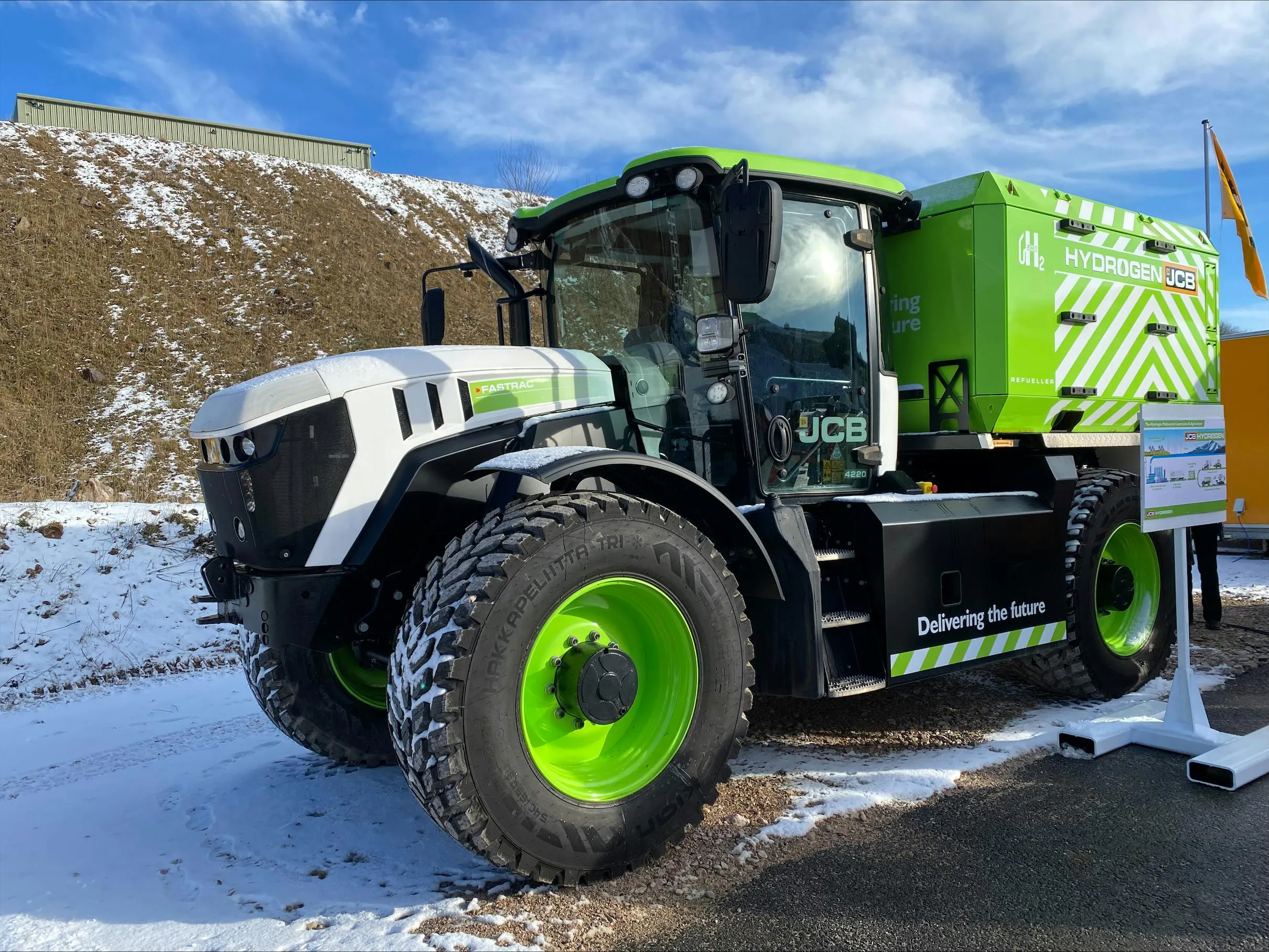
Hydrogen ICE can be refueled with a fuel truck. In fact, JCB has already created one. Fleets could refuel machines quickly in the field instead of waiting for batteries to charge or installing high-capacity electrical infrastructure. Hydrogen combustion also avoids the massive battery packs required to electrify larger machines. That can reduce added weight and preserve payload, digging performance, balance, and machine packaging. Machine makers can also retain much of their existing engine, cooling, hydraulic, chassis, and drivetrain architecture. So, OEMs wouldn’t have to drastically redesign their machines. That familiarity could also make hydrogen ICE easier for technicians to adapt to, although electric machines eliminate many traditional service items, so that advantage is a bit of a toss-up.
Of course, like electric, hydrogen ICE will only work if the industry can solve production and distribution of hydrogen. JCB’s betting heavily on that possibility.
The JCB hydrogen machines we saw
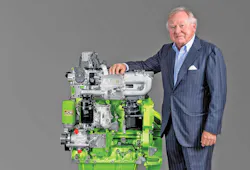
Back in 2023, I traveled to JCB’s headquarters in England to see its hydrogen combustion technology firsthand. JCB demonstrated a prototype backhoe loader and Loadall telehandler powered by its 4.8-liter, four-cylinder hydrogen engine. JCB also showed a hydrogen refueling truck capable of carrying enough fuel for 16 hydrogen backhoes. What struck me most was how familiar everything looked. JCB retained much of its existing diesel architecture, rather than redesigning the entire machine around batteries or fuel cells. Three years later, versions of that same basic hydrogen engine architecture just went more than 400 mph at Bonneville.
The JCB Hydromax gets seriously fast

JCB and Green have broken the land speed record before, about 20 years ago, using a diesel engine in a similar-looking vehicle called the Dieselmax. The Hydromax project began with the target of beating JCB’s own 350.092-mph diesel land speed record from 2006. Green also holds the outright land speed record of 763.035 mph using this insane-looking Thrust SSC (SuperSonic Car). He is often called the fastest man on earth. Driving the Hydromax this week, Green ran 400.623 mph in one direction and 412.135 mph in the other. The average produced the 406.320-mph record.
Two hydrogen excavator engines going over 400 mph is crazy, but it’s not just the speed and power. It’s the endurance and strength. The engines had to endure ambient temperatures of 100°F. The Salt Flats are 4,200 feet above sea level, which means the high altitude would strangle engines of oxygen. Plus, as snow removal contractors know, salt is incredibly corrosive. Salt will degrade mechanical components. These were some of the big challenges to overcome.
To add toughness, JCB designed the Hydromax around technology tied directly to its construction equipment operations, which is the point, right? Let’s prove what this engineering can do in the harshest sandbox. The Hydromax uses two production-based JCB hydrogen engines and four-wheel drive. Its transmissions incorporate technology from JCB’s Wrexham factory, while the clutch draws from hardware used in JCB’s famous backhoes.

The project also included some wild engineering:
- About one kilometer of wiring throughout the car
- Titanium turbo compressors spinning above 150,000 rpm
- Roughly one liter of cooling oil flowing through the pistons every second at full power
- A JCB crankshaft shared with its 448 hydrogen and diesel engine architecture
- Carbon aircraft brakes and electronically controlled parachutes
Does a land speed record actually prove anything?

That’s the big question for equipment owners: Does running 406 mph tell us anything useful about an excavator or backhoe? Obviously, nobody needs a backhoe loader capable of breaking 400 mph, noting that, yes, JCB did make a 70-mph backhoe. This record also doesn’t prove that hydrogen construction equipment is ready to replace every diesel machine tomorrow.
What it does provide is one spectacular stress test.
It demonstrates JCB can push production-based hydrogen combustion technology into an absurdly demanding environment and make it perform repeatedly. Green did it multiple times. He first set an SCTA record at 368.347 mph during SpeedWeek. Days later, he made consecutive FIA runs at 400.623 and 412.135 mph in opposite directions within an hour. That's impressive.
Where do JCB’s hydrogen engines stand today in America?
JCB has been working on hydrogen propulsion for years now. It’s invested more than £100 million. Its program includes roughly 150 engineers, and the company says more than 200 hydrogen combustion engines have been produced so far. Last year, the company secured EU type approval for its hydrogen engine for use in non-road mobile machinery. That’s an important regulatory step toward commercial deployment. Then in May 2026, JCB formally launched the production 3CX Hydrogen backhoe loader for UK and European markets.
When asked about when we might see a JCB hydrogen combustion engine in America, JCB was cautious. It noted it was currently weighing demand in the United States, but it also noted it had begun the engine approval process. JCB doesn’t have a clear timeline for production and release at this point in America. A lot will depend on the speed of infrastructure development to make this technology cost-effective, noted company officials.
In other words, the engine is ready, but the hydrogen infrastructure still has some catching up to do.
About the Author
Keith Gribbins
Keith Gribbins is the head of content at Construction Equipment, where he leads editorial strategy across print, digital, video, and social channels. An award-winning journalist with more than 20 years of experience, Keith has won 17 national and regional editorial awards and is known for his hands-on reporting style, regularly visiting manufacturers, operating equipment, and covering major industry events worldwide.