Can JCB’s Hydromax Prove Hydrogen Combustion Engine Technology at 350 MPH?
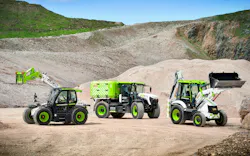
A few years ago, I stood in a snowy quarry in Staffordshire, England, watching steam drift from the exhaust stacks of prototype JCB construction machines. I watched a backhoe and telehandler run on hydrogen combustion engines that looked and worked pretty much like the gas power plants we all know. Hydrogen combustion is an extremely cool alternative propulsion system versus diesel or gas. To me, it’s more exciting than electric in many ways because these spark-ignited hydrogen engines fit into existing engine bays and machines don’t need a ton of re-engineering. Plus, no heavy batteries weighing down the machine — or the supply chain.
JCB has been a leader in hydrogen tech for off-highway equipment with its hydrogen internal combustion engines (H2-ICE). The company has invested over £100 million in the venture. Last year, JCB even secured full EU type approval for its hydrogen engines, allowing sales for non-road mobile machinery across European markets. More than 130 evaluation engines were operating in prototype construction machines last year.
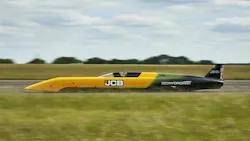
To keep hydrogen top of mind this year, JCB recently unveiled the Hydromax land speed car — yep, just like the JCB Dieselmax — but engineered with JCB’s H2-ICE setup. JCB has begun testing the Hydromax ahead of an August attempt to establish a new Fédération Internationale de l'Automobile (FIA) world hydrogen land speed record at Bonneville Speed Week in Utah. Why?
Consider this: If a production-based hydrogen engine can survive more than 300 mph on the Utah Salt Flats, that’ll probably strengthen JCB’s argument that hydrogen combustion deserves a seat at the table of future propulsion.
Production engines take center stage
The 32-foot Hydromax uses two production-based JCB hydrogen combustion engines. Together, they generate 1,600 horsepower through a four-wheel-drive drivetrain. For some reference, JCB's H2-ICE engines for construction equipment use a 4.8-liter, four-cylinder configuration that produces 173 horsepower and up to 690 Nm of torque. All of these engines use H2 gas (not liquid) ignited by spark plugs instead of compression ignition, and they emit zero emissions (only water vapor).
The engineering on the Hydromax is interesting. About a kilometer of wiring runs through the car, while there has been extensive use of 3D-printed components to keep weight down. The Hydromax crankshaft comes directly from the company’s existing 448 diesel and hydrogen engine families. Designers developed specialized exhaust valve technology to withstand high hydrogen combustion temperatures. Titanium turbo compressors spin above 150,000 rpm, while the pistons require roughly one liter of cooling oil every second to survive full-power operation (as much oil flow as the rest of the engine combined). During a full record run, the vehicle will consume just over 2 kilograms of hydrogen while producing about 18 liters of water.
Testing before Bonneville

JCB has already begun an extensive validation program at RAF Wittering in England. During early testing, the Hydromax reached 177 mph with veteran land speed driver Andy Green behind the wheel. Green is the only person to break the sound barrier on land, and the driver of JCB’s Dieselmax when it set the FIA world diesel land speed record of 350.092 mph at Bonneville in 2006. JCB aims to beat the 350-mph record with the Hydromax — a car it says is “lighter, more powerful, and faster than its 2006 predecessor,” according to the press release. Also from that release:
JCB Engineering Director Ryan Ballard, who is leading the project, said: “More than 150,000 hours of work has got us to this point; the next phase is where we find out what the car actually does, not what we think it will do. Every run, every refuel and every tyre change we complete in the UK is one our team won’t be doing for the first time on the Salt Flats. Our goal is simple: to arrive at Bonneville fully prepared, with a car and a crew that know exactly what they are doing.”
JCB's hydrogen strategy continues to evolve
Hydromax represents another milestone in JCB's years-long hydrogen program, which began in 2019. The company has invested roughly $135 million USD developing hydrogen combustion technology. JCB argues hydrogen combustion allows it to retain much of the architecture, performance, serviceability, and operator familiarity of conventional diesel equipment while eliminating carbon dioxide emissions at the tailpipe. For what it's worth, I agree. If these production-based engines can withstand the punishment of Bonneville, they'll make an even stronger case for life on the jobsite.
About the Author
Keith Gribbins
Keith Gribbins is the head of content at Construction Equipment, where he leads editorial strategy across print, digital, video, and social channels. An award-winning journalist with more than 20 years of experience, Keith has won 17 national and regional editorial awards and is known for his hands-on reporting style, regularly visiting manufacturers, operating equipment, and covering major industry events worldwide.