Fleet Masters Winner Kwest Group Proves Benchmarking and AI Work
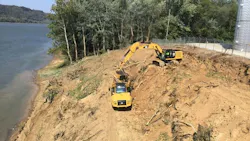
Benchmarking and AI are not just buzzwords or box-checkers, they're valuable tools for top fleets.
Small fleet (ERV under $1 million) Construction Equipment and AEMP Fleet Masters award winner Kwest Group of Port Clinton, Ohio, is a prime example.
Kwest Group, a three-time Fleet Masters winner, is a heavy civil, concrete, grading, rail, and public infrastructure contractor operating across a number of states and growing all the time.
Specifically, benchmarking and AI tools were applied to build up the firm's information management. And there is a whole lot of information circulating around.
Maximizing the 411
"Information management was one of the strongest areas of our program this year," says Brook Speiser, CEM, equipment manager for Kwest Group.
"Our in-house software development team built artificial intelligence into a new internal program that now supports reporting, summarization, and invoice processing. We have direct access to our IT department and can request any report at any time that give us visibility into all our data," Speiser says.
AI in construction: A lot of talk, little use
Kwest supports its data-driven work in the equipment department with a secure internal version of ChatGPT.
"With this platform, we developed a fleet index guide that provides weight ratings, manufacturer comparisons, and key operational details for each machine," Speiser says. "The guide has become a valuable resource for field teams by offering quick and accurate information during planning and daily operations."
What's more, the company established an internal AI committee to guide responsible adoption of emerging technologies. Speiser says the equipment department has a seat on the committee and contributes operational insight to ensure the tools it introduces support real needs in the field.
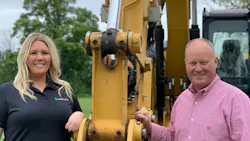
AI also found some hidden costs and strengthened Kwest's financial reporting.
"We introduced an AI-enabled credit card system that improves cost coding by identifying and categorizing purchases with far greater accuracy," Speiser says. "This system reduced previously hidden costs and made our financial reporting more reliable."
On the benchmarking side, Kwest started using AEMP's Heavy Equipment Comparator, a tool developed in conjunction with the Construction Financial Management Association (CFMA), to be a comprehensive industry source for connecting equipment performance with financial outcomes.
In other words, the precise data collected from fleets around the country in a number of crucial categories allows contractors, fleet leaders, and construction financial professionals to:
- Compare performance against peer data
- Identify cost drivers and margin opportunities
- Strengthen collaboration between operations and finance
- Improve equipment ROI and lifecycle decisions
- Support capital planning with defensible benchmarks.
Kwest also had consultant FMI do an independent evaluation that placed the equipment department among the strongest reviewed — recognizing it as "best in class."
Within an FMI peer group spanning companies from $100 million to $1.5 billion in revenue, Kwest ranked within the top half percent for capital strategy, technology use, and risk mitigation.
It is definitely playing with the big boys. No doubt some of it was due to the work Kwest does on equipment lifecycles.
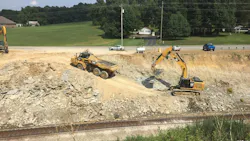
Speiser says lifecycle costing tools including churn charts and cost-per-hour analysis, drive the company's disciplined replacement timing. Standardized specifications, informed by field feedback and OEM collaboration, support operator confidence and maintenance consistency.
Kwest's partipation with Caterpillar’s Heavy Civil Advisory Committee further strengthens the feedback loop between manufacturer and contractor.
Telematics tales
"Within HCSS E360, we connect utilization, maintenance, work orders, repair history, and life cycle analysis into a single view," Speiser says.
"Our field mechanics use Vision Link to locate equipment, SIS Web to diagnose issues, and Cat Central to order parts. Having a standardized fleet has again proven valuable for us to have complete visibility of top to bottom fleet viewing on a single platform," Speiser says.
GPS tracking expanded to DOT (on-road operations) by installing front-facing cameras and using the Samsara platform. All telematics tracking is also visible in our internal software for seamless tagging and viewing.
Telematics guide: Compare OEM fleet management platforms
"This year, we also worked to install remote transfer of GPS files to dozers, which reduced travel demands on our GPS team," Speiser says.
This also gave Kwest the ability to monitor grade by heat mapping to prevent rework on projects.
"These improvements changed how information moves through our organization," Speiser says. "Data now supports faster decisions, more accurate planning, and clearer communication across departments."
Training investments
Kwest feels the workforce crunch as acutely as everyone else.
"The skilled labor shortage remains a challenge across the industry, so we made substantial investments in programs that strengthen our team and prepare new talent for equipment-intensive work," Speiser says.
The company maintains two 100-acre training facilities. Each site includes a dedicated equipment fleet, advanced attachments, and Caterpillar simulators used for onboarding.
New hires completed a week-long program with eight hours of simulator evaluation before entering the field, Speiser says.
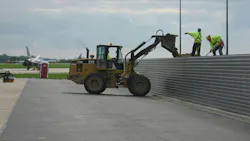
"These sessions helped us identify skill levels, address gaps, and prepare employees for safe operation. Each facility is staffed with NCCER-certified Labor and Equipment Coaches. The Equipment Coaches also hold Level 3 Caterpillar certifications," Speiser says.
Operators practice with grade control, e-fence, payload, slope assist, lift assist, and attachment procedures in a controlled environment before using those features on active jobsites.
Cat adds underground utility work to its excavator simulators
Training goes beyond onboarding. Entire crews participate in multi-day refreshers focused on best practices and equipment care. Required daily digital inspections help reinforce the importance of maintenance and safety.
"Operators also complete photo-based checklists each time they used a machine, and those reports are archived automatically in our database," Speiser says.
Across all programs, the department completed twenty-one thousand hours of craft training in the past year.
Kwest also strengthened its internship and project coordinator curriculum, hired from trade schools, and expanded a "bench" program to prepare employees with limited experience for field assignments
Commitment to safety and customers
"Safety remained one of our strongest values and we continue to take it to the next level," Speiser says.
"This past year we earned the ABC National Safety Excellence Award, the AGC Construction Safety Excellence Award, the AGC National AGC Safety Award, the SCOAR Safety and Total Human Health Program Award, the NOC ABC Total Human Health Award, ABC STEP Diamond Level, ABC Accredited Quality Contractor recognition, and the CURT Construction Industry Safety Excellence acknowledgment."
That's quite a list.
"These awards are a testament of our safety program and culture we live every day," she says.
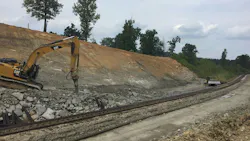
The equipment department's customers are the crews in the field and they are held as sacred.
"Supporting the field as our customers shapes every decision we make in the equipment department. Our team worked hard to ensure field crews received the equipment, tools, and information they needed to perform their work safely and productively on time and in the most cost effective way," Speiser says.
How do they do it?
Real-time request systems give the field employees immediate access to support. Mechanics and field staff communicate directly,which helps resolve issues with less delay.
Equipment scheduling has become more transparent through internal software, and field leaders could track requests from submission to fulfillment.
"We hired an Equipment Operations Coordinator to support our team with fleet logistics, rental vendor relations, and invoice tracking. This has given us the opportunity to be even more connected with our field teams and provide them extra daily support," Speiser says.
Robust communications
"We devoted significant effort to improving communication and alignment across the department," she says. "Weekly meetings grounded in the EOS framework kept our goals visible and helped us address challenges before they reached the field.
"We also hold quarterly department meetings where we review staffing needs, evaluate whether everyone is in the right role, and discuss long-term goals," Speiser says.
"Because our mechanics and field teams work across several states, we continued to hold quarterly mechanic meetings that included overnight team-building activities," she says.
"These gatherings helped strengthen relationships and create a sense of unity among team members who don't see each other often."
About the Author
 Frank Raczon
Frank Raczon
Frank Raczon has covered and influenced the equipment industry for 35 years, including 15 years as senior editor of Construction Equipment, and marketing, advertising, and public relations work with the industry's top manufacturers. In addition to authoring "Caterpillar: Modern Earthmoving Marvels" (Motorbooks, 2015), he has won numerous awards in his career, highlighted by nods from the Construction Writers Association, the Association of Equipment Manufacturers, the Business Marketing Association, and BtoB magazine. Raczon has also won a number of awards from publishing peer groups such as ASBPE and TABPI.