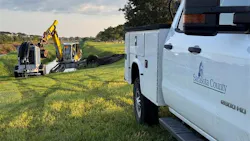
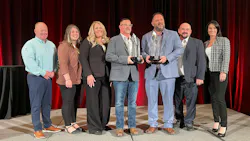
Sarasota County, Florida, Fleet Services won its third Fleet Masters Award earlier this year, and shows no signs of stopping its continuous improvement in processes and employee training.
Prior to 2026, Sarasota County won the award in 2014 and 2019.
Justin Mullins, fleet manager, Michael Naletko, CEM, fleet maintenance manager, and Errin DeJonge, CAFM, fleet business operations manager, run the team behind this year's large fleet award winner with more than $100 million estimated replacement value.
Let's look at some of the strategies that contributed to their third win.
Fiscal transparency, specialist
One of the team's strengths is knowing what they don't know — in other words, where they need a specialist.
"Our dedicated Fiscal Specialist manages all monthly billings for maintenance, vehicle replacement, fuel, fuel taxes, and direct-billed work orders," Mullins says. "She works with our management team to review and adjust the department’s maintenance and replacement rates annually, ensuring they align with our budget.
"Monthly, she provides financial updates to track departmental spending and ensure we're staying within budget. We generate detailed analytic reports to monitor key financial metrics, such as parts and fuel costs, to ensure everything is operating efficiently and effectively."
Sarasota County Fleet Services operates as an internal service fund within the county, and supports departments through a transparent financial model. Revenue is generated through direct billing and monthly rates that cover maintenance, replacement, fuel, and administrative costs.
"We also conduct annual surveys of labor rates, fuel, and admin fees of other local fleets and vendors to ensure our charges remain competitive," Mullins says.
If you're curious, the fleet's across-the-board FY25 rates were: labor = $119/hr.; diesel markup = $.59; gas markup = $.35 over rack rate.
Fuel management system
Fleet Services transitioned to a new fuel management system through E.J. Ward.
"We had many ongoing issues with our previous system, including lost transactions and revenue," Mullins says. "This [new] system is a vast improvement over our old system.
"Their software, Fuel View, automatically collects data on all aspects of our fuel program. It allows us to monitor our fuel sites remotely, including system alarms, and track all transactions, tank levels, deliveries, and other data related to the fuel program."
Most of the fleet's transitions are automated and rely on vehicle fuel rings. This is meant to eliminate human error in the transaction data and provide robust access control.
"We replaced all the control terminals and other hardware on our fuel sites," Mullins says. "We also converted nearly 1,000 vehicles' hardware in less than a month, with minimal disruption to our customers' operations. This new system is state-of-the-art, relying on fuel rings that automatically pull all transaction data from the system and the vehicles' existing telematics units."
Sarasota County hones in on technician training
Mullins says they are getting cleaner data with much better tracking and control of fuel transactions. The system is cloud-based with on-site data backup. The system supports most HID access control products.
"This enables us to use our current County ID badges with the existing fuel fobs, adding greater accountability by requiring dual authentication for all manual transactions," Mullins says. "And, this system accurately tracks on-road and off-road fuel use, ensuring that our customers don't overpay fuel taxes."
Acquisition and disposal
Sarasota County has an Acquisitions Division (handling incoming and outgoing equipment), staffed by DeJonge, a CAFM-certified manager, and two administrative professionals.
Each asset class is assigned a lifecycle point system, which determines when an asset should be evaluated for replacement. This system tracks key metrics, including age, usage (meter readings), and life-to-date maintenance costs. These metrics are integrated into a real-time Power BI report that is accessible at any time. When an asset reaches its replacement threshold, it undergoes a detailed inspection and a review by the relevant department before proceeding.
How to quantify the equipment replacement decision
The acquisitions team collects and enters all warranty information into Fleet Services CMMS system at the time of delivery, enabling warranties to be fully utilized.
A Risk Department is responsible for identifying assessing, and mitigating risks related to the operation of fleet vehicles. This involves ensuring safety and compliance, managing insurance and claims, implementing preventive measures, and leveraging data analytics to monitor and improve fleet operations.
"We have telematics on all our on-road assets and most of our large equipment, which continuously monitor operations and provide safety feedback and reports," Mullins says.
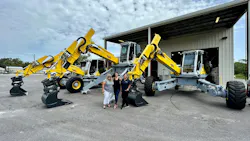
Data management
How is all the data handled?
There are several systems for data management. Most fleet asset information is housed in its FMIS or CMMS database.
"We currently use AssetWorks Fleet Focus, which houses our equipment records, work orders, parts, historical costs, and other data," Mullins says. "The system provides reporting, but we've found it to be lacking. We currently use Power BI to pull specific tables and create custom, real-time reports that show asset replacement criteria, technician productivity, work order completion, preventive versus reactive maintenance, fleet availability and utilization, and many other KPIs."
Mullins says that using Power BI also lets them merge data from multiple databases into a single report, resulting in simpler, more complete reports. Fleet Services then uses this data to benchmark with other local organizations and fleets both within the state and nationwide.
"In addition to our CMMS, we've installed Samsara as our county-wide telematics platform," Mullins says. "We've found the system to be comprehensive but also very user-friendly. It has dramatically increased operational awareness and efficiency. We currently have the system installed on about 1,280 assets. County Administration, Human Resources, Risk Management, and Fleet Services have access to all assets. Other county departments have access only to their assets."
The departments are using it to improve tracking, utilization, and dispatching. "When benchmarked against similar Samsara fleets, we are now in the top 25% for utilization. Risk Management has used it to reduce speeding and severe accidents," Mullins says.
"This year, Fleet also completed an integration that pulls meter information from both our telematics and fuel management software into our CMMS nightly," Mullins says. "This upload ensures accurate meter data in the system and, in turn, more accurate PM intervals. We are also using the system to provide live DTCs that help us prevent breakdowns and expensive repairs."
Additionally, every technician is assigned a laptop to clock in and out of tasks, order parts, and use online diagnostic software such as Identifix, All Data, and Cummins Quickserve. All shop diagnostic laptops have OEM diagnostic software for every manufacturer Fleet Services maintains.
"To help manage all these systems, we have a dedicated EIT employee on-site for software and hardware support," Mullins notes.
Training
Training has always been a hallmark for Sarasota County.
Its team members hold many of the industry's most recognized credentials, including CPFP, CEM, CAFM, EMS, and Lean Six Sigma.
"Through participation in AEMP, APWA, FLAGFA, & NAFA, we evaluate our policies, procedures, and measures to ensure we are following best practices," Mullins says. "In FY24, we received APWA (American Public Works Association) accreditation. During this process, our entire operation, including our policies and procedures, was reviewed and approved by the APWA team."
How to build a training matrix for your equipment shop
For even more transparency, Fleet Services outward-facing policies are published on the county SharePoint site, making them readily available to internal customers. The policies specific to Fleet Services staff are published on an internal cloud drive, which the entire fleet team can access.
Technician training is provided quarterly by bringing in a vendor for in-house, hands-on training on various automotive and heavy equipment classes.
"We regularly send technicians to specialty training on fire apparatus and other specialty equipment," Mullins says. "Our shop supervisors hold smaller classes for the technicians when new hardware is brought into our fleet, such as Samsara and the fuel rings. We have access to several online training resources. These include the County’s leadership/management classes and technical training from Ford, Cummins, Allison, and other vendors."
Fleet Services also has a library of ASE and EVT literature that provides the most up-to-date study material for certifications.
"We have a very aggressive ASE/EVT incentive program that allows technicians to earn up to $10 per hour in additional compensation for holding certifications," Mullins says. "As a result, all three of our maintenance facilities are ASE Blue Seal Certified and have been for the last fourteen years consecutively."
The fleet also compares sustainability data with other state & regional organizations through IFAS. All of Fleet Services' sustainability efforts are coordinated/outlined in a Fleet Energy and Sustainability Plan. When applicable, these items are often incorporated into the county’s Strategic Plan.
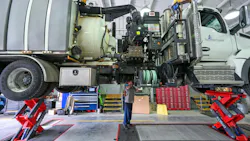
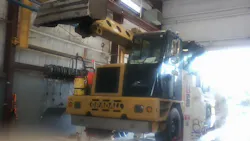
Fleet Services recently expanded, with a new 88,000-square-foot maintenance facility to consolidate operations into a climate-controlled, modern space featuring 32 technician bays, overhead cranes, built-in fall protection, fluid management systems, and expanded training facilities. A centrally located fuel site will further improve operational efficiency.
About the Author
 Frank Raczon
Frank Raczon
Frank Raczon has covered and influenced the equipment industry for 35 years, including 15 years as senior editor of Construction Equipment, and marketing, advertising, and public relations work with the industry's top manufacturers. In addition to authoring "Caterpillar: Modern Earthmoving Marvels" (Motorbooks, 2015), he has won numerous awards in his career, highlighted by nods from the Construction Writers Association, the Association of Equipment Manufacturers, the Business Marketing Association, and BtoB magazine. Raczon has also won a number of awards from publishing peer groups such as ASBPE and TABPI.