Machine Review: Independent Operators Evaluate the Takeuchi TL11R3 Compact Track Loader
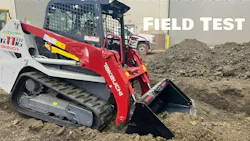
With the compact track loader market remaining hot, a cold day during a Chicagoland winter was the backdrop for a Construction Equipment Field Test of the Takeuchi TL11R3 CTL, the company’s first unit with EH controls.
Takeuchi is the Japanese originator of the compact track loader category, but today it's equally known for its smaller excavators, wheel loaders, and crawler dumpers. The company offers six different models of track loaders in 2026, and the new TL11R3 is one of its most advanced.
The unit is billed as a versatile earthmoving machine, which made it perfect for the Independent Union of Operating Engineers Local 150 in Wilmington, Illinois, who we asked to test it out.
The operator/instructors at Local 150 even had a surprise for us—we were going to put the machine through its paces in one of their large indoor arenas.
Learn safe trailering tips for compact iron
It had ample space to dig, grade and load trucks. The only thing the test would be lacking was the biting north wind.
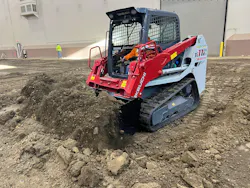
Operator/instructors Brian Russell and John Gallet had the honor of running the TL11R3, hogging dirt, grading, operating on slopes, and loading a truck.
Chris Petges, a territory manager for McCann Industries, Takeuchi's Chicago-area dealer, gave the pros a walk-around on the machine.
The radial-lift model used for the test featured electro-hydraulic (EH) controls, an 8-inch touchscreen, a standard rear camera, and an 80-inch smooth bucket. High-flow units have two additional cameras on the back towers, and screens will show a 270-degree view. Eighty four-inch smooth and tooth buckets are also available.
Three questions with Takeuchi prez Jeff Stewart
All enclosed cabs come with a standard hydraulic quick coupler.
A quick look at the 11,650-pound, 107.3-horsepower machine tells you it's a robust unit made for grading and dirt work rather than carrying mulch. There's a heavy-gauge cross member up front. The cylinders are well guarded. The arms look beefy. Slamming the door makes a solid sound, lending confidence to fit and finish.
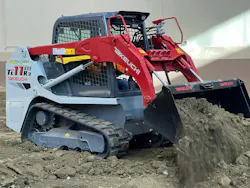
Notable TL11R3 features
As the operator/instructors looked on, Petges pointed out a number of features and helpful changes made to the new unit that will no doubt be rolled out to future Series 3 machines.
"Being that this is Takeuchi’s first electric-over-hydraulic machine, we have the ability to do a lot more features on the attachment side that we didn’t necessarily have before," Petges said. "The operator can choose to be more aggressive or less aggressive [with movements]."
Standard hydraulic flow is 23 gpm. The high-flow option checks in at 40.5 gpm. Standard hydraulic auxiliaries will come with two auxiliary ports and a case drain, as well.
"We also have a 14-pin connector," Petges said. "Takeuchi now offers you the ability to go in and choose which pins are live for which attachments, and in coordination with specific functions on the joysticks."
The TL11R3 is a two-speed machine, and operators will have the ability to put in auto-shift up and auto-shift down depending on the load the machine is under, according to Petges.
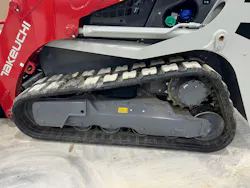
"Undercarriage wise, they’ve done a couple of things differently to these machines," Petges explained. "Up front, we now run a double-flange roller, which allows for a smoother ride. It distributes the weight a little bit better than the single-flange roller that we typically had, and it also helps with [preventing] detracking.”
Takeuchi also runs triple-flange rollers in the middle, which allow for two points of contact at all times, and double-flange rollers on the back.
How to maintain undercarriages
At the back of the machine are some interesting common-sense features not every CTL manufacturer has thought of. Most striking is the thick back door that opens to the cooling system and other components.
"These are very, very heavy steel-gauged back doors," Petges said. "CTLs can be susceptible to backing into objects, and this door holds up well, it’s very rigid. Also, the fins on the door are pointed upward rather than downward. Backing into brush piles, it would push the material upward rather than guiding it into the radiator."
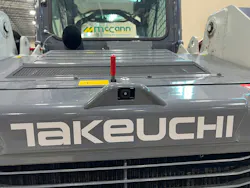
In addition, there is an optional additional counterweight kit. Takeuchi has gone to a side saddlebag style for the TL11R3; prior to that it provided block pattern weights in the back.
Serviceability
The company has enhanced serviceability in ways you can see and in some ways that you can't.
"The hydraulic fill tank in the left-hand tower is made of all steel," Petges said. "As you’re running something likea mulch head or a grinder and that continous flow runs through the machine from the attachment side, the hydraulic fluid begins to warm up, so what that hydraulic tank steel does is begins to dissipate the heat.
"There's also a very large cooling radiator stacked with the cooling module in the back," Petges said. "And there is a secondary fuel filter with a water separator."
All service is performed through an easy access door in the back and via the swing-out radiator, except for maintenance on the hydraulic pilot filter, which is under the cab.
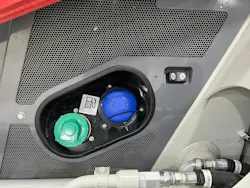
One of the neatest features is for convenience. There is a rocker switch next to the fuel and DEF fill nozzles that helps the operator determine the fluid levels.
"Engage the button and DEF and fuel fill monitor will beep faster and faster as you fill. When it goes to a single, constant tone, you know the tank is full," Petges said.
Operator reactions
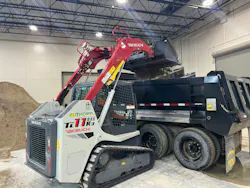
Operator/instructors Russell and Gallet attacked the dirt in the arena, digging, grading, backfilling, and testing the machine on a slope. A truck was nearby for loading, as well.
Russell was first on trenching and backfilling.
"It had plenty of power for digging," Russell said. "It just seemed a little weak on the reactiveness of the bucket, the reaction of the hydraulics. I call it the flop method, where you just take the bucket and kind of throw it up in the air, throw the dirt out in front of you, and it just seems slow on that aspect, and I had the hydraulics set up at the at the high setting.
"There was plenty of stability on the slope and the ride was great, very smooth," Russell said.
He did some precise backing up to find the right angle for backfilling, and the rear-view camera played a role.
"The camera was very nice and clear," Russell said. "It would be nice if there were bars on the display like on a vehicle to let you know how far back you're getting; maybe to just give you a range, where it's green, yellow, red, something like that. If you're red, you know you're close."
Controls
Russell's control preference is ISO, which he finds is more like the old pilot controls than EH, forward and reverse on one side, bucket controls on the other. "It's more like running a dozer," he said. "When I first came here, it was all H pattern. Now I've been trained on the ISO side of it, and I find that ISO is a lot more fitting. Reaction time is immediate."
Russell said he found no stability issues: "I wasn't jarred around at all."
Gallet, on the other hand, ran in H pattern. "So I run in mostly the H pattern. This machine has both run ISO and H pattern. When I was in that machine, it was easy to switch it. Just push a button. It was easy to find.
Using your CTL for land clearing? Here's how to maintain it
"The machine itself had a lot of power. Even when I was breaking up the dirt, it was coming up pretty handily, and I didn't force it into the dirt," Gallet said. "And then, as far as grading, the visibility was fantastic. I could see both sides of the bucket. I also noticed when I was shaving the grinding, just trying to find grade, the machine was had enough power to get through the big areas, but it also let me also fine tune some of the grading areas. It was easy to play with."
Gallet said he did not change any of the sensitivity settings.
"I left everything where it was, because I honestly believe from being an instructor here that the best way to learn the machine is by getting in there and kind of figuring it out," he said. "Then, once you get used to it, adding in all those other features will help you be a better operator."
One heavy run seemed to produce track slippage.
"I wanted to see what kind of power it had to get into those big areas," Gallet said. "And I could feel that even though I was spinning, it was still going into the material. So it wasn't like spinning and stopping. It was working its way in with me working the bucket. I also liked that, because I was able to move and tilt the bucket back and forth to work the bucket into the dirt so I can 'pop it' in sections."
At one point, Gallet encountered a 4X4-foot chunk of dirt.
"I took the bucket, tilted it down, broke it up into pieces, and then I also drove over it with the track to break it up so I could grade the material," Gallet said. "Everything was kind of in a fluid motion. The size of the machine being 11,000 pounds also helped break up those chunks of dirt.
"Your material tells you how you're gonna excavate it or grade it," Gallet said. "And your job as an operator is you have to figure out how to do it. So, when you have a machine that helps you do it and it makes it easier on you, you're gonna get more production that way."
Gallet praised the T11R3's handling and stability.
"I'm surprised how it was because it's a heavy machine, but it did go through the dirt," he said. "When I was fine grading, I like to be able to see if that machine is going to tilt on one side on a low area or a soft area. And it seemed I had control of that machine the whole time, whether I was on hard clay or the soft clay that was broken up, I was able to feel the machine tilt from one side to another. And then you adjust, as an operator, so it's a good feel."
Gallet pointed out that there are some CTLs that can float and fall a bit without the operator noticing.
"You don't realize it until you back up," he said. "You're like, 'Oh my gosh. What did I do over here?' I was able to dig deep in a couple areas, because I wanted to be able to feel it. A lot of times when you're digging, you don't feel it until you get into that area, when it's too late and you're too far into it.
"I was actually able to feel that machine starting to go a little bit deeper or a little bit higher. So I was able to adjust back up and adjust. But as far as being on the field, you can't teach speed, but you can teach being efficient, and this machine can make you more efficient on the job."
Back-up camera help
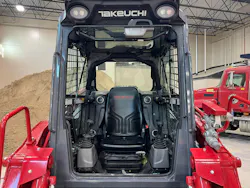
"I used the backup camera all the time in different spots," Gallet said. "I'm a firm believer of visibility on the machine. I did a lot of commercial work, so there were always people all around me. I was always turning my head here to see what kind of visibility I had with the glass and it was great visibility.
How onboard cameras aid visibility
"Plus the monitor is in spot where you could look down, where a lot of people are used to looking up and forward to it, but to have it down like that was a plus," Gallet said.
"Overall I thought the visibility was fantastic," he continued. "I love the visibility when I had the window open. I like the idea of being able to run a machine with the window open and the door closed, because I think sometimes the window distracts you a little bit with your grading, if it gets dirty. I like to be able to open it up and be able to get better visibility, a clearer view."
The machine's hydraulic response impressed Gallet.
"I thought it was perfect," he said. "I stopped the machine exactly where I wanted to stop. Some machines, you stop and it will go another inch or so."
Russell was impressed with the radial-lift unit's truck loading ability and bucket movement.
"I liked it," Russell said. "I had good reach into the truck and was able to see everything. Even with the door open, I was able to see the bucket.
"I was able to raise it with a full bucket and into the truck without feeling the machine tipping. And it wasn't bouncing when I was backing out. I was lowering and backing out at the same time. It was nice and smooth."
Overall, both operator/instructors gave the TL11R3 high marks.
"It has everything we're looking for in a track loader; moving dirt, grading, the visibility, safety, I think this machine is a good machine for operators," Russell said.
"I tried to do everything that I teach my students to do out on the job site," Gallet said. "And it had good visibility and great reaction time. I'd buy it in a heartbeat."
About the Author
 Frank Raczon
Frank Raczon
Frank Raczon has covered and influenced the equipment industry for 35 years, including 15 years as senior editor of Construction Equipment, and marketing, advertising, and public relations work with the industry's top manufacturers. In addition to authoring "Caterpillar: Modern Earthmoving Marvels" (Motorbooks, 2015), he has won numerous awards in his career, highlighted by nods from the Construction Writers Association, the Association of Equipment Manufacturers, the Business Marketing Association, and BtoB magazine. Raczon has also won a number of awards from publishing peer groups such as ASBPE and TABPI.