Perkins Takes Its Hydrogen Combustion Hybrid from Concept to Shredder
Key Highlights
- Perkins puts hydrogen-hybrid power into a working machine. The company is integrating its demonstrator into a Terex Ecotec TDS 820 shredder.
- Electric assist helps handle demanding loads.⚡The engine and motor generator unit deliver a combined 508 horsepower.
- There’s more to this test than horsepower. Read on for our views on hydrogen combustion and its potential for the future.
Last year at bauma in Munich, I caught up with the engine experts at Perkins, but we actually didn’t talk a ton about diesel. Our conversation focused more on batteries, electric assist tech, and hybrid engine platforms designed for alternative fuels. Of course, I remember thinking at the time that a lot of these big concepts (battery power to hydrogen combustion) are just that — big concepts — and I wondered whether these technologies would ever make it into actual applications.
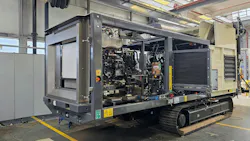
Well, Perkins just announced it is integrating its hydrogen-hybrid industrial open power unit, or IOPU, into a Terex Ecotec TDS 820 shredder. Announced in early October, the collaboration moves Project Coeus from a coolly named concept to an actual test engine in a working machine. From the press release:
“Demonstrating in machine is a key milestone for the team,” says Andy Curtis, customer solutions director at Perkins. “Showing the system operating in a real-world application recognizes the progress made over the past two years. From early in the project, we knew we wanted to work with Terex and its Ecotec environmental equipment business. Terex is one of the world’s leading OEMs for mobile wood processing, biomass, and recycling equipment — which we believe is a great fit for the hybrid IOPU. We were delighted when they accepted our proposal and we’re now working together at our research and development facility in Peterborough to install and demonstrate the system.”
What is Project Coeus?
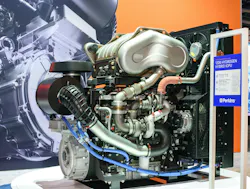
Perkins officially launched Project Coeus in October 2023. The project is built around developing a drop-in hybrid power unit, suitable as a direct replacement for a diesel. The hybrid is a spark-ignited engine concept based on a Perkins 1206 7-liter diesel engine. The prototype system has been developed in partnership with Equipmake and Loughborough University. Four fuels are being explored: hydrogen, ethanol, methanol, and biomethane. We’re seeing similar concepts across the off-highway engine market, with “multi-fuel engines” being one of our top 10 trends reshaping the construction equipment industry in 2026.
This project is being made possible via £11.14 million in UK government support through the Advanced Propulsion Centre UK. Who does what in this partnership?
- Perkins leads the project and developed the configurable spark-ignition combustion platform.
- Equipmake supplies the electrification engineering, including a custom heavy-duty electric motor, its silicon carbide inverter, and associated power electronics. It also integrated the motor generator unit, or MGU, with the Perkins engine.
- Loughborough participates as the university engineering partner.
Perkins and Terex move from development to machine testing
Perkins’ Customer Machine Engineering Team is currently installing the hydrogen-hybrid system at the company’s research and development facility in Peterborough, U.K. Perkins targeted Terex’s Ecotec business because of its wood processing, biomass, and recycling applications. It pairs nicely with Project Coeus’ clean power halo. From the press release:
“Ecotec equipment processes waste materials such as wood waste, biomass, and construction debris, helping customers recover reusable resources and reduce reliance on landfill,” says Conor Hegarty, business line director for Ecotec. “While our products are already making a positive environmental impact through the work they perform, we’re continually innovating to make the machines themselves more sustainable. Projects such as Coeus allow us to explore lower-emission technologies that can help meet future environmental requirements while continuing to deliver the power, reliability and productivity our customers expect from Ecotec equipment.”
How does this hydrogen-hybrid work?
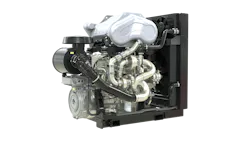
The Perkins 1206 hydrogen-hybrid IOPU combines a spark-ignited combustion engine with electric assistance. Electric assist means an electric motor adds power and torque to help the engine, especially when the machine suddenly faces a heavy load. A motor generator unit, or MGU, provides that electric assist. This 1206 hydrogen hybrid IOPU is engineered to deliver a total of 379 kilowatts, or 508 horsepower, fueled with gaseous hydrogen (like in its molecular form). The power unit delivers 1,938 newton-meters of torque, approximately 1,429 pound-feet, at 1,200 to 1,500 rpm. Perkins noted the engine required an advanced hybrid cooling system designed to reduce fuel consumption and noise from the IOPU, utilizing on-demand cooling technology. There were also other challenges, according to this Perkins article (where I grabbed this quote).
“The other difference is transient response,” said Ian Evans, engineering manager at Perkins. “For hydrogen, we must manage the air flow through the engine more carefully, relying on the turbo performance. You can’t just throw fuel at the engine and get transient response, like you can with a diesel engine. To minimize this change, we are using the hybrid system which has instantaneous torque.”
The Ecotec TDS 820 brings a demanding test application
The TDS 820 is a pretty gnarly unit. Watch it shred in that video above. The TDS 820 is a tracked, slow-speed, high-torque shredder. It can shred wood waste, biomass, and construction debris. This material muncher uses two independently driven shafts, and each shaft measures like 6 feet, 7 inches long, each engineered with welded cutting teeth. Independent gearboxes let the shafts operate separately, which is pretty cool, helping reduce material wrapping. A hydrostatic drive supports bidirectional shredding and provides protection when the machine encounters something that can’t be shredded. Operators can even customize this unit with shredding programs for different materials. Check out everything about the TDS 820 right over here.
Let’s be open-minded about fuel flexibility in the future
It sounds like Perkins is just preparing the demonstrator for machine testing, and the company has not released results on hydrogen consumption, refueling, emissions, or anything like that. And I know a hydrogen engine may not seem practical at the moment because, for one thing, the lack of hydrogen infrastructure for refueling, but hydrogen combustion is also a very practical concept. Instead of completely redesigning a machine around massive batteries or hydrogen fuel cells, a spark-ignited hydrogen engine can fit the engine compartment and operating profile of a wide range of construction equipment. Hydrogen can deliver the refueling speed, duty cycles, and general engine architecture of gas and diesels. That familiarity will go a long way with fleet managers and mechanics.
Don’t get me wrong. I think battery-electric equipment absolutely has a place. So does diesel. But large off-highway machines create different challenges, right? Mid-sized and larger construction equipment often work long, nonstop shifts, and they operate far from electrical infrastructure. Also, batteries are heavy and expensive. Then, there’s the whole recharging mindset — a refueling workflow that must completely change.
Hydrogen combustion offers a different emissions-free path, using an ignition-sparked combustion engine similar to a gas powerplant. Hydrogen ICE (internal combustion engines) can run on hydrogen gas and emit mostly just water vapor (although some aftertreatment may be needed); burning hydrogen at high temperatures can create nitrogen oxides, or NOx, which are pollutants.
Hydrogen ICE can be refueled with a fuel truck. Fleets could refuel machines quickly in the field instead of waiting for batteries to charge or installing high-capacity electrical infrastructure. Hydrogen combustion also avoids the massive battery packs required to electrify larger machines. That can reduce added weight and preserve payload, digging performance, balance, and machine packaging. Of course, this Perkins hybrid uses a battery, according to this Perkins’ engineering update. But these hybrids avoid the large battery capacities needed for an equivalent fully electric machine. Machine makers can also retain much of their existing engine, cooling, hydraulic, chassis, and drivetrain architecture. So, OEMs wouldn’t have to drastically redesign their machines.
Obviously, hydrogen still has to earn its place on the jobsite, and tests like this will help show where it fits. But let’s keep an open mind. The potential for cleaner power deserves a fair shot, and I, for one, am excited to see it in action.
About the Author
Keith Gribbins
Keith Gribbins is the head of content at Construction Equipment, where he leads editorial strategy across print, digital, video, and social channels. An award-winning journalist with more than 20 years of experience, Keith has won 17 national and regional editorial awards and is known for his hands-on reporting style, regularly visiting manufacturers, operating equipment, and covering major industry events worldwide.