Brush Cutters, Mulchers, and More: A Guide to Vegetation Management Attachments
Key Highlights
- Different attachments tackle different jobs: 🌳 Rotary cutters handle grass and brush, drum mulchers grind woody vegetation, and specialized tools remove trees.
- Hydraulic compatibility matters: Matching an attachment to a carrier's working hydraulic flow and pressure helps maintain performance and prevent damage.
- Expert advice from the field: Special thanks to Robert Burnett of HKX and Darin Gronwold of Ignite Attachments for sharing their expertise.
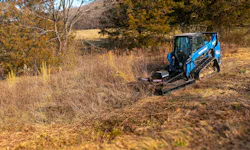
Lots of equipment can spearhead vegetation management. Excavators, tractors, compact track loaders, and even stand-on mini skids can wield mowers, saws, brush hogs, and beyond. Each tool carrier gives you pros and cons. Excavators have that long reach (perfect for cutting near lakes, as an example). Compact track loaders offer high-flow hydraulic power, speed, and easy transportability (ideal for tackling multiple mow jobs in a day). Equipped with the right attachment and safety add-ons, these carriers can tackle a bunch of different veggie jobs — mow highway rights-of-way, clear construction sites, maintain utility corridors, or maybe create wildfire breaks.
For each of these jobs specifically, attachment selection has expanded. Contractors can choose from drum mulchers, disc mulchers, flail mowers, brush saws, tree shears, or crazy extendable saws that are straight out of a horror movie. Each handles vegetation differently, and understanding those differences is important to finding the right combo.
Understanding the different types of vegetation management attachments
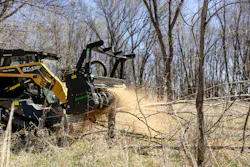
It can be confusing. At a cursory glance, a rotary brush cutter or a disc cutter might look like similar attachments. What’s the difference between a flail mower and a drum mulcher? They kind of look alike when not attached to a machine. There are major differences between these categories. Some quickly knock down grass and saplings. Others grind trees into mulch. Here’s a breakdown.
Rotary brush cutters
Think of these as heavy-duty lawn mowers. Rotary brush cutters use large steel blades spinning beneath a reinforced deck to cut grass, weeds, thick brush, and small trees. Open-front designs expose more of the cutting assembly for tackling woody material, while closed-front decks offer better debris containment. Rotary cutters typically leave behind bigger chunks of brush and debris than dedicated mulchers.
Drum mulchers
When the vegetation gets tougher, call in the drum mulcher. These attachments use a horizontal, high-speed rotor equipped with carbide teeth or steel knives to grind trees, brush, and woody debris into smaller pieces. Unlike rotary cutters, drum mulchers can repeatedly process material on the ground to produce a finer finish. They’re often used for forestry work and clearing heavily wooded properties.
Disc mulchers
Disc mulchers use a large rotating steel disc equipped with cutting teeth to tackle dense brush and standing trees. Their cutting action allows operators to aggressively fell bigger woody vegetation, but they don’t grind material into smaller pieces like drum mulchers. Noting: Some models do incorporate additional teeth beneath the disc to grind material.
Flail mowers
Flail mowers use a horizontal rotor fitted with swinging knives or hammers to shred grass, weeds, brush, and lighter woody vegetation. They’re often selected for roadside mowing, ditch maintenance, and embankments. They’re great on excavators and tractors. Different cutting tools allow manufacturers to configure each attachment for lighter mowing or maybe more serious vegetation.
Brush saws and tree shears
Sometimes the job is to remove individual trees or bushes. Brush saws use rotating, toothed cutting wheels to sever woody material, often close to ground level. Tree shears use hydraulic cutting blades to sever standing trees. Some models incorporate grapples to hold or position the material. These attachments allow contractors to remove trees without making a mess.
Stump grinders and stump cutters
Stump grinders use rotating cutting wheels or drums equipped with hardened teeth to grind remaining stumps into smaller wood chips. Excavator- and loader-mounted models allow contractors to remove stumps without bringing a separate dedicated grinder to the jobsite.
Grapples, tree pullers, and root rakes
Grapples help operators collect, sort, carry, and load branches, logs, and brush piles. Tree pullers use gripping jaws and the carrier’s lifting force to remove smaller trees and shrubs, sometimes including their root systems. Root rakes help separate roots, branches, and other woody debris from soil during cleanup.
Buying advice: Matching a brush-cutting attachment to an excavator
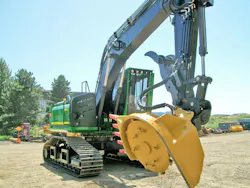
This section was written by Robert Burnett, vice president and general manager at HKX Inc.
Mowers, mulchers, and brush cutters make heavy demands on an excavator’s hydraulic system. They run continuously while the operator swings, booms, and travels to keep the head in material. A few checks before buying will help protect productivity and the machine.
Start with how oil is delivered, not just how much. A standard auxiliary circuit may provide the required flow and pressure, but oil follows the path of least resistance. Swing downhill and the cutter speeds up. Swing back uphill and it slows, forcing the operator to modulate other controls. A priority flow divider sends a set flow to the tool first and shares the remainder with other functions. Ask the dealer how the attachment will perform when several functions are running.
Size the tool to working flow, not rated pump flow. When the head hits material, pressure rises and the pumps destroke, so a machine rated at 100 gpm delivers less under load. A common guideline is to send no more than 40 percent of total pump flow to the tool, or about 40 gpm on a 100-gpm machine.
Check where the oil returns. A hydraulic motor's case drain needs a properly sized path to tank, or pressure builds in the motor case and the seal fails. Main return oil should pass through the cooler, since some tank ports bypass it. Brush cutting is dirty work, so external filtration on the case drain and main return line protects the tank filters.
Look at the hardware. Steel tube resists abrasion in brush better than rubber hydraulic hoses, and line placement should match the attachment’s ports. Latching controls let the tool run steadily, avoiding the on-off pressure spikes that shorten seal life. For high-production work such as right-of-way clearing or wildfire fuel reduction, priority flow is a sound place to start.
Make the first pass count
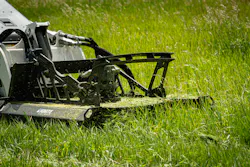
This section was written by Darin Gronwold, product manager at Ignite Attachments.
Effective site preparation starts with understanding what comes next. Before excavation, grading, or utility installation can begin, contractors need to determine how much clearing the project requires. Removing too little can create obstacles down the road, while removing more than necessary wastes time and resources. The key is matching the clearing approach to the next phase of construction.
Start with the end goal: A temporary access route has different requirements than an area designated for foundations or underground utilities. If the goal is simply to open a path, improve visibility, or remove overgrown vegetation, a brush cutter can make quick work of grass, dense brush, and smaller saplings without extensive soil disturbance. This allows crews to establish access and begin work without committing to unnecessary excavation.
Know when cutting isn’t enough: Brush cutters excel at clearing aboveground vegetation, but they leave established root systems and stumps behind. For projects requiring excavation, grading, or permanent structures, those obstacles may need to go. Once crews knock down the overgrowth, they can better assess whether tree pullers, stump buckets, or other attachments are necessary to prepare the site.
Work backward: The most productive clearing strategy isn’t always the most aggressive. By working backward from the project’s end goal, contractors can minimize unnecessary passes, reduce soil disturbance, and create a smoother transition to the next phase of construction.
New vegetation management attachments
Manufacturers continue to expand their vegetation management offerings with new cutting systems, more durable components, and attachments for smaller carrier machines. Enjoy the following showcase.
Loftness Kwik Cut brush cutter
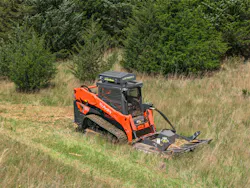
Loftness recently introduced an upgraded Kwik Cut brush cutter attachment for skid steers and compact track loaders, featuring a reinforced housing, stronger floating door, and improved hinge design for increased durability and cutting performance. The attachment can cut brush and trees up to 10 inches in diameter and is backed by a two-year warranty. Its 72-inch disc features four retractable, dual-edge beveled blades and 18 carbide teeth for grinding stumps and brush to ground level. Powered by a 150cc radial piston motor, the Kwik Cut delivers instant torque and efficient cutting performance. Additional enhancements include reinforced steel tubing, improved frame strength, bearing anti-wrap protection, and an easily monitored pressure gauge. Designed for machines with 28- to 45-gpm hydraulic flow and pressures up to 5,000 psi, the updated attachment provides greater strength, reliability, and efficiency for demanding vegetation management and land-clearing applications. For more info, visit Loftness’ website.
Prinoth Grizzly M300e forestry mulcher
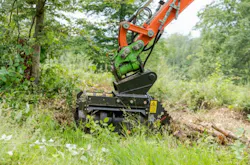
Prinoth’s Grizzly M300e is a compact forestry mulcher for excavators in the 1.5- to 4-ton class, a size range the company had not previously served. Developed and built in Germany for long service life and low operating costs, the mulcher is light and simple to handle, suiting these smaller machines. The 11.8-inch rotor covers a 22.4-inch working width and processes grass, undergrowth, shrubs, branches and small trees. The M300e also introduces Prinoth’s ES compact tool, a single-edged, hardened blade that mounts with one bolt. Direct drive, protected hydraulic connections and a Hardox steel housing support reliability, while replaceable Hardox skids reduce wear and downtime. Applications include forestry, landscaping, municipal and agricultural work. The Grizzly M300e and Prinoth’s other excavator and skid steer mulchers are available now through dealers nationwide. For more info, visit Prinoth’s website.
Blue Diamond Heavy-Duty Open-Front Brush Cutter
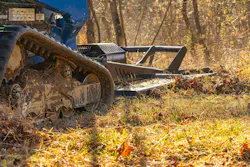
The Heavy-Duty Open-Front Brush Cutter offering from Blue Diamond Attachments now includes a 60-inch model, in addition to a 72-inch model. These attachments deliver powerful and reliable performance for heavy brush and grass cutting and can cut trees up to 5 inches in diameter. Both brush cutters feature a reinforced 1/4-inch steel deck that provides strength and rigidity for a longer attachment life, plus a heavy-duty push bar for operator safety and improved productivity. An oil-filled direct drive system prevents costly lower bearing seal failure, while delivering more power and withstanding greater impact than competitive brush cutters with gearboxes. The Heavy Duty Open Front Brush Cutters also feature three 1/2-inch double-sided, drop-down blades that extend blade life, improve balance and provide a closer cut than two-blade systems. For more info, visit Blue Diamond’s website.
Cat BRX118 and high-flow BRX318 brush cutters
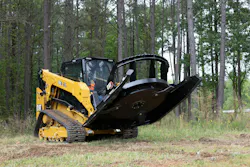
Caterpillar has expanded its industrial brush cutter lineup with drop blade configurations for skid steer loaders and compact track loaders. Available as the standard-flow BRX118 and high-flow BRX318, the attachments feature a 72-inch cutting width and can cut material up to 8 inches in diameter. The drop blade configuration complements the two-blade standard duty and four-blade industrial cutter. The industrial drop blade brush cutters share the same open face cutting deck design as the four-blade industrial cutters while utilizing a three-blade, drop-blade carrier more similar to the standard duty brush cutters. The drop blade style has a lift effect, pulling heavy grasses upwards for a cleaner, more efficient cut and can reduce time spent clearing overgrown areas. Applications include land clearing, landscaping and agriculture, as well as maintenance of pastures, highway medians, building lots and utility easements. A fully balanced, 500+ pound carrier uses three free-swinging, hardened blades to provide high blade inertia for cutting dense brush. Additional features include heavy-duty skids for uneven terrain, a reinforced push bar, anti-cavitation valve and integrated accumulator designed to protect the drive motor and support long-term durability. For more info, visit Caterpillar’s website.
Kubota by Land Pride SC110 Series Skid Cutter

Kubota’s SC110 Series Skid Cutter, available through Kubota dealers as part of the Kubota by Land Pride attachment lineup, helps contractors tackle demanding vegetation management and land-clearing projects. Designed for land clearing applications, the heavy-duty SC11072 offers a 72-inch cutting width and can cut brush and trees up to 10 inches in diameter. Its two-piece laminated steel blade carrier features four reversible, heat-treated blades and 16 carbide grinding tips. A quarter-inch steel deck and side skirts are built for tough conditions, while front and rear chain guards help reduce flying debris. A push bar directs cut material away from the operator’s cab, and a folding front door opens for heavy brush cutting and covers the cutting chamber when not working in heavy brush. For contractors clearing overgrown properties or preparing sites for development, the SC11072 offers a purpose-built attachment for demanding land-management projects. For more info, visit Land Pride’s website.
Bobcat Brush Saw
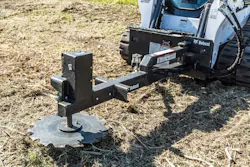
The Bobcat Brush Saw attachment cuts through brush, saplings, and small trees to clear pastures, grasslands, firebreaks, roadways, and utility line right of ways. Unlike a tree shear, the brush saw cuts trees flush with the ground or slightly below the surface to minimize stumps. Its high-torque, low-speed hydraulic motor powers a 28.5-inch cutting wheel with 15 replaceable, weld-on carbide-tipped teeth, delivering efficient cutting while reducing the potential for stalling. The attachment can quickly remove small trees up to 15 feet tall. Operators use the loader’s steering and travel functions to guide the saw through material, with cut debris discharged to the left, away from the loader. A manually adjustable, three-position boom angle allows operators to position the saw at center or 12 degrees left or right for improved visibility of the cutting action. A steel deflector shield helps protect the operator and loader from flying debris. A special applications kit with a polycarbonate door and windows is required for operation. For more info, visit Bobcat’s website.
Takeuchi closed-front rotary brush cutters
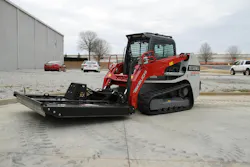
Takeuchi’s closed-front rotary brush cutters are designed to efficiently clear grass, weeds, undergrowth, and small trees. Their closed decks and standard chain curtains help contain flying debris while providing excellent mulching capabilities. Two models are available with 66- and 72-inch cutting widths and recommended standard hydraulic flow rates ranging from 14 to 25 gpm. High-flow motor options are also available. Both models offer a minimum cut height of 1.8 inches and can cut material up to 4 inches in diameter. Dual pressure relief valves protect the motor and loader’s hydraulic system from damaging pressure spikes, while rugged deck bracing provides strength and long-term durability. Replaceable skid shoes add deck strength and extend wear life. Optional rear rollers help produce a smoother ride with less gouging and scalping, while optional swivel casters improve cutting performance. Both attachments are designed for track loaders with a rated operating capacity greater than 1,500 pounds. For more info, visit Takeuchi’s website.
John Deere RE40 Brush Cutter
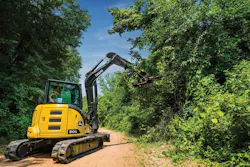
The John Deere RE40 Brush Cutter helps compact excavator operators manage vegetation in difficult-to-reach areas, including embankments, ditches, over-fence brush and rail rights of way. Three swinging blades mounted to a blade carrier can fell and cut material up to 6 inches in diameter, giving contractors a versatile tool for demanding brush-clearing jobs. A heavy-duty hinged debris shield retracts when the head engages trees and brush, exposing the blades for aggressive cutting. Directionally beveled blades draw material into the cutter head for further processing. When the leading edges wear, operators can unbolt and reverse the blades to provide a fresh cutting edge and extend blade life. An automatic hydraulic braking system quickly stops blade rotation after shutdown. A bolt-on mounting system accommodates a variety of coupling systems and allows the attachment to be reconfigured if coupling requirements change, helping contractors adapt the cutter to their equipment needs over time. For more info, visit John Deere’s website.
Ignite Attachments mini brush cutter
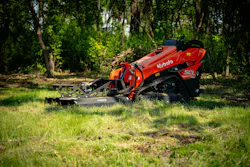
Tight access shouldn't limit the jobs landscape professionals can take on. The 44-inch mini brush cutter from Ignite Attachments expands the capabilities of mini skid steer loaders, giving operators a dependable way to clear overgrown vegetation in backyards, confined job sites and other areas larger equipment can't reach. Built to cut brush and small trees up to 3 inches in diameter, the attachment handles demanding clearing projects without sacrificing maneuverability. Swing-away blades, an integrated stump jumper and a lift restriction chain provide added protection during challenging applications, while an optional push bar helps keep vegetation away from the operator when pushing into thick vegetation. Additionally, the brush cutter offers a low cutting height, helping operators achieve a quality finish with fewer passes. A dual-interface design accommodates both mini Bob-Tach and CII mounting systems, helping landscape professionals and rental centers maximize attachment utilization across mixed fleets. Available in spring 2027, the mini brush cutter brings Ignite’s dependable design and value to vegetation management. For more info, visit Ignite’s website.
Diamond Mowers DM360 Multifunction Machine and Drum Mulcher Pro X2
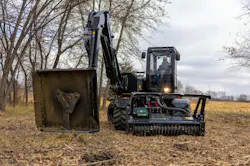
Diamond Mowers has introduced two products for vegetation management: the DM360 multifunction machine and Drum Mulcher Pro X2 attachment. The DM360 combines boom and attachment technology with an integrated carrier platform for roadside, right-of-way, and municipal maintenance. Features include 360-degree operation, joystick steering, multiple steering modes, and a stabilizing axle. A low-mounted engine improves balance, while clear vertical sightlines increase operator visibility. The machine supports mowing, mulching, snow removal, and other seasonal applications. The Drum Mulcher Pro X2 is available in 60- and 72-inch cutting widths and can process material up to 9 inches in diameter. Contractors can choose between open drum and depth control configurations. The attachment incorporates Diamond’s tooth technology, while a redesigned profile improves stability and balance. Simplified service access helps reduce downtime during maintenance. Both products target contractors and municipalities looking to expand equipment versatility across vegetation management applications. For more info, visit Diamond Mowers’ website.
About the Author
Keith Gribbins
Keith Gribbins is the head of content at Construction Equipment, where he leads editorial strategy across print, digital, video, and social channels. An award-winning journalist with more than 20 years of experience, Keith has won 17 national and regional editorial awards and is known for his hands-on reporting style, regularly visiting manufacturers, operating equipment, and covering major industry events worldwide.