Everything You Need to Know About Compact Wheel Loaders in 2026
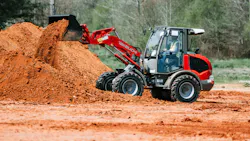
Key takeaways:
- Built to move materials. Compact wheel loaders combine speed, visibility, and lift capacity for productive material handling.
- Choose for the job. Match boom type, attachments, lift height, and travel speed to your application.
- Smarter than ever. Modern compact wheel loaders add automation, telematics, remote operation, and electric power.
A big part of construction is just moving stuff. Move dirt. Move stone. Move pallets. Move mulch. Move snow. Then let’s move it all again. This is where compact wheel loaders shine.
These machines excel at material handling — particularly in confined-space situations. They travel fast, carry heavy loads, and offer excellent visibility. In fact, they offer many advantages over competing compact loaders like skid steers and compact track loaders. Operators sit higher above the work area in comfortable cabs. Articulated steering (vs. zero turning) makes for minimal ground disturbance and reduced tire wear and fuel burn. Larger compact wheel loaders can reach higher, over 10 feet, while telescoping variants can lift over 16 feet. Plus, modern hydraulics can still power attachments from buckets and forks to snowblowers and brooms.
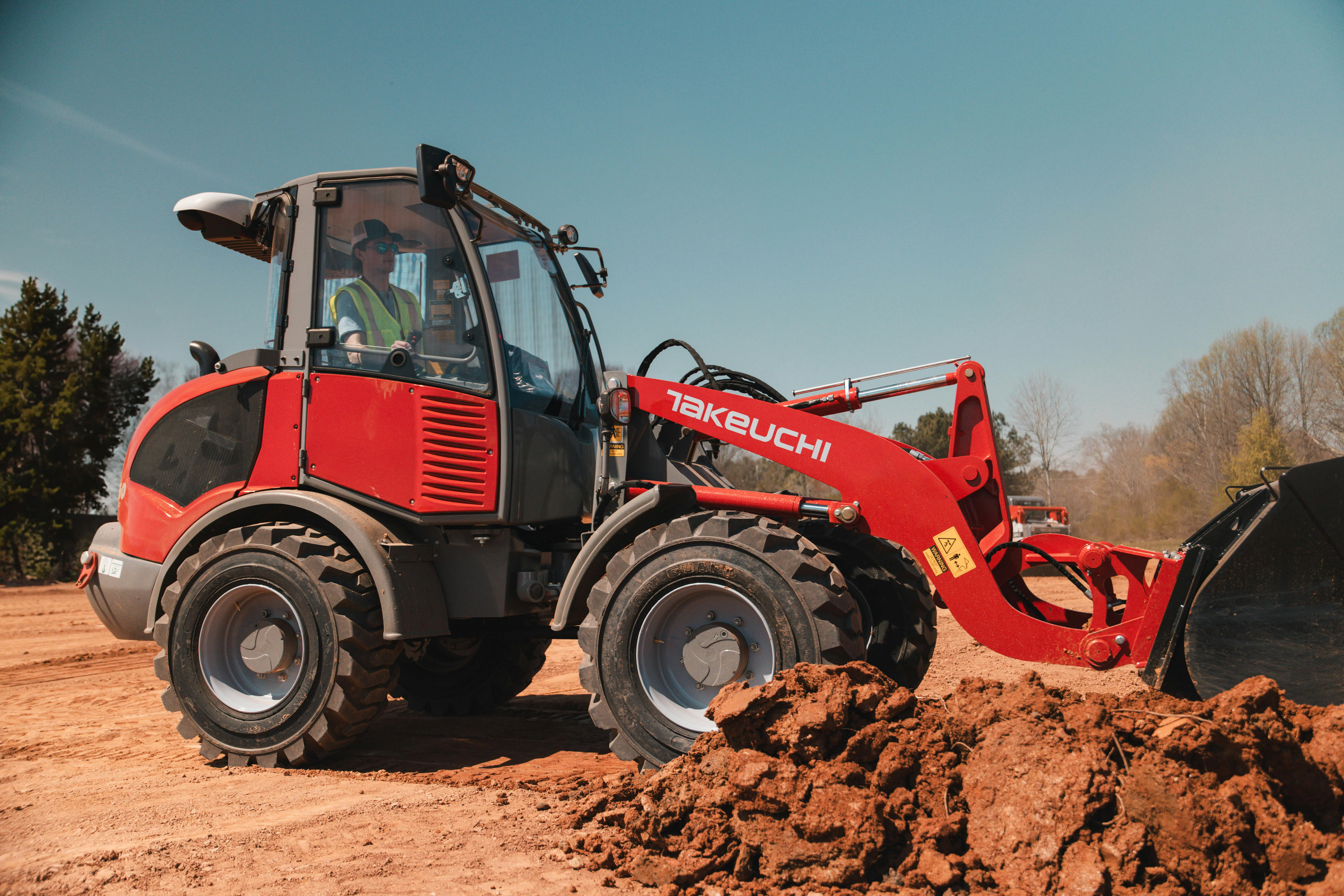
“Ultimately, the decision comes down to the application,” explains Dylan Freeman, product manager at Takeuchi-US, which offers three compact wheel loader models in North America (the TW60 Series 2, TW80 Series 3, and TW95). “While compact track loaders remain a popular choice for grading, excavation, and attachment-intensive work, many contractors find that compact wheel loaders can increase productivity in applications focused on loading, carrying, and transporting materials throughout larger or more spread-out jobsites.”
For years, compact wheel loaders lived in the shadow of skid steers and compact track loaders. Those are American machines. Compact wheel loaders are European. In 2026, more contractors are discovering the productivity and safety secrets to this small material carrier.
What is a compact wheel loader?
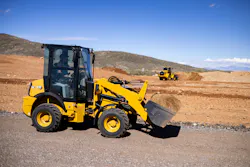
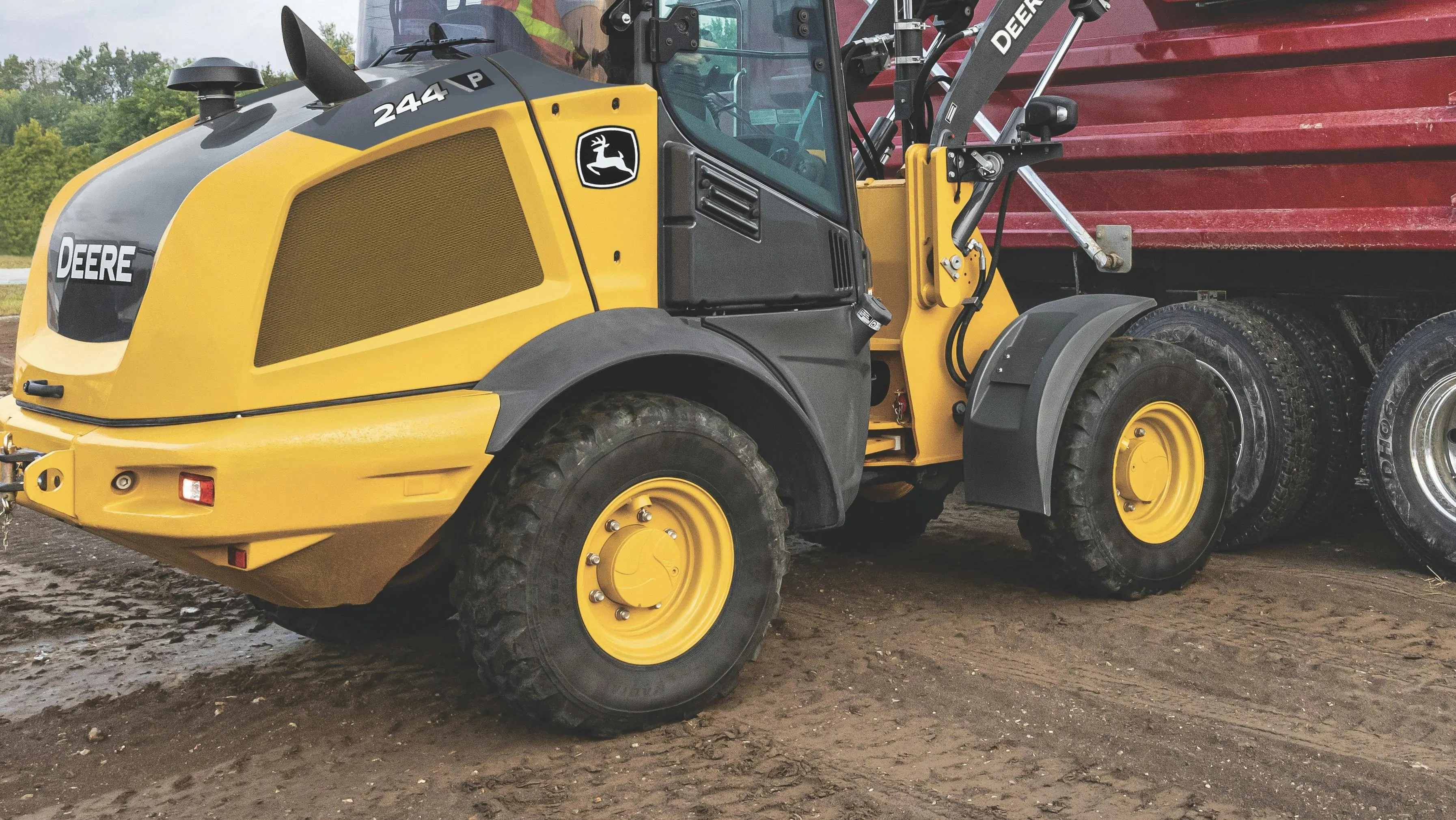
Good question. A compact wheel loader is exactly what the name implies: a scaled-down wheel loader built for smaller jobsites and tighter spaces. Most models weigh between 7,000 and 20,000 pounds of operating weight. They use articulated steering, meaning the machine bends in the middle instead of steering with front wheels alone. That wheel loader articulation also offers operators a tight turning radius and low impact on the jobsite surface (say something delicate like turf). Travel speed is a major advantage on these units. Many compact wheel loaders run between 18 and 25 mph and can often be roaded to jobsites. Unlike skid steers or track loaders, compact wheel loader operators sit high above the work area. Visibility to the bucket, forks, and surrounding jobsite is a big selling point.
“New operators may also be more comfortable learning on a compact wheel loader because it has a steering wheel and pedals rather than the joysticks of a skid steer loader,” notes Mike Camerino, senior marketing consultant at Caterpillar, which sells four CWL models — the 903, 906, 907, and 908. “That lineup is designed to give customers options based on operating weight, engine power, bucket capacity, and application needs, with larger models offering greater lift capacity and performance for more demanding jobs.”
The next generation of operators has grown up in a highly connected, technology driven world and will expect equipment to incorporate advanced technology that makes the machine easier and more efficient to operate," says Drew Norton, product specialist of compact equipment at Hitachi. "In many ways, the experience can feel like the interactive digital environments younger generations are already familiar with.
The category spans a surprisingly broad range of machines. Small models like the Hitachi ZW30 weigh just over 7,000 pounds. Larger units like the Takeuchi TW95 and John Deere 344 P-Tier push into operating weights between 18,000 and 20,000 pounds. I’ll note here that there is also a category of ultra small wheel loaders called “small articulated loaders.” It’s another Euro-style machine made famous by brands like Weidemann, Kramer, and Avant Tecno, but American brands like Vermeer, Case, and Bobcat have gotten into the sector with OEM partnerships. We’ll save those machines for another article.
The traditional compact wheel loader market is crowded with strong players. Major manufacturers include Caterpillar, John Deere, Bobcat, Volvo Construction Equipment, Kubota, Case Construction Equipment, New Holland Construction, Yanmar, Takeuchi, Hitachi, and Mecalac. Prices vary widely depending on size and features, but buyers can expect to spend roughly $60,000 to $85,000 for entry-level machines, $85,000 to $120,000 for mainstream models, and $120,000 to $200,000 or more for larger high-lift or telescopic units equipped with premium cabs, high-flow hydraulics, and advanced tech.
“Snow removal, nurseries, and agriculture are among the key industries driving demand for compact wheel loaders,” says Camerino. “Snow removal was especially active this season, while nursery growth and ongoing agricultural needs continue to support market demand.”
Compact wheel loader linkage and boom options
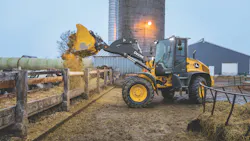
Compact wheel loaders may look similar from a distance, but their boom designs can dramatically change how they perform. Most models use either a Z-bar or parallel-lift boom configuration. Z-bar linkages deliver high breakout forces that excel in digging, loading piles, and moving dense materials like gravel or soil. Parallel-lift booms, sometimes called tool-carrier booms, keep pallet forks and attachments level throughout the lift cycle, making them ideal for material handling and pallet work. Some manufacturers offer hybrid linkage systems that blend the breakout force of a Z-bar with the level-lift characteristics of a tool carrier. An example of this would be Volvo Construction Equipment’s Torque Parallel (TP) linkage system. There are also high-lift and telescoping booms.
“High-lift machines provide a simple solution for customers whose primary need is a little additional dump height or reach,” explains Emily Pagura, product marketing manager with John Deere, which sells seven compact wheel loaders. “For those who need significant reach or height, but also want the maneuverability of a compact machine, our 326 P-Tier telescopic compact wheel loader provides additional reach and placement flexibility compared to traditional high-lift loaders. For applications such as stacking materials on high racking, loading trucks, placing pallets, pushing snow back to make room for the next blizzard, or supporting agricultural operations such as loading TMR mixers, a telescopic boom can significantly expand what the machine can accomplish.”
Attachments and couplers
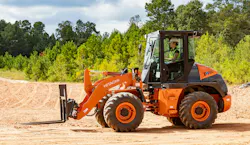
Attachments make wheel loaders tool carriers. Most compact wheel loaders leave the factory with a bucket. Pallet forks remain the second-most common attachment. Beyond that, attachment choices explode.
- Grapples
- Snow pushers
- Snowblowers
- Plows
- Angle brooms
- Bale spears
- Bale grapples
- Material booms
- Power box rakes
- Cold planers
- And lots more
Hydraulic quick couplers have become increasingly important in the compact category overall. There are basic mechanical couplers that involves the operator leaving the cab to manually attach and detach the attachment, and there are hydraulic configurations that allow operators to change attachments from within the cab. Within those configurations, there are a few different coupler styles. Many owners and operators want to switch attachments between machines, so now many compact wheel loaders offer a skid steer-style coupler.
“Hitachi compact wheel loaders come standard with couplers that are compatible with skid steer-style couplers to allow for attachment sharing,” assures Drew Norton, product specialist of compact equipment at Hitachi, which offers three compact wheel loaders (the ZW30, ZW50, and the ZW80). “Pin-and-hook style are also very common.”
The pin-and-hook style uses a two-step hook-and-lock system that allows operators to swap attachments. There is also the Euro- or Global-style coupler, which is popular in agriculture and larger compact wheel loaders, and ISO couplers, which are also more common on European wheel loaders.
Important Compact Wheel Loader Specs
By Dylan Freeman, Product Manager, Takeuchi-US
Lift height, operating capacity, breakout force, travel speed, and attachment compatibility are all important considerations, but how you prioritize them will depend on the application. Before comparing machines, buyers should first identify the work they expect the wheel loader to perform most often.
For material-handling applications, operating capacity, lift height, and visibility are often among the most important factors. Contractors loading trucks or handling pallets need to ensure the machine can safely lift and place materials at the required height. For applications involving aggregate, soil, or other bulk materials, breakout force can be a key performance indicator because it directly affects the machine’s ability to penetrate surfaces and fill the bucket efficiently.
Travel speed is another consideration, particularly on larger jobsites where operators routinely move materials over longer distances. A machine that can transport materials efficiently across the site can have a significant impact on productivity. Attachment capability is another important consideration. Buyers should evaluate auxiliary hydraulic performance, coupler options, and attachment compatibility to ensure the machine can support both current and future applications.
Finally, don’t overlook practical considerations such as machine dimensions, operating weight, serviceability, and operator comfort. The best compact wheel loader isn’t necessarily the one with the highest specifications — it’s the one that best matches the work being performed and delivers the greatest overall productivity for the operation.
Drive and traction systems
Nearly every compact wheel loader sold today uses all-wheel drive, but manufacturers take different approaches. Most machines rely on a hydrostatic transmission (HST), which uses hydraulic pumps and motors instead of a traditional gear transmission. Hydrostatic drives allow smooth acceleration, inching control, and precise low-speed operation, making them ideal for loading and attachment work (like snow). There are some variants. For instance, Bobcat offers an electronic hydrostatic transmission (E-HST) that automatically adjusts torque and speed to improve pushing power and fuel efficiency. There are also sometimes drive modes that operators can choose:
- Work mode — balanced performance
- Travel mode — maximum travel speed
- Eco mode — lower fuel consumption
- Creep mode — independent hydraulic flow and travel speed
Beyond the transmission itself, traction systems vary. Many compact wheel loaders feature open differentials with manually activated differential locks, while others offer limited-slip differentials or fully locking axles. It’s also worth mentioning that there is some unique traction and maneuverability tech on the market.
“One of the biggest differentiators is our industry-exclusive Articulation Plus steering system, standard on John Deere P-Tier compact wheel loader machines,” says Pagura. “This feature combines traditional articulation with rear-wheel steering to deliver an exceptional balance of maneuverability, stability, and load retention while carrying material.”
Wacker Neuson offers multiple steering modes on certain compact wheel loaders, including front-wheel, all-wheel, and crab steering. Mecalac Swing Loaders are built on a rigid, one-piece frame equipped with three standard steering modes: two-wheel, four-wheel, and crab steering. You got options.
Technology on CWLs

Features once found only on larger wheel loaders now appear throughout the compact segment.
“Features such as return-to-dig, boom height kickout, and automatic bucket positioning are becoming more common because they improve consistency and efficiency during repetitive loading and material-handling tasks,” says Freeman. “Ride control is another feature that many now consider highly desirable, particularly in applications that involve carrying loads over longer distances. By reducing bucket bounce and material loss during transport, ride control can improve both productivity and operator comfort. We’re also seeing continued demand for features that simplify machine operation, including multifunction joysticks, intuitive control layouts, and hydrostatic drive systems that allow operators to focus more on the task at hand."
Freeman breaks down each technology:
- Return-to-dig automatically resets the bucket angle after dumping.
- Boom-height kickout stops lift arms at preset heights.
- Ride control smooths the ride and reduces material spillage.
- Creep mode (via inching pedal) separates travel speed from hydraulic output.
- Throttle lock maintains hydraulic flow to attachments.
Snow contractors love creep mode or an inching pedal because they can run a snowblower at full hydraulic output while creeping forward. Landscape yards appreciate ride control because it keeps material inside the bucket instead of decorating the roadway. Technology doesn't stop there.
For contractors who have never operated a compact wheel loader, it’s important to understand that these machines have strengths that differ from other types of compact equipment,” says Dylan Freeman, product manager at Takeuchi-US. “Their travel speeds, lifting capabilities, and material-handling performance can make them exceptionally productive in the right applications.
“I think remote operation will start gaining momentum as the work force evolves,” says Norton. “The next generation of operators has grown up in a highly connected, technology driven world and will expect equipment to incorporate advanced technology that makes the machine easier and more efficient to operate. Solutions like Teleo’s remote operation technology align with these expectations. In many ways, the experience can feel like the interactive digital environments younger generations are already familiar with.”
Telematics continues to spread, and compact wheel loaders often come with free telemetry services for a couple of years. Owners want machine health data, maintenance reminders, fault codes, geofencing, and fuel tracking.
“Safety is always an area that advances with technology,” explains Camerino, “like operator not present auto shut down, seat belt requirements, and collision mitigation. From a performance perspective, payload would help landscape yards by enabling precise loads. Finally, advancements in technology will also allow less experienced operators to achieve the same quality of work as the super-experienced guys. You’ll be able to do more work in less time and for less money.”
Electric compact wheel loaders
Battery-powered compact wheel loaders remain an emerging category in North America. Volvo CE leads the segment with production-ready L20 Electric and L25 Electric models. JCB offers the 403E electric compact wheel loader. Caterpillar, John Deere, and Case have also introduced electric prototypes or early-production models. Diesel still dominates the market, but electrification is slowly gaining momentum.
“As with any equipment purchase, customer requirements ultimately drive adoption,” explains Freeman. “Buyers continue to evaluate factors such as machine performance, runtime, operating costs, infrastructure requirements, and overall fit for their applications. Those considerations can vary significantly from one customer and jobsite to another.”
Cab and comfort options
Manufacturers consistently point to visibility as the most important cab feature. Bigger windows, slimmer dashboards, roof windows, and camera systems help operators see more with less effort. Heated mirrors are becoming common, especially for snow applications. Rear cameras are everywhere. There are also AI cameras available. Visibility must complement comfort.
“Operators also prioritize comfortable seating, intuitive machine controls, lower noise levels, in-cab climate control, and easy cab access,” says Pagura. “Based on industry standards, today’s operators expect equipment that helps reduce fatigue during long shifts. Features such as air-ride heated seats, ergonomic joystick controls, adjustable steering columns, touchscreen displays, and improved HVAC performance all contribute to a more productive operator experience.
A comfortable operator is a productive operator.
“One of the most important things is that the entire cab space works together,” notes Norton. “An operator spends their entire day working inside this space, so it is essential to have everything in well-thought-out positions, within easy reach. Every little detail adds to operator comfortability.”
The future looks productive
The compact wheel loader isn’t trying to replace the skid steer. A compact wheel loader simply does certain jobs exceptionally well. Manufacturers continue adding bigger cabs, smarter controls, more attachments, and advanced tech. Electric machines are arriving, though adoption remains early in North America. Operator-assist features continue to spread. Maybe it's time you go operate one.
“For contractors who have never operated a compact wheel loader, it’s important to understand that these machines have strengths that differ from other types of compact equipment,” says Freeman. “Their travel speeds, lifting capabilities, and material-handling performance can make them exceptionally productive in the right applications. Taking the time to evaluate how a compact wheel loader fits within your overall equipment fleet can help maximize its value.”
Tire Primer
Compact wheel loaders can be equipped with a variety of tire types depending on the application. Standard R4 industrial tires are the most common choice, offering a balance of traction, durability, and roadability. Operators working in quarries, recycling centers, or demolition often choose heavy-duty rock tires (L4 and L5) for their puncture resistance and long wear life. Turf tires minimize ground disturbance on golf courses, parks, and finished landscapes. Agricultural tires provide aggressive traction in muddy or loose soil conditions. Snow contractors may opt for winter-specific tires or tire chains to improve grip on ice and packed snow. For extreme environments, foam-filled or solid tires eliminate flats altogether.
“Tire selection plays a significant role in machine performance, traction, ride quality, durability, and operating costs,” says Emily Pagura, product marketing manager with John Deere. “Different applications require different tire characteristics. Whether a machine is operating on pavement, loose aggregate, agricultural surfaces, or snow-covered environments, selecting the proper tire can improve productivity, reduce wear, and maximize uptime. It’s also important to check tire pressures regularly, to both keep the machine performing well and prevent premature wear.”
About the Author
Keith Gribbins
Keith Gribbins is the head of content at Construction Equipment, where he leads editorial strategy across print, digital, video, and social channels. An award-winning journalist with more than 20 years of experience, Keith has won 17 national and regional editorial awards and is known for his hands-on reporting style, regularly visiting manufacturers, operating equipment, and covering major industry events worldwide.