Smarter Eyes on the Jobsite: AI Cameras Have Arrived for Construction Equipment
Key takeaways:
- AI cameras are evolving from passive recording devices into active safety systems that can detect people, trigger alerts, and even intervene to prevent collisions on jobsites.
- Fleets are using AI camera systems for much more than safety — including operator coaching, incident review, telematics integration, claims validation, and jobsite data analysis.
- OEMs and tech firms like Caterpillar, Tenna, and Brigade Electronics are rapidly expanding AI camera options for construction fleets, with systems ranging from simple retrofits to fully integrated 360-degree platforms.
Are we tired of talking about AI yet? Maybe a smidge? Admittedly, the AI hype cycle is in full swing right now. It seems like you can’t even open a trade magazine or visit a popular machinery website without running across those big two capital letters. But hear me out: Artificial intelligence is doing some pretty cool stuff in the construction equipment sector right now. Let’s take AI cameras, for instance.
“A normal camera records what happened. An AI camera is built to help prevent what is about to happen,” explains Jose Cueva, cofounder and chief product officer at Tenna (a construction technology company just purchased by John Deere).
These multicamera systems are just starting to show up on off-highway machinery, turning blind spots into data and passive video into active safety tools. These systems are quietly becoming one of the most useful upgrades a fleet can make. Why?
“Incident reduction is the primary driver for adopting AI camera systems, as the true cost of an incident extends well beyond injuries, repairs, and equipment downtime,” says Corey Heniser, CEO of Brigade Electronics Inc. (a company specializing in vehicle camera systems). “Incidents often lead to increased insurance premiums, which can have a long-term financial impact on a fleet. Additional areas of return on investment include operator onboarding and retention. The construction industry continues to face a shortage of experienced operators, and AI technology plays a valuable role in closing that gap. Using real-time spoken warnings for unsafe behaviors, AI systems reinforce the training operators receive from their employer. This feedback helps newer operators develop safer, more effective operating habits, resulting in improved productivity, especially compared to machines that are not equipped with AI technology.”
Beyond safety and training, AI cameras are starting to pull double duty as data tools. Fleets are using them to document near misses, validate claims, and build better safety programs. Some systems even tie into telematics platforms, adding context like machine location, speed, and usage to events. That turns a simple camera into a jobsite intelligence system. Well, I guess it’s not that simple, so let’s get into it.
What the heck is an AI camera, anyway?
An AI camera is a vision system combined with the built-in programming of artificial intelligence. “A vision-only camera simply displays what’s behind or around the machine, leaving it up to the operator to interpret what they see,” says Morgan Grigsby, senior market consultant with Caterpillar. “Smart cameras use embedded artificial intelligence to automatically detect in real-time and provide actionable, audible, and visual alerts to the operator.”
There are different types of AI cameras
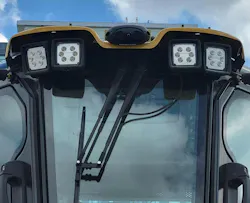
AI is widely used in dashboard camera systems,” notes Heniser, giving one example. “A standard dashboard camera primarily records video and captures short clips when a G-force event occurs, such as harsh braking, sharp turns, or impacts. In contrast, AI-enhanced cameras are designed to interpret what is happening both inside the cab, driver-facing, and in front of the vehicle, forward-facing.”
Other AI cameras for off-highway equipment employ multi-camera systems (up to six). These provide a 360-degree surround view that takes safety to another level. An AI camera processes all these feeds through algorithms developed to recognize specific objects, most commonly people — that’s called human form recognition or HFR. When something enters a defined danger zone, the system reacts, triggering visual alerts, audible warnings, or even stopping the machine. Many systems divide the area around a unit into zones. A person farther away might trigger a visual warning. As that person gets closer, the alerts escalate. At the closest range, some systems introduce constant alarms or even intervene with machine controls. These latter advanced systems can inhibit motion or apply braking if a collision risk becomes imminent. These layered responses aim to build a safety net around the operator.
These AI programs are trained
“Smart cameras are trained with data from customer sites and subsequently evaluated by customers before being released,” confirms Grigsby. “They’re rigorously trained to detect the object they’re looking for — specifically, people.”
Caterpillar offers these types of smart cameras on excavators, dozers, motor graders, and wheel loaders. Cat also offers retrofit kits. That leads us to….
Installation: from factory to retrofit
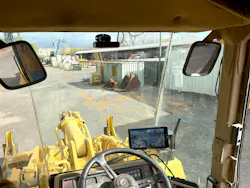
Getting an AI camera system onto a machine depends on how the fleet wants to deploy it. More OEMs are offering factory-installed solutions, which integrate cleanly into existing displays and controls. That’s the simplest path. Retrofits are still common, especially for mixed fleets. These systems typically involve mounting cameras around the machine, installing a monitor in the cab, routing cables, and connecting to power and sometimes the machine’s CANbus. An onboard processor handles the AI workload. Installation time varies. A simple setup might take a few hours. A full 360-degree system can take a day or more. Many fleets rely on dealers or certified installers, though some larger operations handle installs in-house. Once installed…
“Fleets can choose to operate the system using default settings, which many customers find sufficient, or make adjustments through the monitor interface to customize trigger priorities, detection zones, audible alert notifications, and other parameters,” explains Heniser. “Brigade’s technical team conducts extensive onsite research to develop recommended configurations based on vehicle type and application, helping ensure each system is optimized for real-world use while delivering maximum safety and performance.”
These systems also record what happens
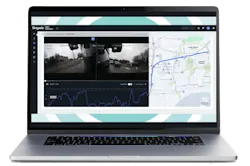
When an event triggers an alert, these systems can tag and store video clips. That creates a record of near misses, unsafe behaviors, or actual incidents. Fleets use that data for training, compliance, and sometimes legal defense. The footage shows exactly what happened, both inside and outside the cab. Some configurations include driver-facing cameras. These monitor behaviors like distraction or fatigue. Others focus strictly on the machine’s surroundings.
“We are not bolting a camera onto a construction fleet,” says Cueva. “We are tying video into the operating system of the fleet. You can access event-based recordings, full video history, AI-detected safety events, telematics data, and asset-level insights all in one place on Tenna. That means when something happens, you’re not guessing — you know the condition of the equipment, whether it was inspected, how it was being operated, and what led up to the event. Coaching is a big part of this. Tenna’s camera system doesn’t just record unsafe behavior — it helps correct it. “
How much do AI cameras cost?
Of course, pricing depends on how complex the system is and how it’s deployed — plus monthly subscription fees. An AI camera system for off-highway construction equipment can range from $2,000 to $14,000 per unit, and then you might have monthly subscription fees from $100 to $600 per camera. Some systems operate as standalone hardware with no recurring costs. Others tie into telematics platforms and include monthly subscriptions for data access, storage, or advanced analytics. Fleets need to consider both upfront and ongoing costs when evaluating options. That said, most discussions about cost quickly shift to risk.
“The important point is that contractors should not evaluate this like a cheap accessory,” says Cueva. “One avoided struck-by incident, one defended claim, one prevented machine collision, or one avoided shutdown can justify the investment.”
Connectivity and data integration
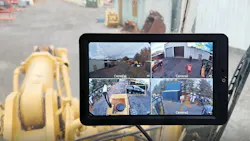
AI camera systems increasingly connect to broader fleet management platforms. Solutions from companies like Cat (VisionLink), Geotab, and Samsara allow camera data to live alongside machine data. When connected, systems can upload event-based video, detection alerts, and machine information like speed or location. Fleet masters can review incidents remotely and track trends across equipment. This can help managers build reports later that support safety programs. Many systems focus on uploading only triggered events rather than constant video, which keeps bandwidth requirements manageable.
“Customers can log in to view detection events and videos of those events,” says Grigsby. “Customers can build customized notifications and reports around detection events. Additionally, appropriately equipped machines are able to send video clips for review. Customers can review the videos and decide whether action is needed based on the footage. These can be used during shift stand-up meetings and coaching to proactively have safety discussions.”
Connectivity isn’t required for the core functions. Most AI cameras process data locally. Connectivity adds visibility and analysis.
“Brigade’s AI vision solutions do not require connectivity to operate, as the ECU is vehicle mounted and processes data directly in the cab,” explains Heniser. “Connectivity becomes relevant only when fleets want the ability to remotely access live video or review recorded footage. To support these needs, Brigade offers both Wi-Fi and cellular connectivity options, enabling live viewing as well as over-the-air uploading and downloading of triggered video events. Fleets can also review continuous recordings from a mobile digital recorder or a camera with built-in recording capabilities and selectively upload specific video clips as needed.”
Weather and alert fatigue: AI cameras still have challenges
AI cameras aren’t perfect. Harsh environments can affect visibility. Dust, rain, and low light still create challenges. False positives happen, though they’ve improved significantly as systems train on more real-world data. There’s also the risk of alert fatigue if systems aren’t configured properly.
“AI-based Human Form Recognition has proven to be highly accurate when properly implemented,” says Heniser. “A recent demonstration at Conexpo-Con/Agg highlighted this progress. During the event, our AI camera was configured with a very narrow detection zone. An attendee who uses a cane shared that he had tried AI systems in the past but experienced false detections, where narrow objects such as poles or sticks were incorrectly identified as people.
To demonstrate how far the technology has evolved, we asked him to place only his cane — without any part of his body — within the detection zone. The system correctly determined that it was not a person. When he then placed his leg next to his cane within the same field of view, the AI accurately identified the human form, putting a red box only around his leg. The attendees were impressed enough to reconsider AI technology based on that single experience.”
Major players shaping the market
Caterpillar
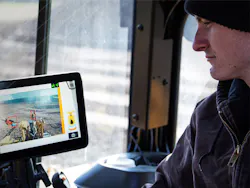
Several companies are pushing AI camera technology forward, each with a slightly different approach. Caterpillar has built its AI camera offerings into the Cat Detect safety portfolio, with solutions like Cat Detect with Smart Camera and the Cat Detect – Collision Mitigation System. The Smart Camera system uses AI to identify people around the machine and deliver escalating visual and audible alerts based on proximity, helping operators react before a situation turns into an incident. It can be factory-installed or added as a retrofit and is available across a wide range of machines, from excavators to wheel loaders. The Collision Mitigation System takes things a step further by combining cameras with radar and other sensors to provide rear object detection, motion inhibit, and even automatic emergency braking in certain scenarios. Both solutions tie into VisionLink.
“We are seeing widespread use of smart cameras across all types of construction equipment,” says Grigsby. “Customers are recognizing the value of warning systems on even the smallest pieces of equipment onsite.”
Tenna
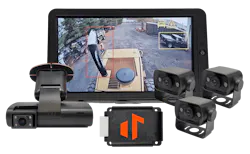
Tenna takes a fleet-focused approach with its TennaCAM 2.0 HE 360 AI system. Built specifically for construction environments, it uses multiple cameras to create a full 360-degree view around the machine and processes AI directly in the cab. Tenna notes the system is engineered with industrial-grade hardware designed to withstand vibration, dust, weather, and the realities of the jobsite. For contractors operating dump trucks, utility vehicles, and heavy equipment in congested areas, the system enhances operator awareness and confidence.
The TennaCAM 2.0 HE 360 AI is offered as a single, fully integrated kit that includes the AI-enabled 360-degree camera system, auxiliary cameras, and CANbus integration. The units require a 10-inch monitor in the cab.
“Contractors should be skeptical of generic fleet technology being repackaged for construction,” says Cueva. “Construction is different. The assets are different. The jobsites are different. The risks are different. A camera company that only understands highway behavior is missing half the problem. Your truck is not safe because it has a camera. Your fleet is safer when inspections, maintenance, telematics, cameras, scorecards, and coaching all work together. That is why Tenna built this as part of a construction platform — not as another disconnected device.”
Brigade
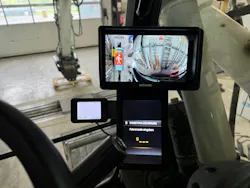
Brigade Electronics takes a modular, hardware-driven approach to AI camera systems, giving fleets flexibility to build or upgrade setups across mixed equipment. Its off-highway flagship Backeye 360 AI system uses four 1080p high-definition cameras mounted around the machine to create a stitched bird’s-eye view, eliminating blind spots and overlaying AI-based human detection directly onto the image. The system runs through a compact ECU and is built for harsh environments, with IP69K-rated cameras designed to handle dust, vibration, and pressure washing. Brigade also offers dedicated front-facing AI cameras for forward collision monitoring and driver-facing cameras that track operator behavior like fatigue, distraction, or phone use.
For fleets that already have camera setups in place, Brigade’s AI Box acts as an upgrade ECU, adding AI detection capabilities without replacing existing cameras or monitors. The company also integrates its camera systems with mobile digital recorders (MDR 644 and 641 units), allowing continuous recording and event-based video capture for training, incident review, and compliance.
“Brigade’s AI-based systems are available as standalone solutions with no ongoing service fees, while others can integrate with Brigade’s telematics platform through a monthly subscription,” says Heniser. “In addition, Brigade systems are compatible with a variety of third-party telematics platforms. This flexibility reflects Brigade’s commitment to improving safety for fleets of all sizes, budgets, and preferred telematics partners.”
ROI for AI Cameras
By Jose Cueva from Tenna
- Safety events prevented
- Claims defended
- Downtime avoided
- Equipment damage reduced
- Training improved
- Insurance conversations strengthened
- Operator confidence improved
- Maintenance issues surfaced faster
- Inspection compliance improved
- Asset utilization and risk trends understood by asset class
- Idle time reduced
- Idle fuel burn reduced
- Compliance metrics (based on required inspections being completed on time with sufficient detail as this could potentially avoid site/safety violations)
- Spotter needs (360 AI cameras could reduce the need for spotters which is particularly important with current construction labor shortages)
About the Author
Keith Gribbins
Keith Gribbins is the head of content at Construction Equipment, where he leads editorial strategy across print, digital, video, and social channels. An award-winning journalist with more than 20 years of experience, Keith has won 17 national and regional editorial awards and is known for his hands-on reporting style, regularly visiting manufacturers, operating equipment, and covering major industry events worldwide.