Caterpillar Breaks Down the 2026 Backhoe Market: Lineup, Trends, and Advice
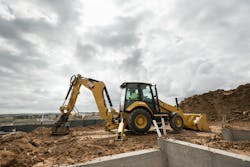
Continuing our deep dive into the 2026 backhoe market, we sat down with David Young, product application specialist at Caterpillar, to break down the company’s current lineup and the market overall. Caterpillar’s backhoes span multiple size classes and applications, making the brand a good barometer for where the category stands today. In this Q&A, Young walks us through Cat’s portfolio — from the 14-ft class up to the 17-ft machines — while explaining what differentiates the lineup in a competitive market. Along the way, he shares insight into attachment trends, control preferences, and how contractors are weighing backhoes against compact track loaders and mini excavator combos. Here we go…
CE: David, thanks so much for taking the time to talk to us today. We’re big fans of everything Caterpillar, including backhoe loaders. Maybe you can start this conversation off by walking us through your current backhoe lineup. Give us a rundown of models and size classes. Also, tell us what makes your backhoes unique?
Young: Caterpillar’s current backhoe lineup spans three size classes. The 14-ft class includes the 416, 420, and 420 XE. The 15-ft class features the 430 and 440, and the 17-ft class is represented by the 450.
Cat backhoe loaders are differentiated by a combination of hydraulic power and efficiency, a comfortable operator environment, and versatility. When equipped with Cat loader and hoe couplers, the machines can use a wide range of front and rear Cat attachments to support multiple applications. Select models, including the 420 XE, 440, and 450, feature seat‑mounted joystick controls that enhance operator comfort, free up cab floor space, and make it easier to rotate between front and rear operating positions. The system also allows operators to control the end of the machine they are not facing and operate implements even when the seat is not latched in the front or rear position. These features are supported by the Cat dealer network, which provides strong service, parts availability, and overall product support.
When looking out over the market, which customer segments are strongest right now?
I would say municipality, utility, and general construction are the top segments.
When customers cross-shop, how do you position a backhoe vs. one-CTL/one-mini-excavator-type situations?
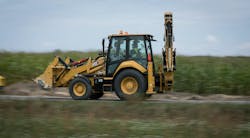
One of the biggest advantages of a backhoe loader is its roading capability, with a top speed of up to 25 mph, allowing the machine to move easily across large jobsites or through cities and towns without the need for trailering between locations. That mobility, combined with the backhoe’s versatility, makes it a highly viable solution for a wide range of applications, including heavy digging, lifting, grading, and load‑and‑carry work. In many cases, a single operator on a backhoe can accomplish the same tasks as a mini excavator or compact track loader, provided space is not a constraint. With skilled operators becoming increasingly difficult to find, the ability of a backhoe to function as two machines in one continues to make strong business sense for many customers.
Side-shift vs. center-pivot: how do you guide customers to the right choice, and what applications benefit most?
Choosing between a side‑shift and center‑pivot backhoe is largely application‑driven, and the side‑shift platform offers several functional advantages. Its compact footprint on stabilizers allows the machine to work tight against obstacles such as walls, while the ability to shift the hoe to either side reduces the need to reposition the entire machine and enables efficient digging of rectangular holes and footings. Offsetting the hoe also improves visibility to the bucket or attachment, rather than requiring the operator to look around the boom as with a center‑pivot design, giving the machine a more excavator‑like feel. In addition, the stowed position of the hoe provides a better roading experience.
The tradeoff is reduced stability, as side‑shift machines are more tip‑limited than center‑pivot models due to the smaller footprint created when the loader bucket and stabilizers are deployed. For customers performing frequent heavy lifting to the rear or side, a center‑pivot backhoe is often the better choice.
What attachments and front-end options are customers actually buying most — 4-in-1s, forks, thumbs, breakers — and why?
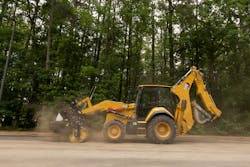
On the loader side, customers most commonly spec 4-in-1 buckets, brooms, and fork carriages to handle a wide mix of material handling and cleanup tasks. On the backhoe end, demand centers on productivity attachments such as hydraulic hammers, thumbs, plate compactors, and cold planers, allowing operators to tackle everything from demolition to compaction and asphalt work with a single machine.
Let’s talk controls. Pilot and EH joystick controls vs. mechanical levers: what’s the demand split today?
The Cat 416 is the only model in the lineup to offer mechanical lever hoe controls, though pilot joysticks are available as an option. All other Cat backhoe loader models come standard with joystick hoe controls. In my opinion, joystick controls have grown in popularity over the years, a trend that is expected to continue as more electronic hydraulic (EH) systems are introduced to the backhoe market. Electronic joysticks are beginning to replace traditional pilot hydraulic systems, and Caterpillar currently offers electronic joystick controls on three models: the 420 XE, 440, and 450.
In your mind, what are the top performance and technology features customers value most right now — hydraulics, automation assists, ride control, kickouts?
Customers are prioritizing features that improve control, comfort, and overall machine efficiency. Key options include auxiliary hydraulics for running a wider range of attachments, ride control for smoother travel and material retention, programmable joysticks on electronic hydraulic (EH) models for tailored response and modulation, and autoshift transmissions to simplify operation and boost productivity.
What are the three daily maintenance checks you wish every operator did without fail?
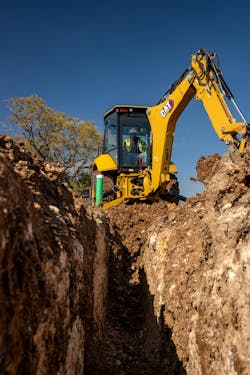
The most important daily maintenance checks include verifying engine, transmission, and hydraulic oil levels, draining the water fuel separator and keeping the machine properly greased. These basic steps are critical, as neglecting them is one of the fastest ways to lead to costly repairs and reduced machine life.
From an operator’s standpoint, what techniques or operating habits have the biggest impact on productivity and the long-term life of the backhoe loader?
I would say it’s running the machine at a lower rpm when operating the hoe. A lot of operators like to set the throttle at high idle to achieve maximum implement speed, but it’s not necessarily the best rpm to run at for efficiency. The Cat backhoes are tuned for around 1,800 to 1,900 rpm. These engine speeds get you the best in terms of fuel burn and productivity — dirt moved per gallon of diesel. All Cat backhoe models can achieve max implement forces at idle, so there is no reason to dial up the engine speed to get performance. The only reason to increase engine speed is to get higher hydraulic flow if you want the implements to move faster when commanded by the operator.
Looking three to five years out, what changes most for backhoes: powertrain — diesel, electric, hydrogen — controls, jobsite role, customer base? What do you think?
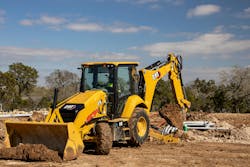
I believe we will see more loader and excavator technology make its way into backhoe loaders, especially as EH architecture is now spreading to more and more machines. Examples of this would be things like grade assist or range of motion limits for the hoe end of the machine. Or even payload calculation capability for the loader end.
Awesome info, David. We really appreciate you taking the time to talk to Construction Equipment. Learn more about Cat backhoes at cat.com.
This interview builds on our recent conversation with Case, where the focus centered on electrification, side-shift growth, and the continued dominance of models like the 580SN. That discussion highlighted how flexibility and emerging tech are reshaping the category. Give it a read at that link.
About the Author
Keith Gribbins
Keith Gribbins is the head of content at Construction Equipment, where he leads editorial strategy across print, digital, video, and social channels. An award-winning journalist with more than 20 years of experience, Keith has won 17 national and regional editorial awards and is known for his hands-on reporting style, regularly visiting manufacturers, operating equipment, and covering major industry events worldwide.