Showcase: ADTs Prioritize Traction, Safety (Part 1)
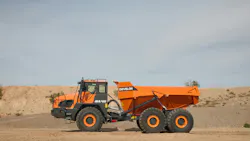
Operating an articulated dump truck (ADT) on rough and slippery terrain under load used to be a little like trying to ride an untamed horse with a rear end much more powerful than yours.
Thankfully, ADT makers have harnessed all that hauling power and given it traction with an assist from their braking systems. Safety on the job site is not only served with these systems, but also through camera technology.
Give me the brakes
Volvo Construction Equipment's ADTs feature Automatic Traction Control, which consists of sensors that control the differential locks by sending signals to the machine’s electronics.
"These sensors notice wheel slip and engage the appropriate drive combination automatically when any wheel spins 10% faster or slower than the others," said Tyler Smith, Volvo's product manager for articulated haulers. "This system also has a smart function called terrain memory, which remembers sections of the haul road where additional traction is needed and automatically switches to 6x6."
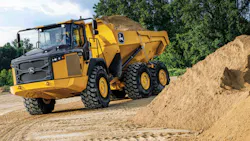
Volvo ADTs also have a feature called Volvo Dynamic Drive, which is predictive gear selection that adapts to operating conditions and skips to the best gear for the situation, reducing fuel burn and providing a smoother, safer ride.
"They also have downhill speed control, 100% differential locks, all-terrain bogies, and hydro-mechanical steering that support traction and stability," Smith said.
"Our Hill Assist technology holds the ADT in place when working on slopes of 10% or more without the need to engage the parking brake. It automatically activates when the operator stops on a hill and disengages when they accelerate."
Dump support
If you think that's clever, you'll love the company's dump support system.
"The dump support system shows the percentage of side inclination and sets safe parameters for dumping," Smith said. "This complements our Load and Dump Brake technology, where the operator can push a button to engage the service brakes and shift to neutral.
"This saves time because they don’t have to mess with the service brake pedal and park brake button. It also reduces wear and tear on the driveline because the truck is in neutral and the tires are absorbing the shock load," Smith said.
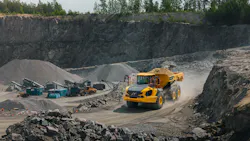
Multitasking braking systems
Some OEMs have their braking systems doing a number of things at once, automatically.
Caterpillar ADTs use integrated braking systems that combine service brakes, engine braking, and automatic retarding features to help operators maintain control, particularly on grades or slippery surfaces.
"All of this occurs without operator intervention," said Scott Thomas, a Cat marketing professional. "That means they can concentrate on the task at hand and not push a button or lever to activate."
Develon utilizes four braking systems on its DA30-7 and DA45-7 ADTs: engine brakes, service brakes, parking brakes, and a hydraulic transmission retarder.
The retarder is the primary tool for maintaining constant speeds on downhill grades, which prevents the service brakes from wearing out prematurely. The new -7 Series models also include a hill assist/auto-hold feature to prevent rolling on inclines.
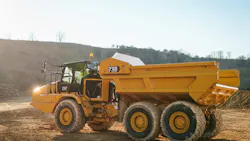
Smile, you're on camera...
...and you're not going to be hit. Struck-by accidents are a common job site hazard and ADT makers have addressed this with increasingly sophisticated systems.
John Deere's ADTs, ranging from roughly 26 to 46 tons of payload, come with varying levels of vision systems to increase visibility and situational awareness from the operator’s seat.
Deere's standard rear-view camera is displayed through an 8-inch center-mounted dedicated display.
VIDEO: See John Deere's autonomous ADT
"The optional John Deere Advanced Vision System is designed to improve situational awareness in a way that’s useful in the field," said Deere product marketing manager Lauren Meyer. "It uses multiple cameras, mounted on the front grille and mirror bows in addition to the rear-view camera. This gives the operator increased visibility to the front, sides, and back of the machine through dedicated monitors in the cab.
'What makes it different is that the system integrates with the articulation of the machine, so the camera views adjust dynamically as the machine turns. That gives operators a much clearer picture of what’s happening around the machine, especially in tight or high-traffic areas," Meyer said.
In addition to standard rear cameras, Cat ADTs offer a surround vision system with object detection as an option. "We use four cameras and sticth them together on a separate display in the cab," Thomas said. "Object detect will give an audible alarm to the operator if they're getting close to an object.