Key Highlights
In this article, you will learn:
- About technologies such as real-time indicator systems and digital models.
- Enhanced safety features on excavators.
- How automation tools boost productivity and efficiency.
- About some electric excavator models.
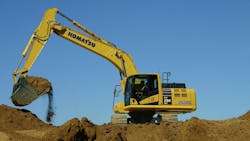
Excavators in the 60,000 to 80,000-pound weight range are now seeing design and development that deliver performance levels not seen before, resulting in improvements to productivity, utilization rate, or safety.
An indicate system that displays real-time progress can save up to 35% on time by allowing operators to dig to the right grade the first time, says Matthew McLean, product manager, assist systems, Volvo Construction Equipment. He says the In-Field Design feature of Volvo Dig Assist transforms paper drawings into digital models with simple on-screen instructions.
“When automation features such the Volvo Active Control feature of Dig Assist are also used, the time savings can jump up to 45% or 50%,” McLean says. All this is made even easier with the second-generation Volvo Co-Pilot on its latest excavators. Compared to the first generation, this Volvo Co-Pilot has a larger monitor and higher resolution and is up to 100 times faster, depending on the function.
More on excavators
- Tips when using excavators for heavy lifting.
- How to evaluate excavator technologies.
- Excavator manufacturers offer tiered machine packages.
- How to maintain undercarriages.
- How to safely operate an excavator.
- How to specify a hydraulic breaker.
Caterpillar Next Gen models first became available in 2017; models in this size range include the 325, 330, 330 GC, and the 335. The 325 and 335 are fully sensored and factory calibrated for such features as payload monitoring and Auto Dig Boost. Cat Grade with 2D is standard; Cat Grade with 3D is optional. Auto Dig Boost increases bucket penetration by 8%. Auto Heavy Lift increases lift capacity by 8%. Both are standard and both operate automatically with no input from the operator required.
The new variant of the 325 that Caterpillar will have on display at Conexpo 2026 will have a heavy-duty undercarriage and will be configured with a blade, tiltrotator, and Cat’s variable angle (2-piece) boom. Steven Faucher, global product and application specialist, medium excavators, says that blade and tiltrotators are seeing increasing popularity take rates on new excavators in the U.S.
“Overall, we’re working to improve versatility that can be taken from job-to-job while still offering the 330 GC for customers who want a reliable, but basic and simple, machine.”
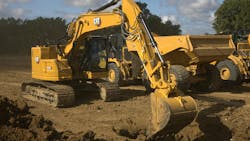
The Caterpillar excavator team rolls out annual products updates (APUs) late each year. Updates can include software and firmware updates, new features, and technical improvements. These APUs are built upon the information architecture present in Next Gen machines; they are backward-compatible to the extent allowed by a particular model’s information management capabilities.
Jim Joy, product manager, LiuGong excavators, says its strategy is to offer fewer configurations but make sure base models are feature rich. LiuGong excavators come with first and second auxiliary hydraulic circuits and hydraulic quick couplers. ROPS/FOPS cabs with guarding are standard and are sufficiently robust even for demanding applications such as forestry and demolition, “although dealers can add guarding to meet customer needs,” which can also include the installation of thumbs. Demolition models do have different sticks and booms than their standard siblings. LiuGong 32-inch tracks with triple grousers are preferred by most customers, so that is the standard configuration. 2D is standard and provides the foundation for future availability of 3D machine control. Other standard features include the heaviest available counterweight, track guards and lighting packages.
Excavator technology makes the job site safer
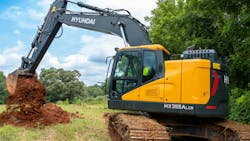
Much of safety comes down to two things: visibility and obstacle avoidance. Visibility includes rear-view cameras, which have become standard on virtually all models in this size range. A second camera on the operator’s blind side is becoming standard. Beyond that are camera upgrade packages that provide 270- or 360-degree views on the standard monitor or on a separate, dedicated monitor. The 270-degree view assumes that the other 90 degrees of the site is within the operator’s visual line of sight. The 360-degree view is a bird’s-eye, or overhead, view. Lighting is an integral part of the safety strategy, with LED lights paired with cameras as well as LED work lights. Upgraded lighting packages are available.
Obstacle avoidance relies on proximity sensors that detect obstacles within a certain distance from the machine. Some systems differentiate between persons and inanimate objects. At the least, these systems will alert the operator with a notice on the monitor or an audible alarm or both. Some include an estop function.
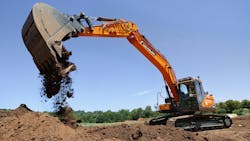
The Develon DX300LC-7 has the company’s AVM (around-view monitor) with its 360-degree top-down view as an option. When the DX300LC-9 is available in mid-2026 as part of the new -9 Series, among the upgrades will be Smart AVM (SAVM) with AI human detection and display features. Sensors will be upgraded from ultrasonic to radar for a doubling of the detection distance (from 3 to 6 meters), and there will be an estop function. An optional Overload Warning device provides visual and audio alerts when the machine is near or exceeding safe operating limits, specifically concerning lift capacity.
Most OEMs still offer base-level machines for customers who are price sensitive or see minimal value in advanced features, including some owner-operators and rental yards as well as those doing traditional production work.
But base-level machines are not minimalist throwbacks. Jeremy Dulak and Neil Detra, product management, North America, Case Construction Equipment, note that the standard package includes fully adjustable high-back heated seats with air suspension, 7- or 10-inch color LCD touchscreen with integrated views from rear and right-side cameras, and LED lighting. As for options, Case offers OEM-fit 2D and 3D Leica machine-control options as well as Case Max View, which gives operators 270 degrees of enhanced visibility. New assist and payload features are available at time of order for select Case models.
Four of Develon’s Dash 9 Series excavators will be available for order at Conexpo and will be in dealer showrooms shortly after; the DX300LC-9 will have a mid-year introduction. Stick steer will be standard; functionality of the thumbwheel and joystick can be swapped for improved efficiency depending on the application. Controls will now be EH. This will allow operators to set function sensitivities and also to allocate power between swing, boom up/down, and bucket curl. The Dash 9 models will have a 12-inch vertical tablet-style display. A second 12-inch monitor can be added and both monitors can be split horizontally to provide four separate, simultaneous views. Breaker Assist to prevent dry firing will be standard.
All but entry-level Dash 9 models will have upgraded 2D. There is no Develon 3D option yet, but the Dash 9 models will have upgraded IMUs (inertial measurement units) in anticipation of the day it becomes available. These new IMUs will keep pace with developments from GNSS providers, according to Brian Kim, heavy excavator product manager, Develon.
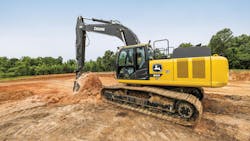
John Deere has three models in this size range: the 250 P-Tier, 300 P-Tier, and 345 P-Tier, the latter offering reduced tailswing. The 250 P-Tier and 300 P-Tier each have four different trim levels. Packages including seating upgrades, deluxe lighting, and even a chrome exhaust stack. An available cold weather package comes with either a block heater or ether start assist. A debris package includes an auto-reversing fan with user-settable intervals; the operator can delay auto-start or activate it manually. The 345 P-Tier provides 30-ton digging and lifting performance with a reduced tailswing, well suited for underground work such as sewer and water installs and tighter sites often found in urban areas.
Justin Steger, product marketing manager, excavators, says the Deere 250 P-Tier and 300 P-Tier offer Grade Reference-ready, which includes mounting points on bucket link, arm and boom for third-party grade reference sensors. Sensors, manufacturer-specific mounts, wiring harness and monitor can be purchased separately from third-party suppliers, such as Topcon, Trimble, or Leica.
Komatsu provides a traditional excavator package in its LC designation as well as its most advanced technology in LCi designated machines.
“There is no one-size-fits-all answer,” says Filip Kopec, product specialist, excavators, Komatsu North America.
Liebherr’s approach with its Generation 8 crawler excavators is its “strategic sensor chain,” an array of sensors on the boom, stick and upper carriage, says senior product manager of excavators Marcus Barnes.
“This factory-installed sensor chain will enable features such as 2D Grade Assist, Bucket Fill Assist, and Payload System,” he says. “Some of these new features will come as standard equipment while others will be offered on a trial basis to allow customers to experience their benefits and decide whether they want them.”
Battery electric models are coming. LiuGong has the 922FE with a 423-kWh lithium iron phosphate (LFP) battery and a 53,131-pound operating weight. At Conexpo, it will debut the larger 924FE, which will be in the 24-metric-ton class (about 52,000 pounds).
About the Author
 Richard Ries
Richard Ries
Richard Ries began his free lance journalism career in June, 1985, calling on his experience as a service manager at a Honda motorcycle dealership to place his first article. When the motorcycle market collapsed in the late 1980s, he moved to the booming bicycle market. Finding that market lacked the professionalism he sought, he moved to construction in 1995 and has remained there ever since.
His countless clients have included entities in Australia, England, France, Germany and Scotland. He has written for trade and consumer periodicals, equipment and component manufacturers, government agencies and non-governmental organizations. Clients have also commissioned him for photography and videography work, either stand-alone or as part of package of text and images.