Fork Yeah! The Ultimate Guide to Pick-and-Place Telehandlers
Key takeaways
- Buying the right telehandler involves more than lift height and capacity. Maneuverability, serviceability, attachment compatibility, visibility, and operator comfort all impact your choice.
- Modern telehandlers combine mobility, versatility, and advanced technology with features like multiple steering modes, load stability systems, telematics, and attachment options that help contractors do more with a single machine.
- High-capacity telehandlers are in demand as data centers, industrial facilities, energy projects, and large commercial developments require greater reach and lifting power.
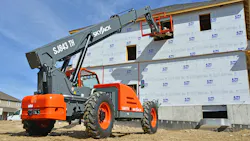
Some projects call for a giant, steely mechanized arm for heavy lifting. This is the realm of the telehandler — a valuable material mover for elevated construction projects. Picture stocking lumber, drywall, and roofing materials to the upper floors of a multistory building, or imagine moving rebar bundles and formwork around a bridge deck with varying heights. Pick-and-place telescopic handlers offer a unique combination of reach, lifting power, mobility, and versatility on those types of jobs.
These big telehandlers look like souped-up dune buggies, working on rough and paved terrain, using multi-stage telescoping arms that extend from 20 to over 100 feet. These machines are usually seen wielding pallet forks at the end of those long booms, placing supplies at height or just ferrying it around. But telehandlers can also utilize attachments like buckets, grapples, and man baskets.
Demand for these larger pick-and-place telehandlers continues to grow. Data centers, manufacturing plants, energy projects, distribution centers, and large commercial developments all require equipment that can lift heavy stuff high and far (these units can extend that boom out too). Unlike cranes, they can quickly move around a jobsite using fast travel speeds (some over 20 mph) and three modes of steering (front-wheel, all-wheel, and crab). Unlike wheel loaders equipped with forks, they can reach up and over obstacles. And unlike many specialized lifting machines like boom lifts or scissors, telehandlers can perform multiple tasks using attachments like buckets and brooms.
This is such a dynamic category that we’ve spent lots of time covering telehandlers recently on Construction Equipment.
- Earlier this year, we explored the growing popularity of rotating telehandlers and how these versatile machines are bringing crane-like capabilities to North American jobsites.
- We also published a comprehensive maintenance guide focused on attachments, hydraulics, daily inspections, and preventative service strategies.
- And for anyone responsible for fleet safety, our deep dive into telehandler load charts and modern load stability systems remains essential reading before putting any machine to work.
Now, let's enjoy more quality telehandler content...
Telehandler buying tips
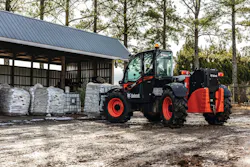
If you're shopping for a telehandler, consider how the machine will actually work on your site. Below are some quick lessons I’ve learned covering this market for the last 25 years:
- Understand your actual load profile. Track the weights, dimensions, and placement heights of your most common materials.
- Consider transport requirements. Larger telehandlers may require special permits, larger trailers, or different hauling equipment. They can be roaded, but how far?
- Evaluate fuel consumption. High-capacity machines can consume significantly more fuel. Ask manufacturers for fuel-use data in typical applications, not just engine horsepower ratings.
- Match tire options to your jobsites. Foam-filled, pneumatic, and solid tires each offer different tradeoffs in ride quality, puncture resistance, traction, and operating costs.
- Check operator training requirements. Telehandler operation requires safety certification, and more advanced telehandlers feature multiple steering modes, stabilizers, load-management systems, and attachments that may require training.
- Review attachment hydraulic performance. If you plan to run buckets, grapples, augers, or specialty tools, verify auxiliary hydraulic flow and pressure capabilities.
- Measure cab entry and exit ergonomics. Operators may enter and exit dozens of times per shift. Good access can reduce fatigue and improve productivity.
- Review stabilizer setup time. If the machine will perform frequent placement tasks, quick and easy stabilizer deployment can improve cycle times.
- Check visibility with the boom raised and lowered. Visibility can vary dramatically between models, particularly when traveling around active jobsites. Operate to find out.
- Assess operator comfort features. Air-suspension seats, climate control, low cab noise, and intuitive controls can improve productivity during long shifts. It can also help retain operators (so key).
For this showcase, we also asked several leading manufacturers to share insights into the latest trends shaping the telehandler market. You will find that info below.
The growing demand for high-capacity telehandlers
This section was written by John Boehme, senior product manager of telehandlers at JLG.
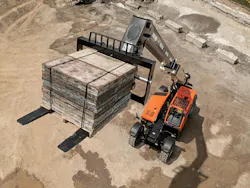
Construction projects across many markets and segments are on the rise, driving greater demand for telehandlers to support heavy lifting and placement. The increased demand for higher-capacity telehandler models stems from the sheer size and scope of the materials to be handled. We’re talking about industrial projects where building materials are much larger. And, there are other applications that, like solar and wind power, as well as energy exploration and extraction and mining, where heavy components need to be moved around the worksite, sometimes over fairly long distances.
High-capacity telehandlers help users save time, money, and labor on the jobsite by allowing operators to accomplish multiple tasks with one machine. Their higher lift capacity helps minimize the number of trips required to move bulky, heavy materials, while their enhanced versatility allows them to move efficiently across the worksite for improved productivity. Today, high-capacity telehandlers are being used to do work which has historically been done by small rough-terrain cranes, excavators, and wheel loaders equipped with forks to improve productivity with advantages such as compactness, mobility, maneuverability, speed, lift height, and forward reach.
Key factors contractors overlook when selecting a telehandler
This section was written by Ben Mansfield, telehandler product manager at JCB.
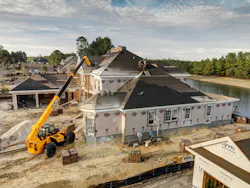
When selecting a telehandler, most contractors focus on the obvious specs: lift height, forward reach, and maximum capacity. While those numbers matter, they do not always determine whether a machine will truly improve productivity on the jobsite. One of the most overlooked factors is maneuverability. On today’s congested commercial and infrastructure jobsites, a telehandler that can navigate tight staging areas or crowded material zones can save significant time each day. Turning radius, steering modes, and machine footprint often impact efficiency just as much as lifting performance.
Serviceability is another critical consideration. Machines with ground-level service points, simplified maintenance access, and extended service intervals help reduce downtime and keep crews productive. For rental fleets and contractors alike, uptime directly impacts profitability, especially on large projects where delays can affect multiple trades.
Attachment compatibility also deserves more attention during the buying or renting process. Modern telehandlers can do far more than move pallets. With buckets, grapples, and hydraulic attachments, many units can support grading, cleanup, material placement, and general site-support tasks. That versatility can help contractors reduce fleet overlap and improve machine utilization across the jobsite.
Operator visibility and ease of use are equally important. Clear sightlines, intuitive controls, and a comfortable cab can help operators work more confidently and efficiently during long shifts. On busy jobsites where multiple crews are working simultaneously, improved visibility also contributes to safer operation and better overall productivity. At the end of the day, the right telehandler is not simply the biggest machine. It is the one that delivers the best balance of productivity, versatility, maneuverability, and uptime for the work ahead.
Pick-and-place vs. pick-and-carry telehandlers
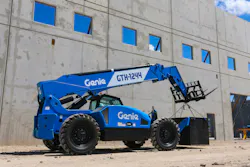
This section was written by Kyle Holdridge, global product director of telehandlers at Genie.
Telehandlers are often grouped by lift capacity and maximum height, but the way a machine is designed to work on the jobsite can be just as important as its specifications. Understanding the difference between pick-and-place and pick-and-carry telehandlers can help contractors choose equipment that improves productivity, efficiency, and material flow. Pick-and-place telehandlers are typically equipped with longer booms and stabilizers, making them ideal for applications where materials must be lifted to significant heights and precisely positioned. Common uses include placing roof trusses, structural steel, masonry materials, or mechanical systems on multi-story projects. Because these machines are optimized for vertical reach and placement, operators often deploy stabilizers before lifting loads, which provides stability for repetitive high-reach lifts.
Pick-and-carry telehandlers, by comparison, are designed for mobility and continuous material movement across the jobsite. These machines generally feature shorter boom lengths, strong load capacity at lower heights, and the ability to transport loads without repeatedly deploying stabilizers. On large projects — such as infrastructure work, industrial facilities, energy projects, or data center construction — telehandlers often function as material shuttles, moving loads from delivery areas to work zones. In these applications, reducing setup time and increasing cycle speed can significantly improve productivity over the course of a shift.
Both machine types play an important role on modern jobsites. Pick-and-place telehandlers excel in high-reach placement applications, while pick-and-carry models are optimized for moving materials efficiently across expansive jobsites. Matching the machine to the application can help contractors improve workflow, reduce unnecessary machine complexity, and maximize overall jobsite productivity.
Telehandler maintenance insights
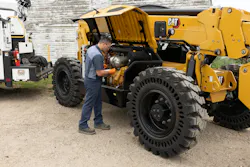
This section was written by Kevin Coleman, product application specialist for telehandlers with Caterpillar.
Maintaining your machine shouldn’t be complicated or time-consuming. When selecting a telehandler, for either rental or purchase, focus on models that have built-in designs aimed at reducing your maintenance burden. Often this can be accomplished by eliminating maintenance on components such as axle kingpins, drive shaft U‑joints, and splines. Identifying machines where these items are lubricated for life removes the need for upkeep of those components entirely. For areas that still require maintenance, look for extended service intervals for tasks such as pin greasing, boom greasing, hydraulic oil changes, and engine coolant replacement.
Longer intervals for oils and engine coolant are typically made possible through the use of higher‑quality fluids recommended by the manufacturer. In some cases, hydraulic oil and coolant service life can be further extended by using a dealer-supported fluid analysis program.
Additionally, consider telematics capabilities to monitor machine performance and health. Focus on machines that offer an integrated solution that delivers real-time diagnostics, remote troubleshooting, and proactive issue detection, while also supporting over‑the‑air software updates for efficient system improvements.
Selecting a telehandler designed for reduced maintenance isn’t just a convenience; it’s a way to save money. Extended service intervals and lower maintenance requirements streamline upkeep, boost uptime, and reduce labor and lubrication costs, while integrated telematics enable real-time monitoring and proactive service — further easing the workload on your technicians and optimizing overall machine performance.
Telehandler drive modes and assist feature
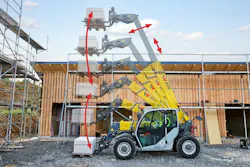
This section was written by John Dotto, product application and training specialist with Wacker Neuson.
Blending precision, control, and jobsite efficiency into one highly versatile platform, a telehandler is an ideal pick-and-place machine for large construction sites. Able to move quickly across expansive jobsites and easily navigate obstacles, the right telehandler can quickly transport materials between work zones without slowing down other operations.
Front-wheel steering on a telehandler is great for road travel and applications where you may push or scrape material and don’t want the machine’s rear end to kick out when steering. All-wheel steer is best in confined spaces, and when maximum maneuverability is the objective. Crab steer comes in handy for precise machine positioning at odd angles, or for parking a machine or hugging up to structures or curbs.
In addition to different drive modes, look for a telehandler offering a driver assistance system to enhance placement accuracy and stability. Features such as Auto Bucket Return also boost consistency and speed during repetitive loading cycles, while Flow Sharing enables simultaneous hydraulic functions for smoother, faster boom operation.
Pick-and-place telehandler showcase
Today’s pick-and-place telehandlers combine impressive lift capacities with advanced safety systems. The following machines represent a cross-section of telehandlers designed to tackle demanding material placement applications in commercial construction, infrastructure, industrial projects, energy development, and large-scale site work. Whether you’re lifting steel or setting trusses, these telehandlers offer the reach, capacity, and precision needed to keep projects moving. Let’s start with…
JLG 2733 telehandler
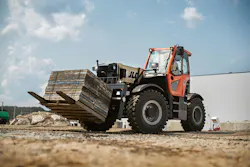
The JLG 2733 telehandler is a machine purpose-built for demanding material handling applications on large construction projects. Offering a maximum lift capacity of 26,600 pounds, the 2733 is the highest-capacity telehandler in JLG’s portfolio and is designed to tackle heavy-duty jobs with a 33-foot maximum lift height and 8,000-pound capacity at maximum reach, providing versatility across the load chart. Equipped with a two-speed hydrostatic transmission, optional ride control, and boom float, the 2733 enhances load stability and operator productivity on uneven terrain. Additional features such as JLG’s Load Stability Indication system, SmartLoad Technology, and a spacious operator cab further improve safety, visibility, and precision handling, while its compact design and class-leading turning radius maximize maneuverability on crowded jobsites. For more info, visit JLG’s website.
Caterpillar Next Generation telehandlers
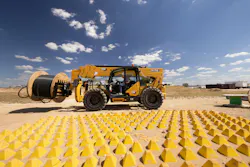
The TH0642, TH0842, TH1055, and TH1255 Next Generation Cat telehandlers come equipped with standard safety features to enhance operator and jobsite safety. These include an operator presence seat switch that disables operation when the seat is unoccupied, a rearview camera for enhanced visibility, and a load stability indicator (LSI) system to provide visual and audible alerts to the operator regarding forward machine stability during operation. For ease of operation, all models feature a pilot-controlled joystick, allowing for predictable and smooth multifunction performance along with a standard tilt steering column for added operator comfort. Service and maintenance have also been optimized, with extended service intervals reducing downtime and cost. A 5-year or 5,000-hour warranty for the boom, main-frame, stabilizers, and stabilizer frame offers peace of mind, while integrated telematics provide real-time diagnostics, with remote troubleshooting and software flashing capabilities. The combination of safety, simplicity, and service improvements deliver reliable performance and lower total cost of ownership. For more info, visit Cat’s website.
Bobcat TL923 telehandler
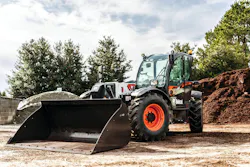
The Bobcat TL923 telehandler is built for tough construction, industrial, and material handling jobsites where reach, lift, and durability matter most. It features a 135-horsepower turbocharged engine, V-drive continuously variable transmission, and heavy-duty drivetrain that delivers smooth operation and optimized efficiency under load. Its advanced hydraulic system with high-flow capability delivers fast cycle times, precise control, and improved lifting performance to boost jobsite productivity. Multiple operating modes adapt machine performance to changing tasks. Operators benefit from a seat-mounted joystick, heated air-suspension seat, and 7-inch LED touchscreen display. A low-profile boom design improves visibility in tight jobsites, while optional camera and mirror packages enhance awareness. Automatic ride control helps reduce material spillage and enables faster travel speeds for greater efficiency. Power Quick-Tach allows rapid attachment changes without leaving the cab, increasing versatility across construction and rental applications. For more info, visit Bobcat’s website.
Genie GTH-1256 telehandler
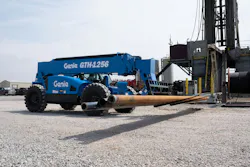
The Genie GTH-1256 high-capacity telehandler is designed to deliver greater durability, productivity, and lifting performance for heavy construction and industrial applications. With a 12,000-pound lift capacity and maximum lift height of 56 feet, 3 inches, the GTH-1256 offers one of the strongest load charts in its class, including a 6,000-pound capacity at maximum height and 3,500-pounds at maximum reach. Powered by a side-mounted 120-horsepower Deutz engine with four-speed powershift transmission, the telehandler delivers more efficiency in power transfer for picking and placing activities. Limited slip differentials on both axles and full-time four-wheel drive provide the traction and control needed across rough terrain jobsites. The GTH-1256 also focuses on lowering total cost of ownership through parts commonality with Genie’s existing GTH product line, including proprietary Enduro A/T tires designed for extended wear life. A redesigned operator cab features enhanced visibility, a 7-inch display, reverse backup camera, and full HVAC system for improved operator comfort and confidence. For more info, visit Genie’s website.
JCB 514-56 telescopic handler
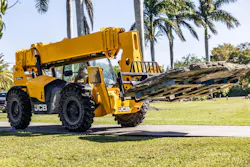
Built for demanding construction applications, the JCB 514-56 telehandler delivers the strength, reach, and productivity needed to keep large jobsites moving. With a maximum lift capacity of 14,000 pounds and a lift height of 56 feet, the 514-56 is engineered to place heavy materials with confidence and precision across commercial construction, infrastructure, and industrial projects. Its 109-horsepower JCB Ecomax engine provides strong low-end torque and fuel-efficient performance without a diesel particulate filter (DPF), helping reduce downtime and maintenance costs. Designed for operator productivity, the 514-56 features intuitive servo controls, three steering modes, and front stabilizers for enhanced maneuverability and stability on uneven terrain. A spacious cab with visibility improves comfort and jobsite awareness during long shifts. With simplified maintenance access, longer service intervals, and durable JCB engineering, the 514-56 is a dependable solution for contractors focused on uptime, performance, and long-term value. For more info, visit JCB’s website.
Skyjack’s TH series telehandlers
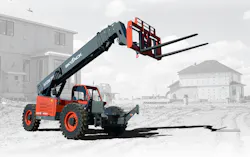
Skyjack’s TH series telehandlers are known for their durability and reliability. Skyjack’s telehandler line also offers a variety of features and attachments that increase customer utilization and limit downtime. Skyjack offers six updated models in the North and South American telehandler series, with lift capacities ranging from 5,500 to 12,000 pounds and lift heights ranging from 19 feet, 1 inch to 56 feet, 3 inches. Maximum forward reach in the series ranges from 11 feet, 1 inch to 42 feet, 4 inches. These versatile machines support customers as they work at height, move cargo in tight spaces, and navigate rough terrain. The standard FlexCab allows for easy conversion between open and enclosed cabs with simple hand tools. For more info, visit Skyjack’s website.
About the Author
Keith Gribbins
Keith Gribbins is the head of content at Construction Equipment, where he leads editorial strategy across print, digital, video, and social channels. An award-winning journalist with more than 20 years of experience, Keith has won 17 national and regional editorial awards and is known for his hands-on reporting style, regularly visiting manufacturers, operating equipment, and covering major industry events worldwide.