Telehandler Maintenance Playbook: Attachments, Hydraulics, and Daily Checks
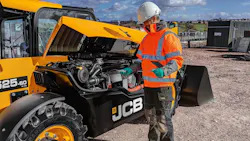
Telehandlers live a tougher-than-average life. A lot of them work in rental, right? And let’s be honest: Renters aren’t thinking too much about wear and tear. Plus, the telehandler lifestyle is aggressive. They lift, reach, crawl, and carry across uneven ground. From big pick-and-place units on commercial sites to compact machines wielding various attachments, these telescoping material handlers endure their fair share of abuse. That makes maintenance in this category a top priority for fleet masters.
For this feature, we worked with three OEMs — Bobcat Co., JCB, and JLG Industries — to break down smart maintenance habits. Their insights cover daily checks, service intervals, telematics, and machine design. You’ll also see how modern telehandlers are getting easier to maintain. Before we get to their playbooks, let’s lay down a few habits that I have learned over the years writing about telescoping tool carriers (small telehandlers that focus on implements). Let’s start with some maintenance tips for telehandler attachments and attachment systems — a different angle that doesn’t repeat what the OEMs served up for us.
Telehandler attachment and coupler maintenance
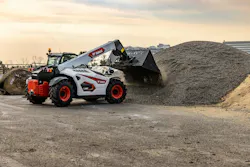
For no particular reason, let’s start at the business end. Attachments like forks, buckets, brooms, and beyond drive wear and hydraulic demand. They can cause weird stresses on the machine and boom. That means a worn fork carriage, wonky coupler, or leaky auxiliary line can grow into big problems. Operators will need to inspect attachment pins, locking systems, and hydraulic quick-connects before startup. Look for scoring on cylinder rods. Check for dirt packed into couplers. If it’s dirty, it’s a problem.
Attachments also change machine behavior. A heavy bucket stresses the boom differently than forks. That means operators should adjust how they run — and then what they inspect. Each attachment will require its own inspection. For a broom, an employee would check for even bristle wear, debris buildup, safety decals, and greasing points. Some attachments use a hydraulic motor, like an auger. The telehandler must be rated to handle the hydraulic flow (gallons per minute or gpm) and hydraulic pressure (psi) parameters of the attachment. Also consider and inspect the hose sizes and lengths that are packaged into the machine’s auxiliary hydraulic system.
We must always remember that hydraulic-powered attachments like grapples, certain buckets, and augers rely on clean hydraulics and tight connections to perform at their best. Contamination is the enemy. Dirt sneaks in through quick-connects, breathers, and worn seals. Treat hydraulics like a closed system that must be protected at all times. That means:
- Wipe couplers with a clean rag before every connection
- Cap the lines immediately after disconnect
- Use proper fitting dust plugs and caps
- Keep boom heads and hose routing clean
- The reservoir breather should be serviced along with the hydraulic filter elements at the manufacturer-specified intervals
- Think about hydraulic oil choice. Wrong viscosity can kill components. Stick to OEM specs
Perform pre-operation inspections
These next two sections were written by John Boehme, senior product manager for telehandlers at JLG
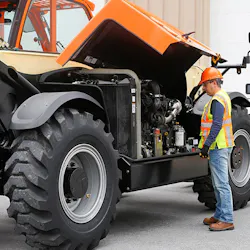
Before operating a telehandler, follow the manufacturer’s operation and safety manual to inspect critical components like:
Overall equipment cleanliness: Hours of operation can leave dirt and other signs of wear on a telehandler. Ensuring the telehandler is clean prevents foreign objects from damaging the machine and helps identify potential leaks. Keeping the equipment clean will make it easier to spot these issues.
Telehandler’s structure: It’s also important to look for dents, damage, cracks (parent metal or weld) and any other discrepancies. Damage to the structure could indicate problems with internal components or, if it spreads, lead to other issues.
Safety decals: All of the safety decals and plates should be legible and in the correct location. These decals show operators potentially dangerous areas of operation to avoid, and they're also required by OSHA to keep them in place. Replace any decals that are missing, and clean decals and plates that have become illegible.
Fluid levels: Ensuring fluids are kept at the proper levels before operation will reduce the need for stops to fill them up — and help prevent damage if the fluid runs out. That includes fuel, diesel exhaust fluid (DEF), hydraulic oil, engine oil, and coolant. Use the proper type and intervals when adding the fluid.
Walk-around inspection: Walk around the telehandler to check common wear items: Boom sections and cylinders, front axle, wheel/tire assembly, mirrors, cab and electrical, rear axle, engine components, boom retract sensor, and frame-level cylinder. Check the machine’s operation and safety manual to determine what additional components need inspection.
Warm-up and operational check: After those components have been properly inspected, it’s time to warm up the telehandler and perform a warm-up and operational check. Refer to the machine’s manual to see which components need to be checked.
Any damage found during a pre-operation inspection should be noted and reported; the machine should not be operated until those are addressed.
3 tire care tips for telehandlers
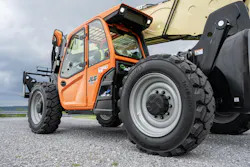
1. Inspect tires daily: Tires need to be inspected frequently throughout the workday, starting with the daily machine walk-around inspection before operation begins and also at each operator change during a shift, as well as at each shift change.
2. Check tire inflation: Properly inflated tires are important for the machine's stability and handling, especially under load. Make sure a tire’s inflation in accordance with the tire pressures labeled on the side of the tire, or the rim, which are approved by the tire OEM. Check tire inflation when the tires are cold.
3. Change damaged tires: If a tire needs to be replaced, it is recommended that the replacement be the same size, ply and brand as originally installed on the machine. Due to variations between tire brands, mismatched sizes, ply ratings or mixing types may compromise the machine’s stability.
The maintenance rhythm every telehandler needs
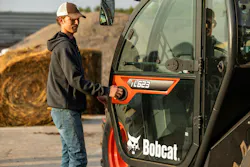
This next section was written by Randi Bakalar, senior communications specialist with Bobcat
Keeping telehandlers operating reliably requires a maintenance approach built around daily inspections and scheduled service intervals. Begin each workday with a walkaround inspection, checking fluid levels, tires, hoses, wear points, and attachments for damage or wear. At approximately 50 hours of operation, operators should complete initial service tasks such as changing engine oil and filters, replacing fuel filters, and cleaning debris from critical cooling components like the radiator and hydraulic oil cooler. Regular lubrication of the lift cylinder, boom pivot points, and axle oscillation areas helps reduce wear and maintain smooth operation.
Ongoing maintenance at 100-hour intervals and beyond should include checking and tightening wheel nuts, monitoring axle and differential fluids, inspecting belts and wear pads, and servicing planetary carriers. Air filtration systems should be monitored closely, especially in dusty environments, to maintain engine efficiency and prevent premature component wear. Design features found on certain telehandlers — like reversible cooling fans, side-by-side cooling layouts, and easily accessible service points — can significantly reduce the time required for these tasks and improve maintenance consistency across a fleet.
Additionally, digital tools such as telematics systems, allow fleet managers to track machine health, monitor service intervals, and identify potential issues before they lead to downtime. By combining routine inspections, scheduled maintenance and data-driven insights, operators can improve uptime, extend equipment life, and protect their investment.
Smarter telehandler design makes maintenance easier
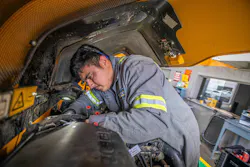
These next two sections were written by Ben Mansfield, product manager of telehandlers with JCB
When it comes to telehandler uptime, essential maintenance begins with design. Engineers need to simplify routine service and keep crews productive. Service access is a primary focus. Ground-level access to daily check points means operators can complete inspections quickly without climbing over or under components. Grouped service filters and a streamlined engine layout reduce time spent on routine maintenance, improving efficiency for field technicians and shop teams.
Durability also plays a role in lowering maintenance demands. Inherently strong boom construction and heavy-duty components are designed to withstand demanding jobsite conditions. Telematics adds another layer of preventative support. The system tracks machine hours, monitors performance, and provides pre-emptive service alerts in real time, allowing fleet managers to schedule maintenance based on actual usage rather than guesswork. For contractors focused on uptime, essential maintenance is not an afterthought. It starts with a telehandler built to make service straightforward.
Practical telehandler maintenance habits
Telehandlers are often pushed hard on busy jobsites, handling lifting, loading, and placing materials throughout the day. A disciplined maintenance routine is critical to protecting uptime and extending machine life. Start with consistent daily inspections. Operators should check fluid levels, inspect hydraulic hoses and fittings, verify tire condition, and confirm attachment locking systems are secure before every shift. Boom wear pads deserve special attention because they experience constant stress during lifting and extension.
Cleanliness also plays a major role in long-term reliability. Dirt and debris can accelerate wear on boom sections and restrict airflow through cooling systems. Radiators and air filters should be cleaned regularly, especially in dusty environments. Some manufacturers offer automatic reversing fans that help expel debris from cooling packages, reducing manual cleaning time and supporting consistent operating temperatures. Lubrication is another essential step. Follow recommended greasing intervals for boom pivots, steering components, and attachment interfaces and drive shafts. Telematics systems can further strengthen preventative maintenance programs by tracking engine hours and sending service alerts. Using machine data to schedule maintenance during planned downtime reduces unexpected failures and keeps equipment available when it is needed most. Proper maintenance protects performance, improves safety and lowers total operating costs over the life of the machine.
About the Author
Keith Gribbins
Keith Gribbins is the head of content at Construction Equipment, where he leads editorial strategy across print, digital, video, and social channels. An award-winning journalist with more than 20 years of experience, Keith has won 17 national and regional editorial awards and is known for his hands-on reporting style, regularly visiting manufacturers, operating equipment, and covering major industry events worldwide.