Inside John Deere SmartGrade: From EZ Grade to Full 3D
Key Highlights
- SmartGrade scales with the job: Deere offers EZ Grade, 2D SmartGrade Ready, and full 3D SmartGrade for increasingly complex grading work.
- Less rework, more consistency: SmartGrade helps boost efficiency while helping operators of different skill levels achieve more consistent results.
- Customer feedback shapes the technology: Deere uses real-world input from operators and dealers to refine SmartGrade, visibility systems, controls, and machine configurations.
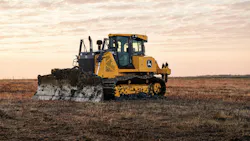
John Deere SmartGrade is the umbrella term for all John Deere grade-assist solutions: EZ Grade, which makes it easy to maintain a grade; 2D SmartGrade Ready for use in grading simple slopes for drainage; and 3D SmartGrade, which adds elevation control for simple or complex 3D engineered projects.
SmartGrade was launched on 700K single dozer in 2016 and continues to evolve. The current iteration has a larger, more responsive monitor that can display 2D and 3D at the same time. SmartGrade delivers many benefits, but at the top of the list are much greater efficiency with far less rework, and a levelling of the field of performance among operators of widely differing skill and experience levels, according to Colton Kreber, product marketing manager, John Deere.
SmartGrade expands across the John Deere dozer lineup
Dozers are a target category of machine for the use of SmartGrade. Deere has nine dozers, eight of which are P-Tier. There is also the 850 X-Tier E-Drive. All accept SmartGrade. EZ Grade comes standard on all small- and mid-size dozers and uses sensors on the chassis and D-frame to provide pitch and roll information. John Deere 2D SmartGrade Ready offers slope control and compatibility with laser and sonic systems. It also accepts total station robotic control to achieve millimeter accuracy.
3D SmartGrade has become very popular, says Mark Colvin, senior product manager, grade management. “It’s rare to see a site now with a dozer that is not equipped with it, and if several dozers are on site at least one will have 3D.” He says the utilization rate is high for 3D on dozers equipped with that feature.
Operations Center tracks SmartGrade use
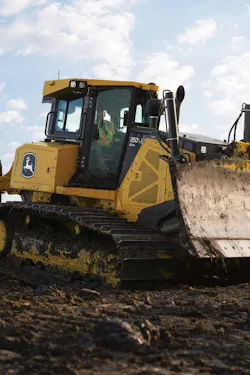
John Deere Operations Center includes machine data but also tracks progress from GNSS data. It allows fleet managers to see how many dozers are on site, how many are equipped with SmartGrade and of those, how many are using SmartGrade in a given time frame. There is an RDA (remote display access) feature so that a technology specialist can see the dozer display in real time, as well as RDC (remote display control) allowing that specialist to take control of the monitor. Operations center communicates via a phone, tablet, or other wireless device.
Customer feedback drives technology development
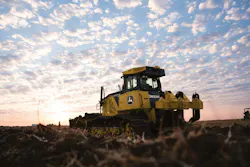
Development of systems such as SmartGrade is customer driven. While many OEMs make this claim, Deere backs it up with a robust customer interaction program. Experts talk with customers and with dealers, as dealers hear about many topics from many customers. These experts are referred to as field teams, and they vary their research practices not only by consulting a variety of customers and dealers, but also by defining specific goals and objectives for these visits. They also vary the geographic locations. The country is a mix of soil types: loam, sand, rock, clay; what works in one cannot be automatically assumed to work in another so field teams spend time at each.
SmartGrade is one example of John Deere applying rigorous protocol to the development of a solution. Their optional Advanced Vision System is another. On dozer applications it provides a 360-degree view of the machine. On the touch-screen monitor the operator can select the 360-degree view or front, right, rear, or left view and can have multiple views displayed at once. Kreber says that during development, testers said they wanted a larger monitor as they felt the front view wasn’t as clear as they wanted.
“By digging deeper into the testers’ concerns we realized the correct solution was not in providing a bigger monitor,” says Kreber, “but in slightly reconfiguring the front camera array. We did that, and it solved their concerns.”
Kreber says it’s important to maintain the essence of the John Deere experience in developing machines.
“We want to provide the same feel and familiarity,” he notes.
To the extent possible as dictated by machine type and function, displays are similar, sealed switch modules (SSMs) are consistent, iconography is the same, and controls have the same look, functionality, and feedback (“haptics”). Seating is similar and the relationship of the seating position and the positioning of controls is familiar and intuitive.
Configuring machines for different customers
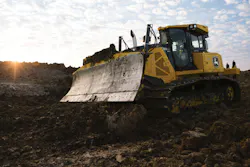
John Deere recognizes that there are subsets of customers and goes to great lengths to ensure machines with the proper configurations are available to each. Two packages that illustrate this are forestry and demolition with unique guarding and other features specific to those applications. Deere also offers varying trim levels, bundles, and performance packages, some of which are factory-ordered and some of which are dealer-installed.
John Deere Performance Tiering is foundational to meeting the needs and expectations of groups of customers. G-Tier machines are simple and dependable yet still offer Deere quality and dealer support to fit smaller budgets. P-Tier brings in a plethora of production and performance features to elevate performance and efficiency for customers who work their machines hard, every day. X-Tier is the gateway to premium technology, fuel efficiency, and overall performance for those who need exceptional equipment to consistently achieve peak performance.
About the Author
 Richard Ries
Richard Ries
Richard Ries began his free lance journalism career in June, 1985, calling on his experience as a service manager at a Honda motorcycle dealership to place his first article. When the motorcycle market collapsed in the late 1980s, he moved to the booming bicycle market. Finding that market lacked the professionalism he sought, he moved to construction in 1995 and has remained there ever since.
His countless clients have included entities in Australia, England, France, Germany and Scotland. He has written for trade and consumer periodicals, equipment and component manufacturers, government agencies and non-governmental organizations. Clients have also commissioned him for photography and videography work, either stand-alone or as part of package of text and images.