AI, Cameras, and E-Stops: The New Safety Tech Reshaping Construction Equipment
Key Highlights:
- AI safety systems now actively prevent accidents. Modern excavators and loaders use 360-degree cameras, radar, and AI human detection to recognize workers and automatically stop machine movement.
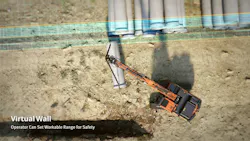
- Virtual Walls and smart guidance improve control. Digital boundaries help operators avoid overhead power lines, traffic lanes, and restricted zones, while 2D machine guidance delivers more accurate digging and grading.
- Connected machines boost uptime and operator comfort. Advanced telematics can predict maintenance needs before failures occur, while features like Transparent Bucket and stick steer reduce stress and improve visibility.
Imagine a crawler excavator swinging a heavy load toward a waiting dump truck in a tight urban space. While the operator focuses on the precision of the drop, a worker enters the machine’s rear blind spot. In years past, this was the recipe for a tragedy. Today, it is a non-event. Modern camera systems and AI-powered human detection instantly tell the difference between a person and a pile of dirt. Before a near-miss occurs, an automatic function smoothly stops the swing, while Virtual Walls ensure that the excavator boom and arm stay clear of overhead power lines.
This proactive approach to safety was a major highlight of Conexpo-Con/Agg 2026. During live demonstrations at the industry’s largest trade show, attendees saw this technology in action. In one moment, as the emcee stepped within 6 feet of a working excavator, the machine’s sensors triggered an immediate, automatic stop. From AI-driven detection to Transparent Bucket technology, these advancements are moving safety from a passive checklist to an active, intelligent partner that helps operators work faster.
Smart monitors and human detection systems
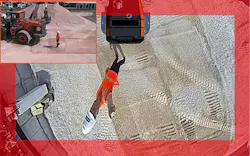
The integration of sophisticated camera systems, like a smart around view monitor (SAVM) camera system and human detection system (HDS), makes it easier to navigate a busy jobsite or position a machine next to other equipment. These advanced systems use a network of six high-resolution cameras, placed at the front, rear, and sides of the equipment, and radar sensors to provide a full 360-degree view of the machine’s surroundings. Unlike traditional systems that often struggle with blind spots created by the engine hood and counterweight, this AI-powered platform differentiates between obstacles and people.
“The most advanced systems use upgraded sensors and artificial intelligence to detect people on a job site,” says Brian Kim, a heavy excavator product manager at Develon. Kim was at Conexpo in March and presented this technology to attendees in the company’s outdoor exhibit. “Unlike traditional sensors that might trigger an alarm for a stationary object like a trench box or a concrete barrier, the HDS is designed to specifically identify human shapes and movement.”
This precision is critical for reducing operator alarm fatigue. By filtering out static background noise, the system ensures that when an alert sounds, the operator knows it represents a genuine safety risk requiring immediate attention.
E-stop and virtual walls
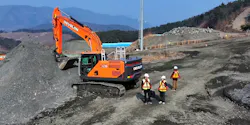
Safety features have evolved from simple visual alerts to active machine intervention. If the HDS detects a person entering the immediate danger zone — typically within a 6.5-foot radius — the E-Stop function can automatically stop swing and travel movement. This provides an essential layer of protection in noisy or crowded environments, where a worker on the ground might not hear the machine approaching. In addition to identifying external hazards, the use of Virtual Walls, or e-fencing, allows operators to set digital boundaries for the machine’s boom, arm, and bucket.
“By establishing these digital zones, operators can prevent the excavator from striking overhead power lines or encroaching on traffic lanes,” says Kim. “These digital guardrails allow the operator to focus on the dig with higher accuracy and less strain, as the machine prevents the boom from swinging into restricted areas.”
2D Guidance and telematics
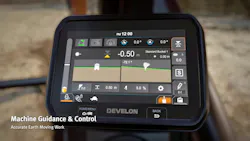
Machine intelligence is revolutionizing how work is performed in the trenches. Machine 2D systems take the guesswork out of grading and digging by providing real-time depth and slope information on a high-resolution in-cab monitor. By letting the operator hit the grade accurately from the seat, these systems reduce the need for ground workers to climb into a trench to check depths with a grade pole.
Behind the scenes, advanced telematics acts as a 24/7 health monitor for the entire fleet.
“Advanced Prognostics and Health Management technology continuously monitors critical parts like hydraulic oil, engine oil, main pump and swing motor,” says Kim. “By predicting maintenance needs and spotting problems early, these systems help prevent the safety risks of a machine breaking down unexpectedly during a heavy lift or a difficult maneuver.”
Transparent bucket technology
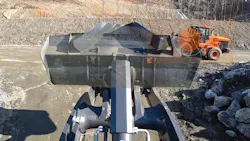
While cameras cover the area around the machine, specialized technology is now addressing the area directly in front of the wheel loader bucket. A safety technology from Develon is the standard Transparent Bucket for new -7 Series wheel loaders. This innovative system uses a combination of forward-facing cameras — typically one mounted on the front axle and another higher up on the cab — to create a dynamic, see-through view directly in front of the raised bucket on the in-cab monitor.
Greg Melton from the Owen County Highway Department in Indiana, tested the Transparent Bucket technology and noted how much it helped his natural vision.
“What I can tell you is I definitely like this loader,” said Melton. “It’s got a Transparent Bucket function on it, so when it's loaded you can see in front of you. You don’t have a blind spot.”
For his team, the ability to “see through” heavy equipment transforms a stressful environment into a controlled one, allowing them to focus on the task at hand without the fear of a hidden obstacle.
Dalton Rasch at Rasch Construction in Fort Dodge, Iowa, echoes Melton’s comments about the Transparent Bucket feature.
“Our Develon wheel loader has the Transparent Bucket function on it, so when it’s loaded, you can see in front of you,” says Rasch. “You don't have a blind spot if somebody were to walk in front of you.”
Smart attachment tech
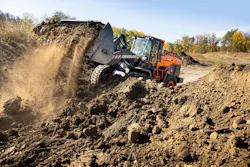
Looking forward, the next frontier in site safety and efficiency is the rise of smart attachments equipped with built-in sensors. These innovative attachments are designed to communicate directly with the machine to streamline operations.
“These tools can track usage and wear in real time and provide maintenance alerts directly to your phone,” says Jay Patel, product manager at Develon. “In some advanced systems, they even communicate with the machine to automatically adjust hydraulic settings upon connection.”
By tracking attachment usage for more accurate service scheduling, these advancements help improve efficiency and further extend the lifespan of equipment, ensuring that every tool on the jobsite is as smart as the machine it’s attached to.
Redefining the operator experience
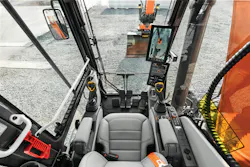
The latest equipment designs focus on reducing physical and mental strain to keep operators sharp. Features like stick steer allow operators to steer the excavator’s tracks using the joysticks instead of foot pedals, making movement in tight spaces much easier. Other features like breaker assist protect both the machine and the operator during demolition work. It prevents “blank firing,” which protects internal parts from wear while reducing the jarring vibration.
Today’s machines are stronger and smarter, and they are capable of actively protecting the crews that work alongside them. By embracing these advancements — from AI-powered stops to predictive health monitoring — contractors can invest in a future where productivity and safety go hand-in-hand.
3 quick tips for high-tech safety
To get the most out of these advanced machine systems, incorporate some simple habits into your daily routine.
- Wipe down the six smart around view monitor cameras during your daily morning fluid check.
- Use the in-cab monitor to adjust E-Stop sensitivity based on your jobsite.
- Review your weekly telematics reports to see if a machine is triggering E-Stop frequently. If so, it might mean a quick safety refresher.