Beyond Range: Building Reliable Jobsite Communication
Key Highlights
1. Complex jobsite layouts, tall structures and heavy equipment can create communication blind spots.
2. A site-based approach combines handheld radios, repeaters and coverage planning solutions to help keep crews connected.
3. Reliable jobsite communication starts by matching the system to the site’s real operating conditions.
Beyond Range: Building Reliable Jobsite Communication
On today’s construction sites, progress depends on people, equipment and information moving together. Ground crews, supervisors, equipment operators and project managers may be working across different floors, buildings and work zones—all while coordinating tasks that can change by the hour.
That makes communication more than a convenience. When teams cannot reach each other reliably, workers may have to walk across the site to confirm instructions, repeat messages or wait for information before work can continue.
For years, one of the first questions contractors have asked about two-way radios has been simple:
“How far does it talk?”
But as construction sites become larger and more complex, range alone does not tell the whole story.
A better question is:
“Will the communication system reach the people and work zones that need to stay connected?”
After 16 years of working across professional communication scenarios, RETEVIS believes reliable jobsite communication should begin with the site—not simply the radio.
Why Large Jobsites Create Communication Gaps
A radio signal rarely travels across a construction site under ideal conditions.
Concrete floors, steel structures, machinery, temporary walls, changing elevations and partially completed buildings can all affect radio communication. A crew working at ground level may need to reach another team several floors above. A site office may sit far from the active structure. Material yards, loading areas and equipment zones can extend communication needs across an even larger footprint.
These challenges mean that advertised radio range should not be treated as the only measure of communication performance.
Instead, contractors should begin by mapping where communication actually needs to happen.
For example:
● Where are the main work crews located?
● Which teams need to communicate regularly?
● Are there upper floors, concrete structures or other major barriers?
● How far is the site office from active work areas?
● Are material yards or loading zones outside normal handheld coverage?
● Which communication gaps could interrupt operations?
This turns radio selection into jobsite communication planning.

From Radio Range to Jobsite Coverage
Once communication zones are understood, contractors can begin designing the system around the site.
For smaller areas, handheld-to-handheld communication may be sufficient. But larger or more structurally complex jobsites may require additional coverage support.
This is where the conversation changes from selecting an individual radio to designing a construction site communication system.
A site-based solution can combine rugged handheld two-way radios with repeater-supported coverage where conditions require it. A repeater can help extend communication between teams that are separated by greater distances, structures or different work zones.
The goal is not simply to achieve the longest possible range.
The goal is to make communication available where the operation needs it.
That might mean connecting a ground crew with teams on upper floors, linking the site office to active construction zones, or maintaining communication between supervisors and workers spread across a large project.
Building a Long-Range Communication Solution
RETEVIS approaches long-range construction communication as a system rather than a single-product specification.
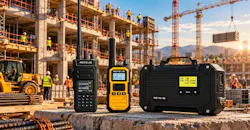
Handheld radios such as the RETEVIS RT29S can support crews that need higher-power communication across demanding work areas. RETEVIS RB48 Plus adds a rugged option designed for challenging jobsite environments. For projects where handheld-to-handheld coverage is not sufficient, RETEVIS RT97L portable repeater can become part of the communication setup to extend coverage across a larger site.
The specific combination should depend on the jobsite.
A multi-story building project may have very different communication requirements from a road project, warehouse expansion or large industrial construction site. Site size, building materials, crew locations, terrain and workflow should all influence the final setup.
This leads to a more practical approach:
Map the site. Identify communication gaps. Match the equipment. Test the system under real working conditions.
Reliability Goes Beyond Hardware
Reliable communication also depends on whether equipment can continue operating under the conditions crews face every day.
Construction radios may be exposed to dust, rain, vibration, drops, temperature changes and repeated handling. Hardware durability therefore becomes another part of communication reliability.
But the equipment itself is only one layer.
For contractors, a more complete definition is:
Reliable Jobsite Communication = Reliable Equipment + Reliable Coverage + Reliable System Design
A rugged radio that cannot reach an important work zone does not solve the full communication problem. Likewise, broad coverage is less valuable if the equipment is not suited to the environment where crews actually work.
Both factors need to be considered together.
The Operational Value of Reliable Communication
Communication gaps may appear small, but their effects can accumulate across a project.
A missed call may lead to a worker walking across the site to find a supervisor. An unclear instruction may need to be repeated. A delivery crew may wait while information is confirmed. Teams working across separate areas may lose time coordinating tasks.
The value of reliable communication therefore extends beyond radio performance.
It can support faster coordination, reduce unnecessary movement across the jobsite and help teams maintain clearer communication across different work zones.
For contractors evaluating two-way radios for construction crews, that makes total communication coverage more meaningful than a single maximum-range number.
16 Years of Reliable Connections
As RETEVIS marks its 16th anniversary, one lesson continues to shape its approach to professional communication:
Reliability should be designed around the real environment where communication happens.
Different construction projects create different communication challenges. The right solution starts by understanding those conditions and then selecting the equipment and coverage architecture that fit the operation.
That is why the next generation of jobsite communication should move beyond asking:
“How far does this radio talk?”
and start asking:
“Where does our team need to stay connected?”
Start with the job. Map the communication zones. Identify the gaps. Then build the system around the site.
RETEVIS will continue this conversation at PMRExpo 2026 in Cologne, Germany, November 24–26, showcasing professional communication solutions designed for demanding working environments.
