The State of Highway Asphalt Pavers: Precision Controls, MTVs, and Smarter Compaction
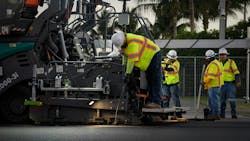
Today’s highway asphalt pavers are being designed less for raw production and more for precision. Contractors still need tonnage, but the industry’s priorities are shifting toward smoother mats, tighter material control, better density, and longer-lasting pavement. From decoupled conveyors and augers to automation, connected machines, and continuous paving techniques, modern pavers are evolving to deliver consistency rather than just speed.
“We strive to provide the machine that makes the smoothest, densest, longest-lasting road possible while also giving the operator more comfort and efficiency and the best ownership value,” explains Brodie Hutchins, vice president of sales, Vögele Products.
Shifting Expectations
“The focus today is less about tonnage and production and more about precision,” says Hutchins. Every aspect of modern asphalt pavers reflects this.
Historically conveyors and augers were driven together. A flow gate would strike off the feed to manage flow. These two processes have been decoupled and now work independently. Pavers may have two pumps or a single pump with a proportioning valve. This independent design is much more accurate and responsive in managing the head of material at the screed. And while the processes are driven independently, they work together as a system to optimize flow.
Automation and Machine Connectivity
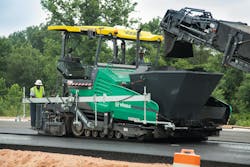
The ongoing shortage of skilled operators has prompted the market to provide more smart features, automation, and control. CANbus is prevalent in asphalt pavers and ISOBUS is making its way into the industry from agriculture and forestry, bringing ISO 11783 and ISO 15143-1 and their promise of an integrated worksite with common communication.
Interestingly, although development of these systems started in 1991 and although the demand is there for something like the ISO interoperability standard (ISO 11783), “implementation has been slow in our industry,” says Hutchins. “The goal would be communication between the paver, roller, truck, and asphalt plant, and we are getting closer to that.”
Changing relationships with machines
Hutchins also points to shifts in culture. Style and distinction are out. Uniformity and efficiency are in. Consider classic cars of the 1950s and ‘60s.
Hutchins says, “Unlike classic cars, there’s nothing inherently appealing about most vehicles these days. People don’t get married to a ‘thing’ anymore. Equipment operators have that sense of detachment from their machines. The days where the same crew ran and maintained pavers in season and diligently repaired and refurbished them in the off-season are gone. That relationship is no longer the norm. At the end of the day, we’re just building tools.”
Good tools. Excellent tools. But tools without soul or personality.
The rise of perpetual paving
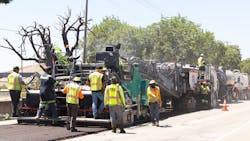
The build-out of infrastructure is largely complete. Residential streets, collectors, arterials, even interstate lanes are still being built, but the vast majority of paving is now resurfacing. Hutchins says the volume of asphalt milled is roughly equivalent to the volume of asphalt laid down. This has led to the concept of “perpetual paving.” Unlike initial construction, there is no defined end point with perpetual paving; resurfacing is always ongoing and will be for the foreseeable future.
Continuous paving
This term applies to the paving process: once the paver is in motion, it is not allowed to stop until it reaches a natural break point, such as the end of the milled roadway. This eliminates the inconsistencies that can result when the paver is stopped and restarted.
A key enabling technology is the use of material transfer vehicles (MTVs). The Roadtec MTD 3500 Shuttle Buggy was the first iteration and appeared in 1989. Astec still offers a Shuttle Buggy, one that is several versions improved from the original. Other manufacturers with MTVs include Weiler, available through the Caterpillar network, and specialized MTVs from BOMAG (BMF Series) and Dynapac (MF Series). MTVs do more than ensure continuous feed. They also maintain the quality of hot mix asphalt by remixing, which avoids both physical and thermal segregation.
Verifying paving quality
Measures have been taken to ensure that continuous paving can take place. But what measures are in place to ensure that the results meet spec? We’ll start with a bit of history. Nuclear gauges have been used for years to assess the quality of paving. Troxler is an industry leader and offers traditional nuclear gauges. They also have their EGauge Combo 4540, a nuclear gauge suitable for soil and asphalt testing that does not require licensing, which greatly simplifies ownership and use. They also have the PaveTracker Model 2701-B Plus, which is an electromagnetic density indicator. These are handheld units for density checking after the fact.
Hamm introduced Smart Compact to their roller line in 2022 and now offer Smart Compact Pro. The Pro system adds real-time asphalt density to the automated compaction process pioneered in the original Smart Compact system. Hamm says they have integrated a “Realtime Density Scan sensor into the automated compaction process. This determines the asphalt density in real time by measuring the dielectric conductivity of the asphalt mix to be compacted forming the basis for the correlation with the asphalt density or the void content.”
Real-time density monitoring
So we have nuclear gauges to confirm the paving meets spec. We have Smart Compact Pro for superior compaction. The next logical step is to have some sort of real-time checking on the paver. There have been such systems for some time, but Hutchins says the systems currently available check for stiffness. The systems in development will check density and voids, which will reveal much more about paving precision and quality.
Changes to screeds
North America used vibration screeds in order to pave faster as our infrastructure was being built. Compaction devices in the screed have been available for some time and are commonly used outside North America.
“We are seeing contractors using this existing compaction technology in niche applications in North America,” says Hutchins.
Safety Edge and roadway safety
The FHWA is promoting the use of their Safety Edge design, which incorporates a 30° slope at the edge of pavement. When motorists run off the edge of a road, they may immediately lose control of their vehicle or may subsequently lose control when they over-correct in an effort to get back onto the travel lane. Collisions often result.
Safety Edge is intended to reduce the likelihood of crashes. Evidence is that Safety Edge has reduced drop-off related crashes by more than a third and fatalities by some 11 percent. To apply the Safety Edge, the screed must have a Safety Edge shoe. There are several manufacturers and the shoe can usually be added to an existing screed. Compaction of the Safety Edge is required, but this compaction results from pressure applied by the shoe, not by a roller.
As the adjacent mat is compacted, the height of the mat is reduced, which is called the roll-over effect. To maintain the 30° edge slope required to meet the Safety Edge standard, the initial shoe angle may be set slightly flatter, in the range of 22° to 25°. Safety Edge is part of the FHWA’s Every Day Counts (EDC) initiative, which was launched in 2009. There are financial incentives for states and other agencies to adopt Every Day Counts measures, including Safety Edge design. One of the core objectives of EDC is improved sustainability of roads, which brings us right back to that shift in focus to quality over volume.
Operator comfort and visibility
In the construction industry, cabs are commonplace and open workstations are increasingly rare. Not so with asphalt highway pavers. Why? There is no single vantage point that works throughout the day on an asphalt paver. Operators are frequently moving from one side of the workstation to the other to get the best line of sight. It’s not uncommon to see two operators, one on either side of the machine, working in unison to keep the paver traveling as needed.
There is no stopping. There is no backing up. The job must be done right the first time every time, and that requires room to move around the workstation.
Discussions of “premium seating” are not wholly irrelevant, however. Some pavers have seating that works well for long runs of minimal complexity. Some pavers have dual seating. Some pavers have single or dual workstations that move with the seating so monitors and controls are always where the operator needs them.
Those monitors are constantly improving and touch-screen navigation of operating menus is becoming more common. USB and Bluetooth have been added. Vacuums for fume extraction move asphalt fumes away from the operator.
Hutchins says since an open workstation on a paver meant open to the elements, canopies have been added to provide shade. Overall design of pavers has improved operator visibility. He also notes that model introductions happen every 7 to 10 years, so the arrival of new models with improved feature sets takes time.
Mind the tender zone
One theme that kept coming up in our discussion with Hutchins was that operators of pavers and especially rollers must be vigilant and ever mindful of the tender zone. This is the mid-range temperature zone where the HMA is unstable and difficult to roll. This is usually between 190°F and 250°F (about 90°C to 120°C). In this temperature range the mix tends to shove or push forward in front of steel-drum rollers rather than compacting properly. The solution is to use breakdown rollers when the temperature is above 250°F and perform finish rolling below 190°F. If compaction must occur in the tender zone, use rubber-tired rollers which exert a vertical kneading action rather than the longitudinal forces of steel drum rollers.
Precision paving for the next generation of roads
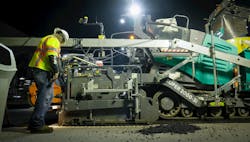
As resurfacing continues to dominate highway work, asphalt pavers will keep evolving toward greater precision, automation, and connectivity. The goal is simple: place the right amount of material, at the right temperature, with the right compaction the first time. In that environment, the modern paver is no longer just a production machine — it’s a precision tool designed to build smoother, safer, and longer-lasting roads.
About the Author
 Richard Ries
Richard Ries
Richard Ries began his free lance journalism career in June, 1985, calling on his experience as a service manager at a Honda motorcycle dealership to place his first article. When the motorcycle market collapsed in the late 1980s, he moved to the booming bicycle market. Finding that market lacked the professionalism he sought, he moved to construction in 1995 and has remained there ever since.
His countless clients have included entities in Australia, England, France, Germany and Scotland. He has written for trade and consumer periodicals, equipment and component manufacturers, government agencies and non-governmental organizations. Clients have also commissioned him for photography and videography work, either stand-alone or as part of package of text and images.