Autonomous Quarries to Mountain Cranes: Here Are 8 Wild Operations Highlighting Construction Equipment
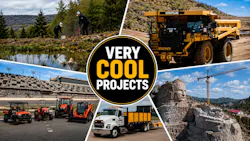
Construction equipment does some really cool stuff, and we don’t celebrate that enough. Imagine operating a massive crane helping construct the Crazy Horse Memorial or showing up at a NASCAR race ready to spearhead maintenance in a skid steer. So cool. I love when I see construction equipment highlighting projects and partnerships that showcase their big abilities. This roundup celebrates those projects. These are real jobs where equipment and technology are solving both very unique and very common problems in cool ways. Some projects protect workers. Some restore ecosystems. One is literally carving a mountain. That’s a pretty good range. Below are eight examples of construction and mining equipment stepping into the spotlight. Congrats to everyone involved.
Komatsu machines helping rebuild a forest in Appalachia
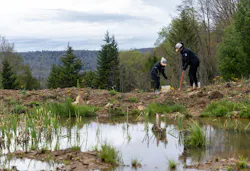
Reforestation projects rarely get coverage in construction. It’s usually the opposite. That’s why I wanted to draw your attention to this one. Komatsu partnered again with Green Forests Work to restore former mining land inside West Virginia’s Monongahela National Forest. The project is huge. Since 2019, the partnership has helped plant more than 700,000 trees and restore roughly 1,500 acres. The work also created more than 1,000 wetlands. This year’s focus targeted an old mining area filled with drained sediment ponds. On April 29, the Komatsu team planted more than 1,200 seedlings in the national forest’s Mower Tract. Ponds in this area have been heating nearby waterways and hurting trout populations downstream. The solution: plant trees, add shade, and cool the water. Simple, right? Well, that takes serious ground prep.
That’s where equipment enters the story. Komatsu dozers, excavators, and wheel loaders helped rip compacted soil and prepare land for planting. Contractors used the machines to break up decades of mining damage so roots and water could move naturally again. It’s a cool reminder that dirt work is not always about development. Sometimes the job is giving land a second chance. Love this story, so it gets the lede.
Caterpillar goes autonomous at a Michigan quarry
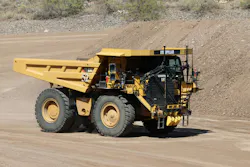
Autonomy is not futuristic anymore. Caterpillar and Carmeuse announced a new autonomous hauling deployment at Carmeuse’s limestone quarry operation on Drummond Island, Michigan. The site will use Cat MineStar Command for hauling across a fleet of Cat 777 trucks. Dealer Fabick Cat will support the rollout. Now, autonomous mining projects are not new for Caterpillar, but it’s another reminder of how quarries are becoming major proving grounds for autonomy. The environment is controlled enough for automation to work well but still rough enough to expose safety concerns for workers. Plus, the cycle repetition is key.
The Drummond Island quarry produces high-quality limestone used in construction, steel production, and infrastructure projects throughout the region. Cat also noted this deployment is including complementary MineStar capabilities for Carmeuse loaders and staffed equipment. That’s a detail you should note. The future is not just autonomous trucks driving around alone. The future is mixed fleets where manned and unmanned machines are working together.

Barge-bound Takeuchi excavator tackles hurricane recovery on Florida’s Gulf
Hurricane recovery projects are messy. Saltwater, unstable shorelines, limited access, debris everywhere, brutal heat — it’s basically like playing the boss level if you operate compact equipment. With hurricane season on the horizon, I wanted to highlight seawall and dock experts FarMore Construction, who are still tackling projects along Florida’s Gulf Coast damaged by Hurricane Helene in 2024. The video above highlights an 800-foot seawall repair where a Takeuchi TB290 excavator works off a barge to handle marine-side excavation work.
On this 800-foot seawall project the crew excavated 8 to 10 ft deep into dense coral rag limestone before installing a new PVC seawall system. Then they paired the excavator with a modified vibratory post driver to drive panels directly into the seafloor. I mean, that’s pretty darn impressive. Floating equipment + precision hydraulic work + marine conditions = pretty badass. A smaller Tak TB216 excavator handled tight-access work onshore. Crews removed sidewalk sections and dug footers between the roadway and seawall. These are both great examples of how compact excavators thrive in infrastructure repair jobs with limited space and (sometimes) just barge space.
One JCB pothole machine changes Vancouver’s patching strategy
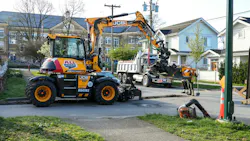
All Roads Construction is a British Columbia-based civil contracting firm. The company specializes in road paving, site grading, roadway-building-related concrete work, asphalt pavement milling, land development, lots, and lots of stuff. All Roads is also progressive. On its homepage, the company calls itself a “technology-obsessed road builder,” and here’s a fun story to prove it. All Roads is currently conquering Vancouver’s giant road patching backlog using a JCB Pothole Pro.
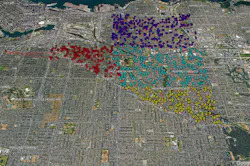
If you’re unfamiliar with this machine, the JCB Pothole Pro is a self-contained road repair machine (it looks like a wheeled excavator) that mills, crops, sweeps, and cleans potholes from a single cab, helping crews complete repairs faster while working safely in tight urban streets. The machine can repair potholes in under eight minutes and travels at speeds up to 25 mph. All Roads reportedly averages 14 completed patches per day using the Pothole Pro — more than triple the city’s previous production rate. The company may even finish the city’s 1,800-patch contract months ahead of schedule. That’s a very cool project.
Mack trucks protecting highway crews with crash cushions
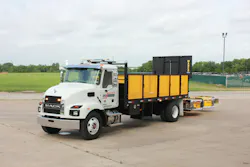
Mack Trucks announced that upfitter Gulf Highway Equipment plans to purchase 160 more Mack MD Series chassis for Truck Mounted Attenuator (TMA) applications after already deploying more than 250 units. TMAs are energy-absorbing crash cushions attached to the rear of trucks that are designed to protect workers and motorists in construction zones. The TMA is placed behind work crews to help protect them and redirect motorists from potentially driving into the work zone. Should an accident occur, the attenuator absorbs the impact, reduces its effect on the worker and the driver, and can increase the likelihood of survivable accidents.
The Mack MD6 platform supports specialized upfits while staying compact enough for urban work zones. The newer cab design also improves comfort for operators spending long hours parked behind paving crews, striping teams, or utility operations. This partnership is a good example of construction equipment (or a vocational truck in this instance) disappearing into the background while doing incredibly important work. Nobody notices a TMA truck until the exact second they really need one.
Kubota rolls into NASCAR
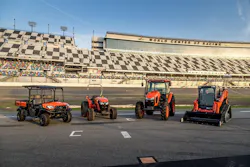
Construction equipment and racing actually make a lot of sense together. Both worlds obsess over uptime, precision, speed, and maintenance. That Venn diagram explains why Kubota Tractor Corp. signed a new multi-year partnership with NASCAR. The agreement makes Kubota the official tractor, compact equipment, construction equipment, and utility vehicle partner of NASCAR. Kubota will also serve as the official partner in the same categories for the upcoming NASCAR San Diego Weekend.
Kubota equipment will actually support track operations at select NASCAR venues. That means compact equipment (think skid steers, wheel loaders, and UTVs) handling facility maintenance, grounds work, preparation tasks, and logistics around race weekends. The partnership also ties into Kubota’s veteran-support efforts. During NASCAR San Diego Weekend at Naval Base Coronado (June 19-21), Kubota plans to recognize recipients from its Geared to Give program, which supports farmer veterans transitioning into agriculture careers. During the ceremony, the farmer veterans will be presented with the keys to new Kubota equipment in front of race attendees. FYI: Kubota has maintained a presence in NASCAR through its partnership with Trackhouse Racing since 2022.
Liebherr and the Crazy Horse Memorial project
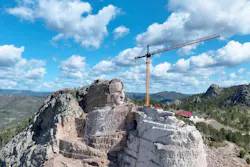
Some jobs never really end. Posting new stories on this website, for example. But the Crazy Horse Memorial project might be the ultimate example. It’s been going on for nearly 80 years. Recently, the memorial project added another Liebherr 1000 EC-H tower crane to support ongoing work carving the massive sculpture into Thunderhead Mountain in South Dakota’s Black Hills. The crane comes through a long-running partnership involving Liebherr and Morrow Equipment Co.
To put the scale into perspective, the sculpture measures roughly 563 feet high and 641 feet wide. That’s absurdly large. The cranes handle granite blocks, tools, materials, and lifting operations in steep, windy mountain conditions. The Liebherr 1000 EC-H can lift up to 50 tons with a maximum working radius of 80 meters (that’s more than 262 feet). Its modular tower system allows crews to adapt crane height as the mountain changes shape over time. This 1000 EC-H is now a part of one of the world’s largest carving projects, which may never end. Sounds like pretty job security.
Blue Diamond brush cutters keeping Texas oil fields under control
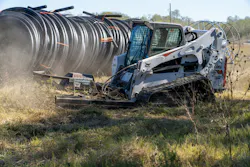
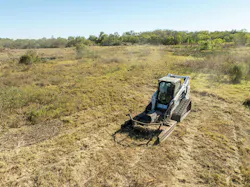
Some projects are basically brush battles. TINCUP Water Solutions in southeast Texas understands this. The company’s primary mission involves transferring water from frack ponds to frack locations for hydraulic fracturing, but the company also must maintain extensive oil and gas infrastructure. That means maintaining frack ponds, right-of-ways, and oilfield pipelines sometimes surrounded by thick brush, tall cane, and small oak trees. To manage the growth, TINCUP relies on compact track loaders equipped with Blue Diamond Attachments, supplied through Southern Plains Equipment. Their primary weapon is an 84-inch dual-motor brush cutter capable of clearing everything from grass to trees (some up to 10 inches thick).
The brush cutters operate around frack ponds and pipeline right-of-ways where crews need safe access for inspections and maintenance. What’s cool about these mower-style brush cutters is that the floating deck design helps operators work across uneven terrain without destroying the cut quality or making machine stability all wonky.
Some terrain challenges on this project included:
- Dense cane growth taller than machines
- Frack ponds spanning 2 to 5 acres
- Pipeline right-of-way maintenance
- Mesquite and oak brush clearing
- Uneven oilfield terrain and steep embankments
Send me your wild assignments
Got a cool machine story? Operating in a cool location? Supporting a unique partnership? Send it my way ([email protected]). I’m always looking for more examples of big iron showing up in interesting places and tackling unusual assignments.
About the Author
Keith Gribbins
Keith Gribbins is the head of content at Construction Equipment, where he leads editorial strategy across print, digital, video, and social channels. An award-winning journalist with more than 20 years of experience, Keith has won 17 national and regional editorial awards and is known for his hands-on reporting style, regularly visiting manufacturers, operating equipment, and covering major industry events worldwide.