The Flat-out Truth About Early Smooth Drum Rollers
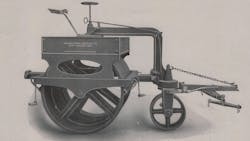
The earliest means of compaction was feet–the feet of soldiers, conscripts or slaves, and the hooves of livestock. Exactly when the first compaction machine was developed is unknown, but it was likely a weighted smooth drum pulled by stock.
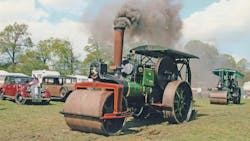
The first known mechanized compactor dates to 1866, when British manufacturer Aveling and Porter developed the first steam roller. The propulsion by boiler gave the entire realm of self-propelled rollers a name still in common use today, approaching a century since the obsolescence of steam.
This behemoth traveled on three smooth drums in a tricycle arrangement–a pivoting wide front drum for steering, and two larger but narrow rear drums for propulsion.
The three drums contacted the surface across the full width of the machine. It reportedly weighed thirty tons, and those rear drums were seven feet in diameter. It certainly would have compacted, but it proved too heavy for roads of the time.
What to look for in intelligent compaction
Weights of later machines rarely exceeded twelve tons, twenty at the most. Three-wheel rollers were used for all manner of work; over 160; almost all weighing 10 tons, were deployed on construction of the Pennsylvania Turnpike in 1968 and 1939.
Everybody, what's that sound? Three axles
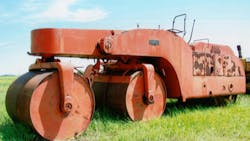
Tandem rollers, which applied the roller’s weight to two full-width drums, were also introduced during the steam years. Used for finish rolling, they typically weighed five to fourteen tons. As with three-wheeled rollers, variable weights through ballasting were introduced in the early 1940s.
In the mid-20th century, Buffalo-Springfield, Galion, and Ingram offered three-axle versions, with two steering drums; the most common size weighed thirteen tons empty, twenty ballasted. Other variations of tandem rollers included portable models on detachable or retractable rubber tires for towing behind a truck, and small, lightweight versions for turf, sidewalks, tennis courts and the like.
Static smooth-drum three-wheel and tandem rollers are still produced, but not nearly as abundantly as before industry acceptance of vibratory rollers in the 1960s. Here is a sampling of early smooth-drum rollers, the ancestors of what are so commonly used today.
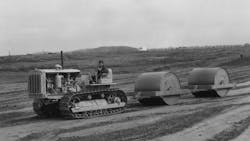
Caterpillar contribution
Hooves plus a drum

About the HCEA:
The Historical Construction Equipment Association (HCEA) is a 501(c )3 non-profit organization dedicated to preserving the history of the construction, dredging and surface mining equipment industries. With over 3,500 members in a dozen countries, our activities include operation of National Construction Equipment Museum and archives in Bowling Green, Ohio; publication of a quarterly magazine, Equipment Echoes, from which this text is adapted, and hosting an annual working exhibition of restored construction equipment. Individual annual memberships are $45.00 within the USA and $65.00 US elsewhere. Our next International Convention and Old Equipment Exposition will be held August 28-30, 2026 at Concordia, Kansas. We seek to develop relationships in the equipment manufacturing industry, and we offer a college scholarship for engineering students. Information is available at www.hcea.net, or by calling 419-352-5616 or e-mailing [email protected].
Scan the QR Code for information on joining!
About the Author
Tom Berry
Tom Berry is archivist for the Historical Construction Equipment Association (HCEA). Information is available at www.hcea. net, or by calling 419.352.5616 or e-mailing [email protected].