From Cost Center to Capital Driver: Rethinking the Equipment Department
For years, the equipment department has struggled with an identity problem. At different times, it has been treated as a profit center, then a cost center, and now — by leading contractors — as something more strategic. Each shift was meant to solve a problem, yet each created new challenges. Today, the most successful contractors are asking a different question: Should the equipment department exist only to control costs — or should it help the business make better capital decisions? The answer is what separates average fleets from high-performing ones.
How equipment became “just a cost center”
Many companies once expected the equipment department to operate like a profit center or a mini business within the business. Internal rates were set to cover ownership, repairs, overhead, and even generate a profit. That approach caused problems. Higher internal rates made bids less competitive and created friction with operations. Jobs were harder to win, even when execution was strong. To fix this, companies shifted equipment into a cost center role. The new goal was simple: break even. Recover what it costs to own, repair, and maintain the fleet — no more, no less. That change made sense. But it came with an unintended side effect. In many organizations, it disconnected the equipment team from the capital side of the business.
The hidden problem with the cost center mindset
A cost center is responsible for expenses, not assets. For the equipment department, that often means managing repairs and maintenance, staying within budget, and adjusting internal rates to recover costs. At the same time, purchase and replacement decisions often moved to operations or ownership. That’s where problems begin. Equipment purchases made by operations are usually driven by immediate project needs: A job is starting, a machine is down, and a project deadline is tight. These decisions are being made to solve today’s problem. But an equipment purchase is not a short-term decision. It is a multi-year capital commitment.
Short-term thinking vs. long-term reality
Operations teams are focused on winning work and delivering projects. When they choose equipment, they naturally prioritize availability right now, job-specific performance, or features to keep crews moving. What often gets overlooked is lifecycle cost, fleet consistency, long-term maintenance impact, resale value, and utilization after the project ends. That does not make operations wrong. It just means they are focused on the wrong time horizon for capital decisions. If a machine is needed only to solve a specific project issue, that is not a purchase decision. That is a rental decision. Buying equipment to fix a short-term problem almost always creates long-term headaches — under-utilized machines, inconsistent fleet mix, higher maintenance costs, lower resale value. And the equipment department is the one left to balance a budget that manages the consequences.
When equipment is left out of the decision
One of the most frustrating realities for equipment teams is inheriting equipment they did not choose — and then being held responsible for keeping it running. When equipment is excluded from specification decisions, brand or model selection, purchase timing or even disposal planning, the department becomes reactive by default. Machines arrive that are poorly spec’d for the work, inconsistent with the rest of the fleet, or require special parts, tools, or training. These “problem children” are harder and more expensive to maintain. The result is predictable: higher downtime, rising costs, added pressure on parts and suppliers, rushed repairs, and growing tension between equipment and operations. The equipment team is left managing machines they would not have selected, yet accountability for availability remains squarely on them. All while the expectation stays the same: just break even. That dynamic doesn’t create accountability — it creates friction.
Why breaking even isn’t the goal
Breaking even sounds responsible — but it doesn’t create value. Internal equipment rate programs exist to recover costs — which, for most companies, are often the costs that have already been spent or budgeted to be spent. They do not improve capital efficiency. They do not optimize fleet size. And they do not fix bad purchase decisions. Why? Because the biggest factor that drives rate recovery isn’t wrench time — it’s utilization. When utilization drops—rates go up, operations pushes back, rentals increase, and tension grows — and the cycle repeats. Meanwhile, the real financial impact of owning equipment — capital invested, lifecycle costs, replacement timing, and resale value — remains largely unmanaged. This is the flaw in treating equipment as only a cost center. Breaking even becomes the ceiling.
What an investment center looks like
An investment center is accountable for costs, assets, and returns. For the equipment department, that means:
- Internal equipment charges represent the department’s revenue
- Maintenance and repairs are costs that must be controlled
- The fleet itself is a capital asset that must produce a return
The focus shifts from simply asking “Did we break even?” to “Did we break even—and…”:
- Do we have the right fleet mix?
- Are we using capital wisely?
- Are machines sized and spec’d correctly for both current and future work?
- Are we replacing equipment at the right time?
This mindset does not mean spending more money, carrying larger fleets, or chasing cost recovery through internal rates. It is no longer about just managing costs or recoveries. It is about the efficient use of capital invested. In short, it means spending with intent.
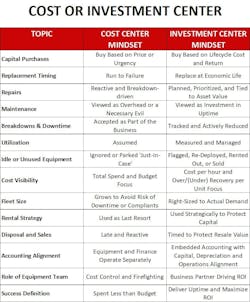
Cost center vs. investment center: what changes
This table shows how the same equipment topics and activities can look very different depending on the mindset.
Where equipment really creates value
Equipment does not create value by breaking even. It creates value through proper specification, high availability, streamlined maintenance, reduced breakdowns, optimized replacement, and timely disposal. In other words, how well the asset is managed over its life. Those decisions happen before the machine ever hits the jobsite — and long after the job is done.
The role shift: from wrench turners to business partners
The best equipment teams today are no longer just fixing machines. They are capital advisors, risk managers, lifecycle planners, and also well-versed in the languages of operations and accounting. They help answer questions like:
- Should we buy or rent?
- What machine spec works not just for this job, but for the next one too?
- When does this machine stop making financial sense to keep?
That is more than a cost-control role. For a time owners, boards, and senior leaders tried to fill this gap by leaning more heavily on accounting. Accountants brought discipline and financial rigor, but their view is naturally backward-looking—focused on what was spent, what was recovered, and what the return on investment looks like on paper. Taken to the extreme, that view can lead to the conclusion that owning no equipment at all would be the safest financial option.
What was missing was a forward-looking perspective that balances capital risk, operational reality, and lifecycle performance. That’s where modern equipment teams add real value. When equipment leaders are involved in buy-versus-rent decisions, specifications, setting lifecycle targets, timing replacements, and disposal planning, the business gets better answers — not just cheaper ones. That’s not just managing costs. That’s producing deeper results. That’s acting as a business partner.
The bottom line
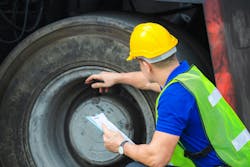
Equipment will always cost money. The question is whether it is managed only to recover costs — or to generate returns on capital invested. If equipment decisions are only made to solve today’s problem, the result will always be tomorrow’s headache. If equipment decisions are made with a lifecycle view, the result is a stronger bottom-line return with a better fleet, higher margins, and fewer surprises. That’s the difference between a cost center — and an investment center.
About the Author
 Craig Gramlich
Craig Gramlich
Craig has extensive experience in equipment management across transportation, heavy lifting, civil projects, mining, and construction sectors. Driven by a passion for cost and data analysis, he excels in enhancing equipment accounting, rate modeling, and developing programs for rate escalation and transfer pricing.
Through Lonewolf Consulting, Craig effectively unites Equipment, Operations, and Accounting departments, leveraging his extensive field experience to help companies streamline operations and find cost savings, significantly boosting ROI.
He holds a Bachelor of Commerce from the University of Alberta and a Certified Equipment Manager (CEM) certification, along with a variety of professional development courses, showcasing his commitment to ongoing professional growth.