The Lifeblood of Machinery: Construction Equipment Oil Sampling Guide
When something feels off, you go to the doctor. Low energy. Pain that won’t go away. Something just doesn’t feel right. The doctor doesn’t just ask how you feel and send you home. They order bloodwork. Because how you feel is only part of the story. The real answers come from what’s happening inside your body. Cholesterol. White blood cells. Iron. Testosterone. Those numbers tell a story — often long before symptoms show up.
Heavy equipment is no different. Talking to an operator or reading a pre-use inspection is like asking a patient how they feel. It’s useful. It gives context, but it’s incomplete. Oil sampling is the bloodwork of your fleet. It shows what’s happening inside the machine — before it becomes visible, before it becomes a breakdown. And yet, most companies treat it like paperwork instead of insight. Reports come in, get emailed around, and if we’re lucky, it gets attached to a work order. More often, they get filed and never looked at again. Then something fails, and it feels unexpected. So, we go back to look at the reports — and there it is. The signs were there all along. We just didn’t see them or act on them.
Why it takes time to get it
For years, the importance of oil sampling has been questioned. Is it really necessary? We’ve got mechanics. We’ve got a team. We’ve got experience. Isn’t that enough? Oil sampling matters. The value just isn’t always visible. Unless someone has experienced a preventable failure, the value of oil sampling can be hard to see. So, what often happens is this: a failure happens — an engine, a transmission, or maybe a final drive — then an oil sampling program gets put in place. And … for a few years, nothing fails. Because the program is working.
Then pressure shifts to reduce costs. Failures are gone, so the value becomes invisible. Sampling gets reduced, deferred, or treated like a box to check. Then a failure happens and the cycle repeats. Over time, the parallel becomes harder to ignore. As the body ages, small signals start to show up. Energy dips. Recovery slows. Things feel slightly off — but not enough to really impact life. That’s where bloodwork matters. It shows what’s happening before something serious shows up. Iron levels creeping too high can quietly damage organs. Hormone and vitamin imbalances can affect focus and energy. Most of the time everything feels “fine” … until it doesn’t. That’s when it clicks — this is exactly what oil sampling does for equipment. Oil sampling is the bloodwork for our equipment.
Health, heat, and the silent killers

The human body is built to operate within a narrow range. A temperature of 98.6°F keeps everything in balance. A couple of degrees higher or lower, and performance drops fast. Focus disappears. Energy crashes. The body loses function. Machines operate the same way. Cooling systems, lubrication, and operating pressures all exist to maintain balance. When that balance is lost — through heat, contamination, or poor lubrication — damage starts to occur. Quietly. Heat is one of the most damaging forces in equipment. Just like a fever in the body, it signals that something is off. And left unchecked, it accelerates failure. The same is true for contamination.
Dirt, fuel, and coolant in the oil act like silent killers. They rarely cause immediate failure. Instead, they slowly wear down internal components over time. This is the “high blood pressure” of equipment. There’s no immediate pain. No obvious signal. But inside the system, the damage accumulates. By the time symptoms show up — noise, smoke, loss of performance — the damage is already done. Oil analysis reveals those problems early before anyone can feel them.
Hours don’t equal health
A lot of decisions get tied to machine age. In many cases, machine age and hours are directly connected and correlated to replacement timing and resale value. But age — will never tell you health. Two people can both be 45 years old. One runs marathons. The other hasn’t exercised in years. Age alone doesn’t tell you who’s healthy. The same applies to machines. Two excavators at 8,000 hours can be in completely different conditions depending on how they’ve been operated, maintained, and cared for. Just like people, machines live a lifestyle, and that lifestyle leaves traces inside the oils. Exposure to dust, extended idle time, inconsistent servicing, and operator behavior all shape internal condition. The hour meter tells you age. Oil analysis tells you condition.
Why trending matters
Consider two identical machines each showing 30 ppm of iron in their latest oil sample. One machine may be at 8,000 hours with results holding steady around 30 ppm for multiple samples. The other may be at 4,000 hours with a trend of 8, 10, 14, 20, and now 30 ppm. Same number. Completely different condition. One machine is stable. The other is deteriorating.
That difference only shows up when you look at the trend. One oil sample is just a snapshot in time. It tells you where the machine is today, not where it’s going. A series of samples tells a story. When you trend the data over time, you can see stability, movement, and whether things are improving or getting worse. A higher-hour machine with stable results often carries less risk than a newer machine with rising wear. Condition — not age — defines reliability and a rising trend is never normal. If you’re not trending, you’re guessing.
Prevention vs. diagnosis
Now think about what happens next. Bloodwork comes back, and it explains what’s already happening inside the body. At that point, it’s no longer prevention. It’s diagnosis. You’re reacting instead of responding. And sometimes the solution is simple. But sometimes it isn’t. Everyone has seen it — or experienced it. Someone close feels fine, maybe just a little off, and then they get a call from the doctor and suddenly the news is far worse than expected. And the first question is always the same: Could this have been caught earlier? That’s the difference between diagnosis and prevention. Diagnosis explains what’s already happened. Prevention shows you where things are heading. That difference is where the value of oil sampling actually lives. Not in explaining failures, but in avoiding them.
Because with equipment, failure doesn’t just mean a repair. It means downtime, lost production, field crews on standby, schedule impacts, lost revenue, contract disputes, and reputation risk. It means scrambling to find replacement equipment, pushing other machines harder, and increasing risk across the fleet. It means money that could have been profit is now being spent on recovery.
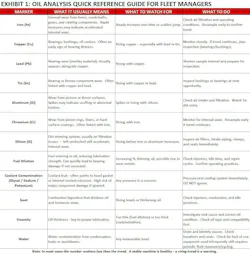
That’s the operational reality. And it’s why prevention matters. A single number doesn’t tell you much. But a number that keeps moving in the wrong direction? That’s information. That’s where action matters. Wear metals and contamination don’t appear overnight. Copper rises before a bearing fails. Fuel dilution increases before lubrication breaks down. Silicon shows up before internal surfaces are damaged. These are early warning signs or signals. Opportunities to inspect, adjust, and avoid much bigger issues. Because once the failure happens, the conversation changes. Prevention avoids that conversation entirely. It creates options, and in equipment management options are everything. The goal of oil sampling isn’t to confirm what failed — it’s to avoid failures altogether.
What to look for
You don’t need to be a lab expert to get value from oil analysis. You just need to understand the common markers, what they mean, and when to act (Exhibit 1).
The financial reality
Oil analysis isn’t just a maintenance tool. It’s a risk management tool — and one of the cheapest forms of insurance the equipment has against six-figure failures. It helps answer the questions that matter most:
- Repair or replace
- Rebuild or run
- Stretch or sell
An oil sample might cost fifty dollars. A major failure can cost tens of thousands — before considering downtime, lost production, and reputation. The absence of failure doesn’t mean everything is fine. It just means the problem hasn’t shown up yet. Oil sampling provides early visibility into problems — while there’s still time to make decisions before failure forces action.
Final thought
Bloodwork isn’t just used to confirm health issues. It’s used to prevent them. Oil sampling serves the same purpose. If bloodwork isn’t part of your regular health check yet, now is the time to start. And if oil sampling isn’t part of how equipment is managed, it’s worth taking it seriously. Because equipment doesn’t fail randomly. It follows a pattern. It whispers before it screams. And the fleets that perform consistently are the ones that learn to listen — early, clearly, and before the cost becomes unavoidable.
About the Author
 Craig Gramlich
Craig Gramlich
Craig has extensive experience in equipment management across transportation, heavy lifting, civil projects, mining, and construction sectors. Driven by a passion for cost and data analysis, he excels in enhancing equipment accounting, rate modeling, and developing programs for rate escalation and transfer pricing.
Through Lonewolf Consulting, Craig effectively unites Equipment, Operations, and Accounting departments, leveraging his extensive field experience to help companies streamline operations and find cost savings, significantly boosting ROI.
He holds a Bachelor of Commerce from the University of Alberta and a Certified Equipment Manager (CEM) certification, along with a variety of professional development courses, showcasing his commitment to ongoing professional growth.