Motor Grader Maintenance: What the Experts Want You to Check
Key Highlights
- Protect grading accuracy. Circle wear, cutting edges, tire pressure, and machine balance can all affect precision and finished grade.
- Know your service intervals. Operating conditions, severe-duty applications, and fluid analysis can affect recommended maintenance schedules.
- Make operators part of maintenance. Daily walkarounds can catch leaks, excessive wear, and play before small problems become expensive repairs.
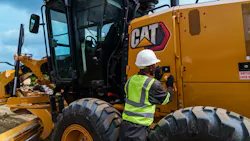
We got great information on motor grader maintenance from experts at three leading grader OEMs. We’ll list the common topics first and then move on to their insider tips. Let’s start with…
Service access and color coding
Ground-level service has become commonplace among construction equipment, and graders are no different. Daily service checks are grouped behind access panels, often one panel on the left side of the cab. Fluids and filters, diagnostic ports, pressure checks, and other access points that are used regularly but not daily are behind one or more covers, usually on the right side of the cab. Color coding has become standard so that everything related to one system — such as the dipstick, fill cap, and filter for engine oil — is all one color.
Service intervals
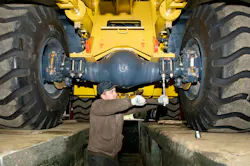
PM intervals are often 500 hours, and OEMs try to aggregate as many service procedures as possible in that one interval. Simple enough. But PM intervals are malleable. They assume certain duty cycles and operating conditions, as well as the use of specified products. Fluid sampling can extend these intervals; the use of non-OEM products can reduce them, as can applications that fit the OEM’s definition of “severe duty.”
Operator habits

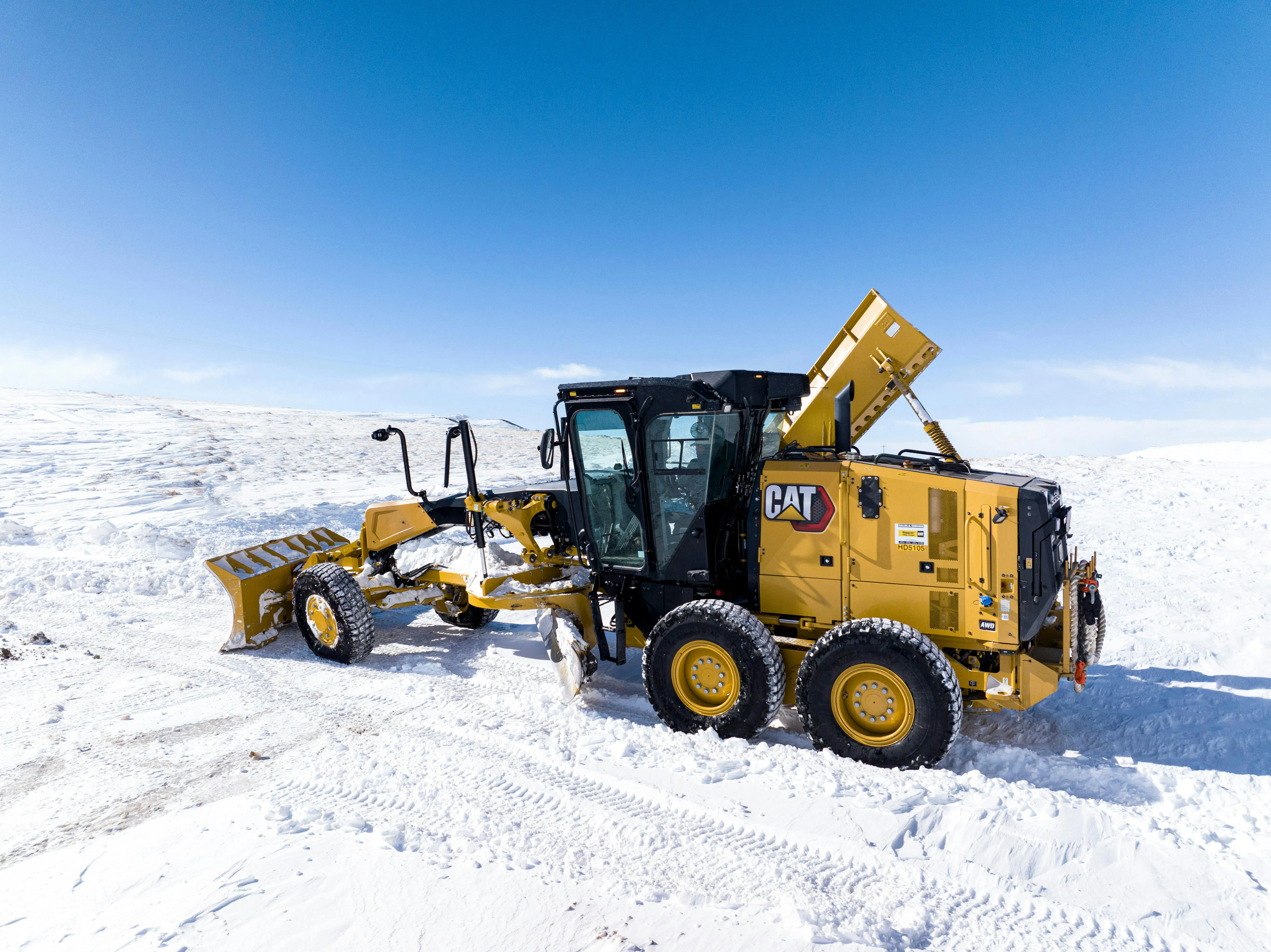
Operators can significantly affect the need and timeliness of service. Careless operation will cause material to overtop the blade and get into areas that should be kept free of debris. End bits are abraded when they make contact with an adjacent finished roadway. Float mode puts excessive pressure on cutting edges and should be used judiciously in specific applications, such as snow and ice removal.
Upgraded circle option
Two characteristics of the grader circle work in opposition: Its integrity is essential to the accuracy of the grade and it is constantly trying to degrade that integrity and, hence, the accuracy as the result of wear. Some customers understand this and accept the burden of regular adjustment and maintenance to get back the accuracy they need. Others, however, choose to upgrade to a circle that holds its alignment. These upgraded circle designs use heavy-duty bearings to support and guide the circle as the moldboard rotates. Traditional circles develop play as wear surfaces age, requiring technicians to periodically adjust or shim the circle to maintain proper alignment. The bearing-supported designs eliminate much of that routine adjustment, helping the circle stay tight and maintain grading accuracy. OEM versions include the Case Protected Circle, Caterpillar High-Performance Circle, and John Deere Premium Circle.
Snow and ice
Plows and wings are more likely to strike obstacles in ditches and at the edges of the roadway. Snow hides a multitude of obstructions and the attachments routinely operate beyond the normal range of moldboard use. Make sure your maintenance program includes inspection and repair of snow attachments and inspection of their mounting points on the grader.
Case: The daily walkaround
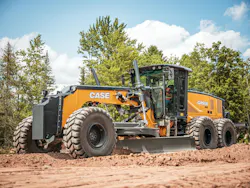
George MacIntyre, product manager, Case Construction Equipment, says to start each shift with a thorough walkaround. Look for anything unusual and pay particular attention to the components that do the hardest work during grading. Check cutting edges and end bits for excessive or uneven wear, inspect hydraulic hoses and lines for leaks, damage, or rubbing, and look around the circle and moldboard for accumulated dirt, debris, or excessive play. Tires and other visible components should also be inspected before the machine goes to work.
“Keeping a motor grader clean makes it much easier to identify leaks, damaged components, or abnormal wear before a small issue becomes a large repair,” says MacIntyre. “Pay particular attention to the grader’s circle, drawbar, and articulation points.”
Caterpillar: Check for play and don’t forget safety

Eric Kohout, senior product consultant, Caterpillar, offers a procedure for easy visual assessment of play. Raise the moldboard so it is level and perpendicular to the grader frame. Lower one end until it makes solid contact with the ground. Any slop or play in the system will be readily apparent as the blade is lowered to the ground. Lift and repeat as needed to confirm.
Kohout also mentions safety features associated with the blade. There is a circle drive slip clutch that allows the blade to deflect when an end strikes an object. There is also an optional blade lift accumulator circuit that gets the blade up and over an obstacle of 1 to 3 inches if contacted in the middle run of the moldboard. Neither feature is called upon much, and they are often overlooked in service. Ask operators for their observations of the functioning of these features. Also check the operating and maintenance manual for more information.
John Deere: pressure and balance
Matt Costello, motor grader product manager, John Deere Construction Equipment, says tire pressure should be adjusted to alleviate rhythmic (harmonic) wheel hop. He says to have different tire pressures from side-to-side on the front and two sets of matching tire pressures diagonally on the back. Differences should be in the 3- to 5-psi range while remaining in the tire manufacturer’s recommended pressure range. He also says graders come with optimized primary balance from the factory and customers should take steps to preserve that balance. Basically, anything you put on the front — counterweight, scarifier, etc. — should be balanced at the rear and vice versa.
Bypass: two relevant definitions
The term “bypass” has two different meanings when discussing filtration on motor graders (and other equipment), and the concept can apply to engine oil, hydraulic fluid, transmission oil, and other lubricating fluids. A bypass filtration system, sometimes called a kidney loop, supplements the machine’s primary filtration system. It continuously diverts a small percentage of the fluid through an extremely fine filter — a β₂ = 200 filter — which is 99.5 percent efficient at removing particles 2 microns and larger at the specified test conditions before returning it to the system. Over time, the system’s fluid repeatedly passes through this fine-filtration loop. Be sure to replace this filter as scheduled.
The other bypass refers to filter assemblies with a bypass mode. It’s in the housing for canister-style filters or part of the filter itself for spin-on style. If a primary filter becomes clogged and restricts oil flow, the bypass valve allows oil to flow around the filter. The idea is that dirty oil is better than no oil. In pre-electronic days, a system may have run in bypass mode for hours, days, even weeks, causing damage the whole time. Now, when systems enter bypass, the operator is alerted and telematics convey the alert to the office. Advanced systems use differential pressure (ΔP) sensors to warn of impending blockage that would lead to bypass mode if left uncorrected.
OE vs. aftermarket parts, fluids, and filters
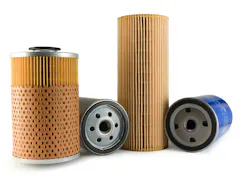
OEMs insist their brand-labeled products are superior to aftermarket products, that they are specifically formulated for use in their systems in their machines. Well-informed customers will insist their product choices perform as well as or even better than OEM products without the OEM markup, and in some cases they’re likely right. Cost-sensitive customers will buy aftermarket under the mantra, “It’s good enough.”
Of all the reasons OEMs cite for using their products, one stands out: assurance. Customers using OEM products have the assurance those products meet OEM specs. But don’t aftermarket products also meet those same performance standards? Maybe. Answering that question requires answering three other questions: What is the OEM specification? Does the aftermarket product meet that specification? Has the customer confirmed that the product is compatible with the application?
Cost savings is a similar multifactor consideration. Parts and supplies are a fraction of the total cost of maintenance and repair. Saving 30 percent on parts might save less than 10 percent on the total cost of service once labor, transport, and other fixed factors are included. Service history of using OEM products will boost residual value. Excessive wear and premature failure will gobble up any remaining savings. Excessive wear as indicated by fluid sampling, which customers should do routinely.
Customers may still opt for aftermarket products, and that’s fine. But they should do so from a position of knowledge, not ignorance, and if the time required to acquire that knowledge is burdensome and draws resources away from other objectives, OEM-branded products seem like the only reasonable choice.
Find a flat spot
Have a known flat plane for checking wear on all GETs (ground-engaging tools): ripper teeth and scarifier tips, moldboard cutting edges, and end bits. Some worn GETs can be reworked to useable form. Some must be replaced and all can be replaced when wear exceeds a limit. Understand the procedure for identifying and quantifying wear and for dressing and replacing those wear items.
About the Author
 Richard Ries
Richard Ries began his free lance journalism career in June, 1985, calling on his experience as a service manager at a Honda motorcycle dealership to place his first article. When the motorcycle market collapsed in the late 1980s, he moved to the booming bicycle market. Finding that market lacked the professionalism he sought, he moved to construction in 1995 and has remained there ever since.
His countless clients have included entities in Australia, England, France, Germany and Scotland. He has written for trade and consumer periodicals, equipment and component manufacturers, government agencies and non-governmental organizations. Clients have also commissioned him for photography and videography work, either stand-alone or as part of package of text and images.