Breaker Buying Guide: Selection, Maintenance, and New Hammer Options
A lot of jobsites need something broken. Concrete, rock, frozen ground, old bridge decks — it all eventually meets a hammer. So, just bolt a hammer to an excavator and start breaking stuff, right? Um, no wrong. In reality, breakers are one of the most misunderstood attachments in a fleet. Oversize one, and you beat up your carrier. Undersize one, and you waste hours chasing fractures. Skip maintenance, and you turn steel into scrap. That’s why we built this breaker overview. We’re digging into the decisions fleet managers and operators need to make. Spec it right. Maintain it correctly. Buy it smart. Each section below tees up deeper coverage, with links to the full stories.
Specifying a breaker is a matter of matching priorities
Matching a breaker to a carrier is about balance — weight, hydraulic flow, pressure, and stability all working together. Hydraulic flow is the lifeblood of both host machine and breaker. Too much oil or pressure overspeeds the breaker and causes overheating of the hydraulic oil, which breaks down its lubricating properties and damages seals. Too little flow robs the hammer of impact energy and can potentially damage the tool tip due to improper piston firing. Either way, you lose production. We've already written a great guide on selecting the right breaker for the right excavator — read that feature right here. Here's a quote from it:
According to Joel Escalante, senior product specialist, Doosan Infracore North America, “The proper rule of thumb for excavator/breaker matching is to ensure one pump flow. For instance, if the maximum flow on an excavator is 2 x 50 gpm = total of 100 gpm, the maximum flow requirement by the breaker should not exceed 50 gpm. In other words, if the flow required is 60 gpm, you must use a bigger excavator or reduce the size of the breaker.”
Weight matters just as much. A heavy breaker on a light excavator creates instability, excessive stress on the boom, oil overheating, and wasted energy. A small breaker on a big machine invites severely reduced productivity and premature damage to both the breaker and the carrier. Boom geometry, lift capacity, and coupler setup all play a role in breaker selection. Material matters too. Hard rock, soft concrete, trench work — each demands a different approach. There is no one-size-fits-all hammer. Want to go deeper on pairing breakers to carriers and applications? Read this article!
Quick breaker spec checklist
- Match hydraulic flow, pressure, and backpressure limits
- Size the breaker to carrier weight and lift capacity
- Consider boom geometry and coupler compatibility
- Align tool type with material and application (rock breaking is different from concrete breaking)
- Validate setup with real flow testing using a hydraulic flow meter
Maintenance keeps the hammer alive
Breakers live a hard life. That’s the job, so you gotta show your breakers some love. Start with lubrication. Breakers typically need grease every one to two hours of operation. Harsh conditions (think dust, heat, cold, dampness) might require every 30 to 60 minutes. No grease means metal-on-metal contact, which means the tool shank and bushings will overheat and seize (for starters). Also, use a high-quality chisel paste instead of standard grease, as it stays in place under extreme heat and pressure, reduces wear, and extends lubrication intervals.
Many breakers use compressed nitrogen gas in a chamber to assist and accelerate the piston downward and increase impact energy. So, operators and mechanics will need to check nitrogen gas pressure periodically. Remember, pressure drops naturally with temperature changes, so watch for loss of impact power as a warning sign.
Hydraulic health matters just as much. Even a properly matched breaker can fail if the carrier delivers bad flow or dirty hydraulic fluid. Modern breakers are helping here. Auto-lube systems, power management, and sealing designs reduce wear, contamination, and operator error. Some even recycle energy or adjust output automatically. Get the full breakdown on keeping breakers productive from our classic story right here.
Maintenance habits that pay off
- Grease properly and frequently with the right product
- Monitor bushings, tools, and wear components
- Check hydraulic flow and pressure regularly
- Avoid blank firing and long continuous runs
- Check nitrogen gas pressure periodically
- Adjust maintenance for harsh environments
- Take advantage of automatic tech like auto-lube systems to reduce downtime and missed intervals
Where breaker technology is heading
Breakers are getting smarter. There are automated systems that can detect the material density and adjust the impact energy accordingly, which is pretty cool. Sound suppression and vibration damping are expanding where breakers can work, especially in urban environments. Automatic lubrication is becoming more common. Accumulator-less technology reduces the need for constant nitrogen gas recharges, lowering maintenance needs. Next-gen breakers also now feature intelligent sensors that monitor operating hours, strike frequency, and maintenance requirements, transmitting data to mobile devices. The best breakers today combine these smart features with durable, long-lasting designs that are easy to maintain and rebuild. Speaking of the best breakers today, here is a set of hammers to get you thinking about your next purchase.
Breaker attachment options for excavators of all sizes
Blue Diamond Attachments hydraulic breakers for excavators

The Blue Diamond Attachments line of hydraulic breakers is designed for construction, demolition, and quarry applications, including underwater jobs. The line includes 12 models and is compatible with excavators up to 55-ton class. Key differentiators that add performance and value to set them apart include:
- A solid mono-block design milled from a single piece of steel rather than assembled sections held together with tie rods that stretch, eliminating the most common maintenance issue found with competitive models.
- A unique vibration dampening system consisting of a polyurethane (poly case) shell that wraps around the mono-block and sits inside the Hardox steel outer casing.
- Many models feature interchangeable mounting brackets.
- A self-regulating valve that protects them from over pressurization, excessive flow, and back pressure.
- Anti-blank firing means they will not operate unless pressure is applied to the tool.
The hydraulic breakers feature four tool configurations — a moil point, a chisel tool, a pyramid tool, and a blunt tool. Tools are easily interchangeable with minimal downtime. All Blue Diamond hydraulic breakers come with the Blue Diamond Satisfaction Guarantee and are backed by a three-year warranty. For more info, visit Blue Diamond’s website.
Takeuchi hydraulic hammers for excavators
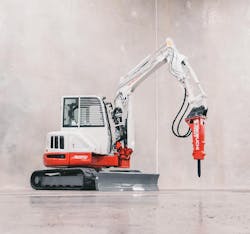
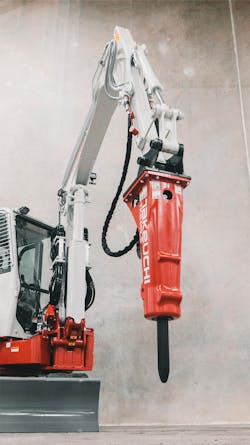
Takeuchi’s line of sound-suppressed hydraulic hammers is designed to deliver high-impact power while minimizing noise, which is especially important when conducting demolition work in noise-sensitive environments. With seven models available, these hammers can tackle a wide range of applications. Engineered for performance and longevity, Takeuchi hammers feature a sound-suppressed housing intended to reduce noise and enhance protection from dust and debris. The constant blow energy (CBE) system allows for adaptable oil flow settings while safeguarding against high back pressure. Additionally, an integrated hydraulic accumulator eliminates nitrogen leaks and recharging needs, ensuring consistent impact force and lower maintenance costs. Durability and ease of service are central to the design of Takeuchi’s compact and medium hammers. With a streamlined internal structure, no tie rods, and a robust 3-in-1 lower tool bushing, these hammers are built to simplify maintenance and maximize longevity. For more info, visit Takeuchi’s website.
John Deere HH145 hydraulic hammer
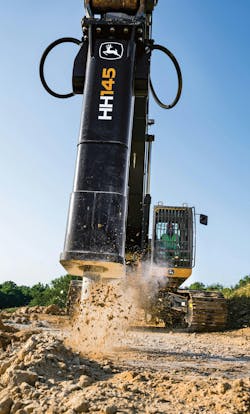
The John Deere HH145 hydraulic hammer attachment is built for larger excavators and engineered to perform efficiently on demanding demolition jobs or when breaking up materials for landscaping, trenching, recycling, and other applications. Designed to maintain optimal impact even with hydraulic-flow changes, the HH145 delivers consistent performance in tough conditions. Its heavy-duty housing and protected components are made to withstand challenging environments, helping reduce maintenance requirements and overall operating costs. The HH145 is well suited for breaking up concrete, hard ground, and small boulders, making it a strong choice for quarry work, demolition, and site preparation. A built-in restrictor valve helps protect against damage and premature failure caused by system overload, while idle-blow protection prevents unnecessary strokes to extend hammer life. A standard auto-lube system increases wear-part service life and reduces downtime and grease waste. For more info, visit John Deere’s website.
Mecalac MB30, MB40, MB50, and MB80 hydraulic breakers
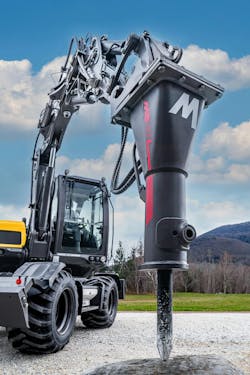
Mecalac, world leader in the design, manufacture, and distribution of compact machines for urban worksites, has a range of hydraulic breakers: the MB30, MB40, MB50, and MB80. Offering four breakers of different calibers, Mecalac is able to respond effectively to a multitude of needs. In fact, by adjusting the combination of hammer model and machine size, it is possible to respond effectively to all levels of use, whether occasional or intensive. The MB30, MB40, and MB50, designed for excavators from 5 to 12 tons, are compact and lightweight, with a no-load protection system for added durability. They also offer additional operating comfort thanks to their suspensions, which help to reduce noise pollution. The MB80, designed for excavators from 9 to 16 tons, combines performance, robustness, and ease of maintenance, with a protection system against dry striking and a soundproofed cradle equipped with suspensions. Its standard automatic greasing system simplifies daily maintenance. For more info, visit Mecalac’s website.
Bobcat hydraulic and nitrogen breakers
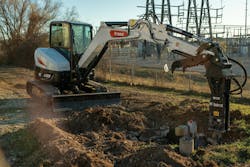
Bobcat’s hydraulic breaker attachments turn your machine into a powerfully precise demolition workhorse, breaking through concrete, rock, and asphalt effortlessly. The hydraulic breaker’s auto power regulates pressure automatically, ensuring its operation regardless of changes to outdoor temperature. Additionally, the upper and lower shock absorbers isolate the breaker, reducing noise and vibration to deliver operator comfort without sacrificing performance. Bobcat’s nitrogen breakers are a perfect attachment for breaking reinforced concrete slabs or other tough demolition work. The long piston stroke, combined with a unique valve design, maximizes impact energy and minimizes recoil while reducing strain to the carrier’s hydraulic components. The working tool is heat treated to specific hardness targets for low wear in high-impact applications. For more info, visit Bobcat’s website.
Montabert V-series breakers
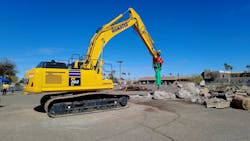
The Montabert V-series features the most advanced breaker technology available in its lineup, engineered for 18- to 120-ton carriers. The V-series features automatic energy-per-blow adjustment and autonomous working pressure control. It continuously adapts impact force to material resistance, helping maintain consistent production as ground conditions change. A sealed hydraulic accumulator eliminates routine nitrogen checks and recharging on the jobsite, simplifying maintenance and supporting steady performance. An integrated energy recovery system reuses recoil energy to enhance hydraulic efficiency. Carrier protection is built in, with anti-vibration dampeners and pressure spike management designed to help protect the excavator’s hydraulic system. Blank firing protection, automatic lubrication and a tool protection system are designed to support operator confidence and extended tool life. The V-series — V32, V47, V57, V67 and V7000 — is part of an extensive lineup of advanced breakers from Montabert. For more info, visit Montabert's website.
About the Author
Keith Gribbins
Keith Gribbins is the head of content at Construction Equipment, where he leads editorial strategy across print, digital, video, and social channels. An award-winning journalist with more than 20 years of experience, Keith has won 17 national and regional editorial awards and is known for his hands-on reporting style, regularly visiting manufacturers, operating equipment, and covering major industry events worldwide.